Showing posts with label Bobbi. Show all posts

Friday, May 22, 2015

Coaching Teachers in Supporting Student Centered Writing

Bobbi Campbell contributed today's post. More of Bobbi's thinking can be found here.

The following resource was created after a discussion with a grade seven team of Language Arts and Social Studies teachers.  The problem they were trying to solve was two-fold:
1. How do I get my students to engage in the revision process?
2. How do we conference with every student in a timely way? 

Because of these issues, I created the following document specific to argument writing. As we engage in student-centered coaching cycles with teachers, we need to remember that the focus must be on student evidence of learning. Student learning includes building choice within parameters (promotes self-efficacy), shifting the cognitive load from teacher to student, and promoting the growth mindset by allowing students to reflect on the process of revision and the direct correlation to writing improvement. 

CLICK HERE to access the complete document 
(which includes differences between revision and editing, an argument criteria checklist, and directions for use).

The beauty about student-centered coaching is that whatever resource you create, the measure of its effectiveness includes feedback from the students themselves as well as teacher reflection on the adult implementation. Implementing this resource to support the revision and editing process is  recursive in nature and may require numerous iterations until success is achieved. The important piece is that we use evidence of student learning to shift our practice, or to problem solve next steps.

Monday, April 27, 2015

What Do You Do When You're Overwhelmed?

Bobbi Campbell contributed today's post. More of Bobbi's thinking can be found here.

What do you do when you are overwhelmed?  I have an interesting coping mechanism for this...avoid, avoid, avoid, until it is impossible to ignore the mountain of work seeping through every crack and orifice, extending out at least 3 feet.  Sometimes the workload is self-imposed; sometimes it is because of the choices I have made (working full-time with a 75 minute commute, mother of three...yada, yada, yada, yada) and mostly, it is due to the demands of being an educator - I know anyone reading this blog...are you out there bloggess?, knows exactly what I am talking about. Plain and simply, the demands can make one question education as a career choice.  But this blog is not about questioning your choice, because we all know we are in education for a myriad of reasons, mostly centering on making a difference in a child’s education.  This blog is about taking care of yourself, so that you CAN take care of the education of children.

Lately, our district focus has been on the following agenda items:
  • Gradual Release of Responsibility
  • Equity Traps
  • Growth Mindset
  • Culturally and Linguistically Responsive Practices
  • Focus Standards: W1, W5,W10, SL6, R1, L6, R10

While the areas of focus are extremely important, none of it matters if you are stressed, overwhelmed and unsupported.  I can hear your questions now…”This is our job, we have to learn, do, pay attention to all of these agenda items!” - yes, you do, but first we need to practice self-care so that we can be more efficient, more focused, more open to learn new things and try them, and gosh darn it, happier.  

The following list of self-care or sanity savers are not prescriptive, or necessarily healthy for you, but they work for me.

  • Force yourself to exercise. I personally get up at 4:30 to get the darn thing out of the way.
    • Choose yoga if you know you will be in meetings all day.
    • Kickboxing if you know you will be working with difficult people.
    • Tae Kwon Do if you know you will be working with someone higher up on the food chain
    • Weights if you have to present in front of a large audience (you may sweat and have to take off your jacket, showing your arms, hence the weights).
  • Phone a friend who will make you laugh.
  • Keep positive notes, letters, emails handy and retrieve them when you need some cheer.
  • Go to your favorite takeout place and get dinner for the entire family.
  • Open up an expensive (my expensive bottle is probably not your expensive) $12.00 bottle of wine and have, not just one glass, but two!!!!!!!!!!!!
  • Stop at T.J. Maxx on the way home and purchase a small pick-me-up item.  Nothing major, just a little treat!
  • Journal. Put it away. Take out journal and read it. Write back to yourself.
  • Step outside and look up to the sky.  Take a deep breath and stretch  your arms, reaching towards the sky.
  • Hug your loved ones.
  • Get at least 7 hours of sleep, no matter what tasks will be left undone.
  • Paint your toes.
  • Read a trashy novel, followed by something of quality.
  • Repeat to yourself: you did your best, forget the rest.

So, if you want to be a happier, more productive employee, take care of yourself by practicing self-care.  Your colleagues and the kids will appreciate it!

Friday, March 13, 2015

Lesson Study: Guided Practice

Bobbi Campbell contributed today's post. More of Bobbi's thinking can be found here.

Recently, our literacy team  developed a sample lesson plan including the dialogue and actions of the teacher as well as the dialogue and actions of the students.  Making the thinking visible within the lesson plan allows for an opportunity for educators to be involved in a lesson study. During a lesson study, school-based teams can identify the areas where guided practice is visible, as well as identify other areas where guided practice can be inserted. The videos found within the Tools and Resources: Guided Practice can be used to prompt further discussion and collaboration.


For this lesson, we highlighted guided practice during a lesson on the following content standard:
  • Use words, phrases, and clauses [ to link the major sections of the text], create cohesion, and clarify the relationships between claim(s) and reasons, between reasons and evidence, and between claim(s) and counterclaims. (CCSS ELA W.9-10.1.c)

Note:  While I typically work with middle schools, I have added one high school this year as evidenced by the grade 9 standard.  Please note the new learning in the standard which is indicated by the use of brackets [ ].


The strategies used are explicitly labeled and examples are provided within the lesson plan where you will see a lesson on using co-constructed anchor charts to improve student writing. Don’t be daunted by the length of the lesson, as it is 16 pages due to the fact that all Teacher Talk, Teacher Moves, Student Talk, and Student Moves are all included within the lesson.


Links to the Tools and Resources:
Tools and Resources: Guided Practice: This document includes research articles and videos.

Example Grade 9 ELA Lesson Plan : This lesson can be used for a lesson study.

Friday, February 13, 2015

What’s it like to be in a session with Diane Sweeney?


Bobbi Campbell contributed today's posts. Bobbi's recent posts focus on her learning around student centered coaching (facilitated by Diane Sweeney).

This blog entry is an example of a full-day professional development opportunity with Diane Sweeney, including coaching reflections and notes in response to the content.

https://lh5.googleusercontent.com/uhBIE42NuAVaF1msa6JVwJxBB07ZJPm_IXfR5M_XykZNJQoUYlBQ3XQZKhdSmRFQcmpIhGT4hUCDRRIBFBOxGiWOFFcjfIWMbsF1nyCsPLTANeXFBe5cVOQqGoyJ9Ej1ZAThe essential questions for the session were:
  • EQ1: How can a coach guide goal setting towards culturally and linguistically responsive instructional practices?
  • EQ2: What are some coaching skills that bring about culturally and linguistically responsive instructional practices?
  • EQ3: How might learning labs create opportunities for teacher collaboration in MMSD?
Read about the content of the session and Bobbi's notes (shared in PDF using GoogleDrive).

Wednesday, January 28, 2015

Student Centered Coaching: How Do We Change Teacher Practice Through the Art of Questioning ?


Bobbi Campbell contributed today's post. Read more of Bobbi's posts about student centered coaching here.


January is always the time of year when I feel most reflective and commit to changing something that I can control.  This year I am committing to changing my questioning techniques. I want to try to use David Perkins research on offering meaningful feedback to teachers and coaches in order to increase student learning.


We all know that truly changing instructional practice comes from the choice within the person needing to change.  That is what is so glorious about student-centered coaching - the focus is on the student, not the teacher.  It is through the art of questioning from the coach that can
move teachers to finding the answers within themselves. The overall purpose of the coaching is always on the student learning.


Perkins (2003), states that offering meaningful feedback can be categorized by the following:
  1. Clarifying questions or statements
  2. Value statements or questions
  3. Questions or possibility statements


To help facilitate coaching conversations, here are a few talk stems from,“Coaching Conversations: Transforming YOur School One Conversation at a Time”  by Cheliotes and Reilly.


Clarifying Questions:
  • “How do you see this different from…?”
  • “How did your students respond to this process?”
  • “What gaps did you notice within your student work samples?”


Value Statements/Questions:
  • “You have really thought about this deeply.”
  • “I see evidence of…”
  • “It provides high engagement for students by…”


Reflective questions or possibilities:
  • “What are you considering in regard to…”
  • “What connections have you made to…”
  • “I wonder what would happen if…”

I highly recommend reading the entire book! In closing, remember when giving feedback, ask yourself the following questions:  is the feedback productive? Is it specific enough to result in a change in practice? Is it respectful?

Friday, January 9, 2015

The Amazing Adventures of Student-Centered Coaching!

Bobbi Campbell contributed today's post.

The Amazing Adventures of Student-Centered Coaching - Featuring, Diane Sweeney!
Interactive Blog Series by Bobbi Campbell


Diane gives new meaning to the word practical.  Unassuming, she arrives and begins a discussion, using her realistic research to engage Madison Instructional Coaches.

Diane Sweeney, Student-Centered Coaching Guru, is an educator, mother, friend, and Professional Developer.  Although, I have not personally established a close friendship with Diane, as an audience member, you feel as if you are in her kitchen with a strong cup of coffee discussing and solving the problems we encounter as educators.


Our district jourrney began with Diane  in the Spring of 2014, as we forged a partnership with the Universityof Wisconsin, Madison. Through research and support by the UW, we finally decided that student-centered coaching was indeed the model for us.  In September, Diane began our first coaching session with a comparison of three coaching models: Student-Centered, Teacher-Centered, and Relationship-Driven Coaching.


What do you think the differences are among the three models listed? (Use the link, page 7)


As we investigated where we as coaches felt most comfortable, we discovered that most of us had been operating as relationship-driven coaches.  What is wrong with forming relationships with the teachers you coach?  That is what I was thinking the first time I looked at the chart located on page 7 of her book, Student-Centered Coaching at the Secondary-Level.
So, what could possibly be wrong with this type of model?


Of course there is nothing wrong with forming relationships, but if we stay there and never move forward, therein lies the problem. The bottom line is, if we want more impact on student achievement, we need to focus on student learning targets. Next, we need to analyze student work to analyze progress, design instruction based on formative data and select appropriate text and technology as a tool for moving kids on the continuum of the learning progression.  Whew!  We can do all of this alone, but what if we had a thinking partner?  That is what student-centered coaching is all about - partnering with a focus on student data.  Next interactive blog will focus on Coaching Teachers to Assess and Deliver.


Friday, November 21, 2014

Bio: Bobbi Campbell

Bobbi Campbell is a Literacy Activist for the Madison Metropolitan School District. Bobbi has a passion for working collaboratively to promote and support equitable access  to high quality instruction for all of our children.

Wednesday, April 16, 2014

Smarter Balanced: Resources for Professional Learning

Today's post is brought to you by Bobbi Campbell.

The following resources were developed by Madison Metropolitan School District in response to the 2015 implementation of the Smarter Balanced Assessment in grades 3 - 8.

Resource 1: 30-minute Overview (with speaker notes)
Can be accessed in GoogleDrive.


Resource 2: Facilitator Guide for Overview
Can be accessed in GoogleDrive.
The first facilitator guide is intended to be paired with the Power Point.  It provides information about the components of the test and includes examples.  


Resource 3: FAQ (for practitioners)
Can be accessed in GoogleDrive.
This is designed to be a quick snapshot of the Facts and Questions associated with Smarter Balanced Assessment. This version of the FAQ is designed for practitioners and referenced in the Overview presentation. 


Resource 4: FAQ (for administrators and instructional leaders)
Can be accessed in GoogleDrive.
This is designed to be a quick snapshot of the Facts and Questions associated with Smarter Balanced Assessment. This version of the FAQ is designed for administrators and/or instructional leaders and referenced in the Overview presentation. 


Wednesday, March 5, 2014

Using Metacognitive Think-Alouds for Explicit Instruction

Today's post is brought to you by Bobbi Campbell.

Making Sense of the Common Core State Standards:

After several coaching experiences at one building, the literacy leadership team decided that an area of focus should be modeling what a think aloud could look like, focusing on explicit modeling of metacognitive skills. We created a video and a script for use at a school to stimulate conversation about using explicit modeling to demonstrate metacognitive skills.


The following script supports the recorded focus lesson. It can be viewed using GoogleDrive.


Friday, December 20, 2013

Blondes Have More Fun

Today's post is brought to you by Bobbi Campbell.

Ann Kerkenbush, Brenda Berg, Georgie Rattan, the four blondes (plus me makes four) as we were referred to many times, but mostly by one another, are truly people you want to know if you want to know something about education, or if you just need a little fun in your life. These fine ladies spanned multiple generations and shared many character traits; they mothered, disciplined, educated,  and maneuvered seamlessly solving  one disaster after another.  All this and more in this ever changing educational landscape, and they did it  with flair and style. I have never yearned to be a writer, but I have never felt such desire to gain access to the right words and phrases to describe these ladies, my mentors.

I would be remiss if I did not share just a few moments into the lives of these strong women.  Ann Kerkenbush was a teacher of English Literature, dedicated to the profession, even more dedicated to the students she served. She still visits a former student who, unfortunately is currently residing atTaycheda Correctional Institution.

Brenda Berg was a music teacher, a profoundly good singer with a flair for life and style anyone would envy. She could get the most resistant student believing they could sing, and by gosh when she was done with them, they could.

Georgie Rattan was one of the first women in the African Peace Core. A teacher that taught me how to teach kids first, not content. A teacher who knew that writers are within everyone- and she always knew how to find ways to motivate and enrich   - I love her and so did all of her students.

I am not a lucky person, but I believe I was fortunate when when I had the opportunity to be mentored by these three fabulous ladies.  I am the teacher and coach today because these fine mentors took the time and patience refining my skills and ensuring that I , too might know a portion of what they had procured over the years. A mere thank you is not enough, but know that no matter how much knowledge and talent you possess, no matter how many students you have had an impact on or how much educational prowess you possess, mentoring a young person to repeat the cycle is a true measure of success and one that extends far beyond the four walls of a mere classroom.

So, I challenge the gurus of education - the Fishers, the Wiggins, the Wolfes, whom have you mentored lately?  Whom will you choose to coach?

And by the way, I do believe that blondes do have more fun...just ask Brenda, Ann, or Georgie.

Friday, November 29, 2013

The CCSS: Making Sense of Argumentation!

Today's post is brought to you by Bobbi Campbell.

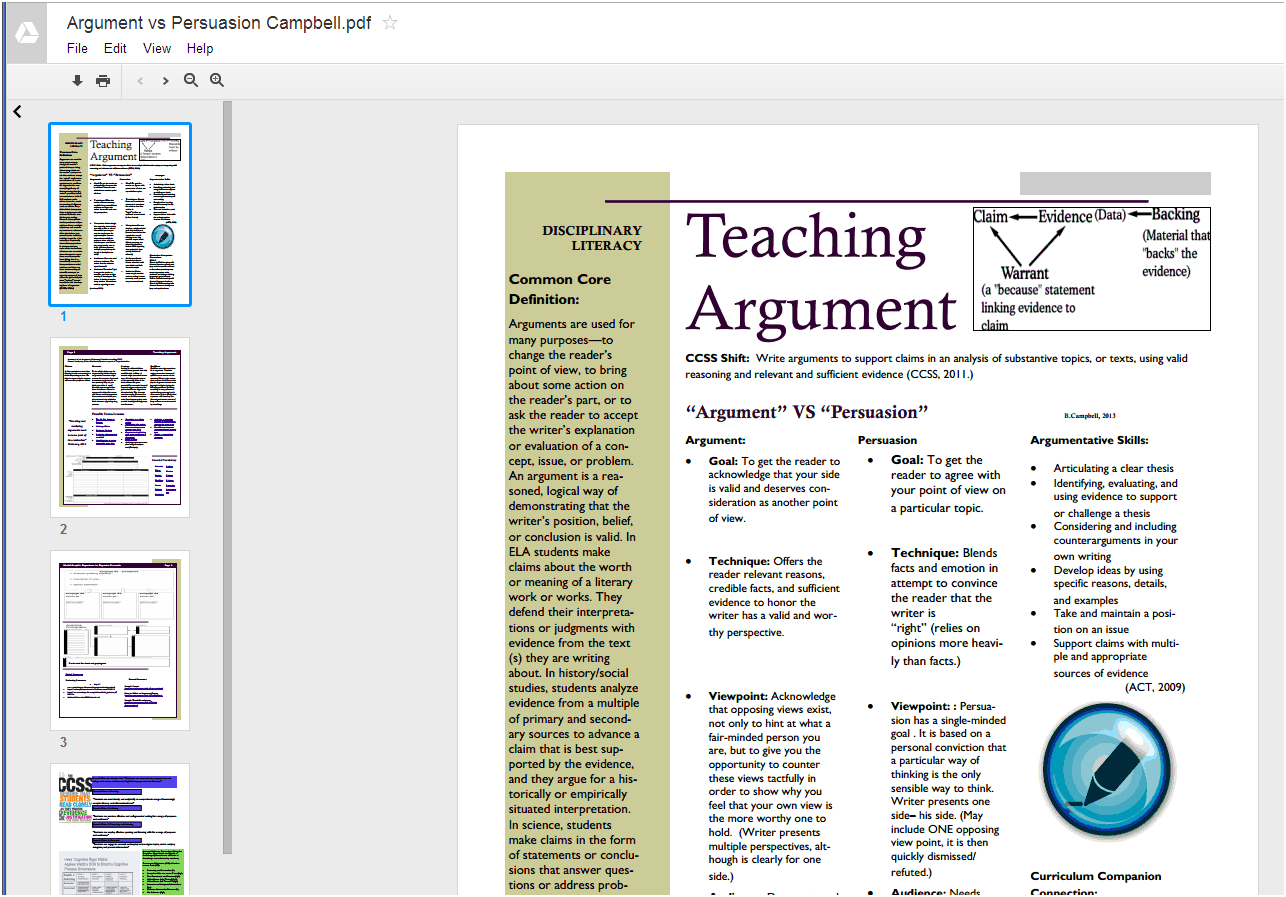
Planning for instruction takes time, so I wanted to develop a tool that would support coaches and teachers in planning for instruction – specifically, planning for a shift in teaching and learning from persuasion to argumentation.  

Before I could jump into resources regarding this shift, I wanted to provide the research supporting this shift; hence, the reason for the development of this handy dandy resource in the form of a newsletter/hot-linked document.  This document’s purpose is to provide the research supporting the shift from persuasion to argumentation, as well as to light a fire under students’ butts to get them excited about digging into text, while tracing arguments, analyzing the rhetoric and style of some authors, and eventually towards writing their own fantastic and dynamic arguments.  

Who knows, we may create a mutation of argumentationators (disclaimer:  argumentationators is not really a word, silly.) There are links to possible focus lessons, vocabulary, and graphic organizers.  Knock yourself out and choose the resources that best match your style, kids, and/or teachers. 

(Note: Image below is a screenshot. Click on hyperlinked text above to view the PDF in GoogleDrive.)

My only request is if you use this resource, please post comments and feedback  so I can revise.

Tuesday, October 29, 2013

The Many Roles of the Literacy Coach

Today's post is brought to you by Bobbi Campbell.

Role, Roll, Role


For this particular post, I informally interviewed several fantastic, multi-talented coaches. The work they do on a daily basis never ceases to amaze me. Here is why…


(Note:  I have changed the names to protect the coaches mentioned in this blog.)
Image taken from this source.
The Cheerleader:  Peppy Patty spends part of her day giving a shout out to a teacher over the loud speaker, as moral is way down and Patty needs to boost it.  She also spends some of her time sending out positive emails about shifts in the CCSS, best practice and the use of researched strategies, curriculum writing, new books in the library, and professional journals for check out.
Image taken from this source.
Disciplinarian: Prudent Patty keeps a tight ship, especially when she is covering for her colleague who does the regular discipline. I see Peppy Patty peeking out every so often, but then I see the pursed lip, straight spine, hands deflecting bad behaviors and I know that Prudent Patty has returned? 
Image taken from this source.
The Defensive Line Coach: Packs-a-Punch Patty delivers her coaching with fervor and precision.  She is determined to articulate a plan, deliver it, and have a post conference recap and sets a new plan in motion without taking one breath. 
Image taken from this source.
The Wonder Woman: Permeating Patty is like diffusion across a semi-permeable membrane – seeping in every crevice, focus, and agenda, that involves instruction. She does it all: facilitates team meetings, discipline specific meetings, whole staff meetings, and district meetings.  She has just enough time to show off her excellent skills with a whistle and ball bin when she monitors students during combat, I mean, lunch duty.
Image taken from this source.
The Data Analyst: Proficient Patty constructs data sets for teams to analyze for use in informing instruction. She helps teachers to make decisions based on evidence and tracks progress towards those goals derived from the data.
Image taken from this source.
Magician: Plentiful Patty finds a way to carve out time even when we all know there are only 24 hours in a day. No task is insurmountable for Patty; no task unbeatable; no task puts Patty up against a brick wall – she, like master of allusions, can make magic happen right before your eyes.
Image taken from this source.
Hats off to coaches across the state – they are many things, but most of all, they are appreciated for their brave endeavors, their daunting tasks, and their burning passion for all things literacy.

Wednesday, October 16, 2013

Building Relationships with Principals

Today's post is brought to you by Bobbi Campbell.


As I began to think of ideas for this blog post, I struggled to choose an approach that would speak to readers.  My first idea was to write about the twelve principals I work with, comparing each one to a well-known cartoon character. The idea was to highlight their strengths as an instructional leader, while comparing them to the trait of the carefully chosen character.  I knew I was doomed from the start when my first cartoon character I chose was Homer Simpson.  No matter how much I love Homer, I am not sure it would send the right message. Therefore, I began thinking about other ways to write about the complexities of building relationships with principals – especially when there are twelve of them.
First, I started my walk down memory lane thinking about all the principals I have worked with as teacher and now coach. Why did I have a better relationship with _________ than I did with ___________.  I began to wonder about the commonalities among the principals of whom I forged strong relationships.  What was it about them that so many people, including me, felt it easy to build and keep productive and beneficial relationships with the leader of the building?
I cannot move forward without mentioning my very first principal, Vincent Maloney. We still exchange holiday cards, even though we have not worked together in over 18 years. He no longer serves in this grand profession but will always hold a special place in my heart and has definitely made a lasting impression on my approach to building relationships with principals.  Unfortunately, he spoiled me for all the rest…
The qualities he possessed made it easy to build a strong professional and productive relationship.  He shared many characteristics outlined in an article by GreatSchools, 2013.
1. Great principals take responsibility for school success.
Vince Maloney knew how to do this, while making everyone in the building responsible, too.

2. Great principals lead teaching and learning.

This was not his strength so he relied on key staff that could help him lead.   
3. Great principals hire, develop, and retain excellent teachers.
I think this was his strongest asset as a building leader. He empowered his teachers and coaches in the building to lead and be instructional leaders whenever he could.
4. Great principals build a strong school community.
Vince knew that building a strong school community meant he had to have relationships with his teachers.  He was invested in knowing his staff personally as well as professionally.  He knew that by doing this, he would build safety and trust within his staff so that he could have the hard conversations.  It was always a problem/solution based conversation.
So how does sharing my story help guide other coaches in developing relationships with principals?
I believe knowing how your principal sees himself or herself, regarding the four characteristics mentioned, will help guide you to a reciprocal and productive relationship. Reciprocal in respect, but also trust – the foundation of leadership that fosters growth in staff and students.
Depending on your situation, you might come right out and ask your principal’s opinion about the four characteristics every good principal share; however, most of us will not feel comfortable handing our principal a piece of paper outlining the four characteristics. Personally, I like the direct route, but I have found that is like playing Russian Roulette– some respond favorably, and some need a little more time to adjust to a 5”2  energetic (some say overly enthusiastic) short lady with attitude.
Instead, the more reasonable of us will have to take the other route – be patient and collect data as you observe your principal in action.  Use the characteristics as a guideline for collecting data to be used as a catalyst to spark conversations.  Knowing how he or she sees himself or herself as leader, will help you understand how your principal sees you as instructional coach in your building.  Ultimately, this will guide your work together, creating a true learning community.  
My repertoire of skills has hit an occasional brick wall. I am having a bit of bad luck with two of the twelve principals I work with, so I challenge you, readers, to share your trick, approach, or magic of how you successfully won over YOUR Principal Ed Rooney (Principal in Ferris Buehler’s Day Off).