Showing posts with label Julie. Show all posts

Thursday, April 13, 2017

Study Groups with Jennifer Allen

Julie Schwartzbauer contributed this post. Click here for more of Julie's thinking.


I recently attended a professional development with Jennifer Allen. Jennifer is a literacy coach and professional developer. You may be familiar with her book Becoming a Literacy Leader or A Sense of Belonging. Jennifer uses a layered coaching framework. At the workshop I attended, Jennifer focused on coaching through Study Groups. If you are not familiar with the term Study Groups, think Book Study.


Though Jennifer typically has four different study groups running from October - April, you may want to start with just one or two. Jennifer meets with each group once per month, for an hour at a time. Her study group budget includes the book, office supplies and food. Jennifer purchases fun office supplies as study group giveaways and everyone appreciates food.


During the study group, Jennifer uses a detailed protocol/agenda that encourages participants to move through the hour quickly and accomplish everything they set out to. She reminds us not to exhaust every idea. “Leave teachers wondering,” says Allen.


I have included the protocol for Study Groups below or click here.


Monday, June 13, 2016

Coaching Really is an Art - Coaching from Compassion and Curiosity

Julie Schwartzbauer contributed this post. Click here to read more of Julie's thinking.


Last week I was fortunate enough to be able to attend The Art of Coaching Conference put on by Wisconsin ASCD.  The featured speaker was Elena Aguilar.  If you are not familiar with Elena, you should be!  Along with many articles, she has written the following two books:


I would like to share with you my big take-aways from the two days I spent fine-tuning my personal art of coaching.  I will be sharing big ideas and my own personal self-reflections.  I will also share some direct quotes from Elena Aguilar.


As coaches, we facilitate a lot of large group professional development.  Elena shared the following facilitation strategies:
  • Set up invitations for participants, rather than norms
  • Ask participants to reflect on their intentions for what they hope to get out of the day.
  • Cut conversations short by about 20 seconds - leave the participants wanting more
  • Raise your hand to call for attention - invite others to raise their hand as well


Elena’s Definition of Coaching:
  • Coaching is a form of professional development with someone who willingly (ideally) engages in reflective learning.
  • Coaching happens in conversation.  It’s the vehicle.  
  • Coaching results in reflective practitioners who make decisions that further the learning and achievement of all students every day.
  • Coaching is not something we do to people.


We observed a live coaching demonstration where we heard Elena ask and state the following:
  • “In that I hear… are you willing to explore that?”
  • “Why does it matter?”
  • “I hear some emotion there… Can you identify that?”
  • “Tell me who you were when you began teaching”
  • “Just tell me about one student who is struggling but may have some potential”
  • “Tell me about the strengths you see in your students”
  • “Do you think there’s anything you can do that impacts how students engage in your class?  Can you influence that at all?”  
  • “Let me check in….what I’m hearing is....
  • “It’s going to help your heart and your mind to just focus on one student and it is going to spill over to the other students.”
  • “I want you to imagine” - scenario
  • “You have so much knowledge and skill to build on.”
  • When a teacher comes in agitated and emotional, try these coaching moves...
    • slow it down, intentionally take notes slowly
    • shift the energy- think about how you can use humor to create a shift in energy when the teacher is obviously deflated
    • provide closure by bringing it back to the individual saying, “I want to try...I’m willing to do this”
  • As a coach, you might try these phrases…
    • “I hear a lot of emotion, exhaustion…”
    • “I’m wondering about our conversation, is there anything you feel we can talk about that would be helpful to you?  I don’t want to add to your stress.”
    • “If we meet and talk today, would it be helpful to talk about your emotions, the curriculum, the students?”
    • “What would my support for you look like?”


Some things I was left wondering about…
  • Do our coaches have the time to sustain a high level of coaching?
  • How do we increase effective coaching, while looking at the current level of staffing and resources, in order to make a difference as a district?
  • What data do we use to show evidence of success?
  • How do we maximize the coaches potential to impact adult learners?


Monday, April 4, 2016

When the Role of Literacy Coach Becomes Muddled

Julie Schwartzbauer contributed this post. Click here to read more of Julie's thinking.


Lately I have been thinking a lot about the role of a literacy coach.  According to the International Literacy Association’s 2015 research brief, “The Multiple Roles of School-Based Specialized Literacy Professionals,” the role of the literacy coach is defined as one who works with teachers and facilitates efforts to improve school literacy programs. They may work with individual or groups of teachers to support them in their efforts to improve classroom instruction. At the same time, they may hold responsibilities that influence literacy programs school-wide (e.g., developing curriculum, selecting instructional materials).


In the Appleton Area School District, the majority of our building coaches share the role of literacy coach with the role of literacy interventionist.  The International Literacy Association defines the primary role of the reading/literacy specialist as an instructional one, predominantly working with students who are experiencing difficulties with reading and writing.


We are finding, that more often, when the need for intervention increases, the literacy coach is often asked to work with individual students or groups of students on a regular basis. This role can be be of value to a school if class sizes are large and there is a shortage of expertise in working with struggling readers and writers.  This, however, takes a coach away from coaching.  It is important that principals and school staff understand that.  


If there is a high need for intervention in a building, an alternative might be for the coach to work in the classrooms with individual students or small groups.  This type of work can combine instructional services with coaching.


As a literacy coach, make sure that you have clear coaching goals that are shared with your principal and staff. That way, if you are being asked to provide pull-out services to individual students or small groups,  you can reflect on how that work would not contribute to your coaching goals.


The chart below comes from International Literacy Association’s 2015 research brief.  It depicts the varying levels of intensity as a means of illustrating coaching responsibilities.
Click here and navigate to page 11 to view this chart larger.


Wednesday, February 17, 2016

Maintaining Best Practices Through Back to Basics

Julie Schwartzbauer contributed this post. Click here for more of Julie's thinking.


As our district continues to focus on implementing best practices through a Back to Basics model, we are faced with the question of how we maintain the work that has been done.  I can say with confidence that all of our 16 elementary schools have participated in a roll-out pertaining to the various back to basics components (Read-Aloud, Shared Reading, Independent Reading, Minilessons, and Conferring).  What I am unsure of is whether or not the best practices surrounding these components are being implemented.  It makes me uneasy to think that all of the hard work our building coaches have done is not being implemented and maintained across grade levels and buildings.

I recently shared my uneasiness with our coaches.  Together we brainstormed ways to  ensure that Back to Basics are not only being implemented, but maintained throughout the year and in the future.  Some questions that arose were surrounding new teachers and how to meet their needs and support them throughout the year.  Below is an organizer we created.  Even with this chart, we all know that our crazy schedules can easily get in the way of good intentions.  How can we make the items below a priority?  I hope to revisit this topic with our coaches at the end of the year.


How will we implement Back to Basics with new teaching staff and how will we support them throughout the school year?
  • Set aside time to meet with new teachers throughout the year.
  • Review shared beliefs surrounding Back to Basics components.
  • Visit classrooms to observe student learning and engagement.
  • Create a new teacher support checklist that includes Back to Basics components.
  • Survey new teachers to determine areas of needs.
  • Use the coaching continuum.
  • Implement new teacher collaboration time during lunch and include a  monthly email regarding the topics being addressed.
  • Incorporate learning opportunities during PLCs.
  • Implement weekly check-ins.
How will we maintain the implementation of Back to Basics components in the future?
  • Survey ALL staff regarding the implementation of Back to Basics.
  • Implement classroom walkthroughs with principals, based on each building’s vision for classroom visits.
  • Provide a survey to determine needs.
  • Use the coaching continuum.
  • Use PLCs to revisit and dig deeper into the components.
  • Create checklists for self accountability.

Monday, January 11, 2016

What’s this I’m hearing about Language Workshop?

Julie Schwartzbauer contributed this post. Click here for more of Julie's thinking.

In the Appleton Area School District, we have begun to build knowledge and understanding surrounding the big picture of language workshop.

This is what we have come up with so far...

Language workshop is a protected time of the day to build listening and speaking comprehension through reading aloud and thoughtful, collaborative discussions of complex texts. Teachers provide explicit instruction in grammar, punctuation, and conventions of language through literature and informational texts using the workshop approach.  In the process, students acquire knowledge of content, vocabulary, text structures, and language functions, including grammar and mechanics. This in turn supports the work we do in other workshops.
So you might be wondering how the standards fit into language workshop....


We feel that the language standards can be taught within language workshop, and woven throughout reading workshop, writing workshop, and other content areas.  They are taught through the following components: 
  • Read Aloud / Shared Reading
  • Wordless Picture books
  • Poetry
  • Mentor Authors
  • Interactive Writing/ Shared Writing
  • Phonics Lessons
  • Words Their Way

With the anchor standard being the same for grades K-12, it is important for teachers to understand that the guiding principle is that core language skills should not change as students advance; rather, the level at which students learn and can perform these skills should increase in complexity as they move from one grade to the next.

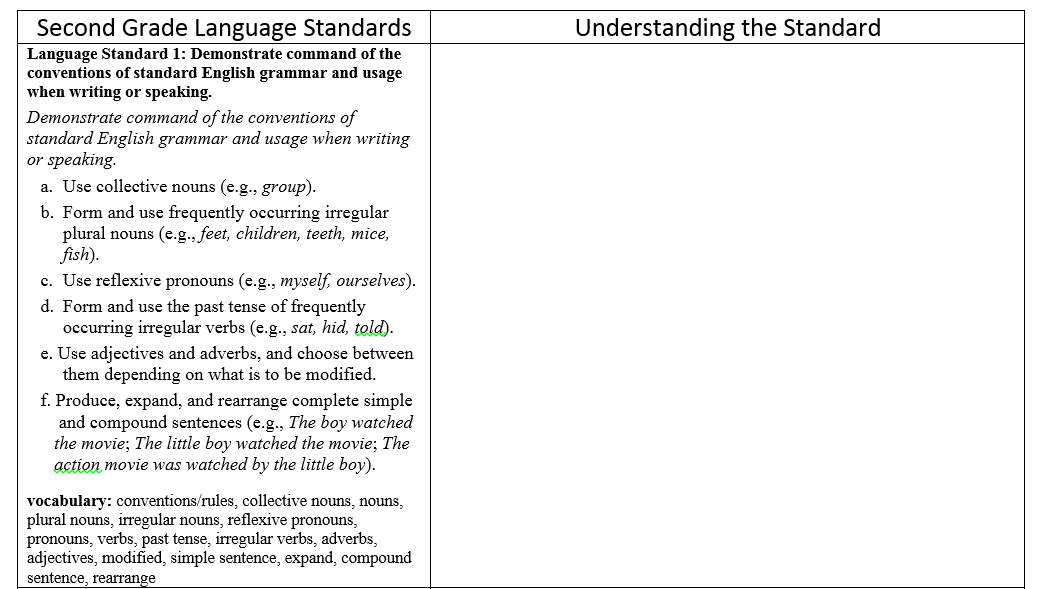
We know that students in early grades can not jump over developmental milestones in order to master the anchor standard.  Therefore teachers must build their expertise in understanding the standards by completing a Standards Trace.  Please see a piece of a resource document my colleague and I created for K-6 teachers at one school, to assist them in completing a trace.


Teachers began with Language Standard 1.  They used various resources to help build their understanding of the standard, while meeting in their grade level PLCs.  Teachers filled in the column on the right with definitions and examples to to clarify their understandings.

A few weeks later all K-6 teachers came together at a late start and completed a trace by sharing out their understandings of standard one across grade levels.  Teachers also discussed how they would determine which of the above vocabulary terms would be critical for students to know and understand.

Here are some questions teachers had while completing the trace...
  1. What is a modal auxiliary?
  2. Can we have a list of common Latin and Greek words? (6th grade)
  3. What are frequently occurring adjectives?
  4. How do you teach plural nouns? (besides just add the s…especially for ELL students
  5. Should we use common language? i.e. conjunction
  6. What does demonstrate command of in writing or speaking mean?
  7. What is the correct terminology? Linking or helping verbs?
  8. What does spell grade level words mean? Is there a list? Is it the old No Excuse words?
  9. What is proven to be best approach to teaching Greek/Latin words, can these strategies be shared across the district?
  10. Irregular verb spelled with a t? verbs whose past tense and past participle are not formed by adding-ed, -d, or –t to present tense.


I am hoping that teachers will continue to build their understanding of the language standards and what they look like across grade levels.

Friday, December 18, 2015

Back to Basics Update...


Upon request from some coaching colleagues, I have decided to update you all regarding our Back to Basics Initiative in Appleton.  For those of you who may be reading this blog for the first time, please go back to learn more about the great things we are doing in Appleton.


This year started out with three Back to Basics goals in mind.  Those goals were to develop shared beliefs surrounding minilessons, conferring, and language workshop.  You might recall, we ended the year with developing shared beliefs about minilessons with our coaches and principals.  The intent was to roll out those shared beliefs to teachers during October and November of this year.  We wanted the month of September to focus on last years Back to Basics (B2B) components and getting new teachers up to speed.

That being said, as you all know, part of being a teacher and coach is about being responsive to the needs of those you work with.  Our coaches were becoming concerned with the expectations surrounding the three B2B components.  They were worried that it was too much roll-out information for one year.  We decided to move forward with minilessons and then spend the remainder of the year around conferring.  We would save language workshop for next year.

After taking language workshop off of our plate, there still remained teachers very interested in learning more about it.  In an attempt to satisfy that desire, we decided to create a mini professional development piece on language workshop.  Schools have been requesting this PD during late starts, lunches, and PLCs.  This PD is allowing us to build background and provide a framework for teachers regarding language workshop.

We have gone one step further, by planning for our 2016 Summer Literacy Institute to focus on language workshop.  Some of the sessions will include topics on grammar and mechanics, vocabulary, author's craft, and word study.  We are hoping that all of this professional development will prepare teachers to spend next year getting their feet wet in language workshop.

Friday, November 27, 2015

Principals as Literacy Leaders

Julie Schwartzbauer contributed today's post.


"Through a lifetime of working in schools, one of my most powerful insights and core beliefs is that teachers must be leaders, and principals must know literacy.  Without a synergy between literacy and leadership and a committed, joint effort by teachers and principals, fragile achievement gains do not hold."
Regie Routman


I am very excited to share some great work we are doing in Appleton.  

If you are a literacy coach, you know who Regie Routman is.  And if you understand the importance of principal as instructional leader you have read her latest book Read, Write, Lead.  


Recently, I was fortunate enough to attend a dessert and conversation with Regie where participants engaged in an informal conversation regarding school change strategies, challenges, and successes.  One of the big Ah-ha's that came out of that evening was related to sustainable change and how the principal and literacy coach must work collaboratively to fully support teachers.  


In working as a district literacy coach in Appleton, I have learned that while  all principals come into their position with a vast array of knowledge, their background does not always include a foundation in literacy.  According to Regie, “without deep knowledge about literacy, principals remain restricted in their quest to raise reading and writing achievement across a whole school.”


Recently, three of our principals expressed interest in participating in ongoing professional collaboration with their building literacy coach.  Their goal is to increase expertise in literacy and create a solid infrastructure in their school.


Appleton Area School District is large and it takes time to build sustainable change.  It is our hope that by using Regie’s book as a starting point, with just a few schools, we will be able to move the connection between literacy and leadership to the forefront.  We will meet monthly with the three principals and their coaches, to lay the foundation which will lead to more effective literacy instruction, and ultimately accelerate and sustain student achievement.

Wednesday, October 7, 2015

So Much to Learn and Never Enough Time. . .

Julie Schwartzbauer contributed today's post.

As I sit at my desk reflecting on this first month of school and how quickly it has gone by, I am surrounded by some of the people I admire most.  At my desk is Diane Lapp, Barbara Moss, and Matt Glover.  At the table behind me sits Brenda Overturf, Jennifer Serravallo, Patrick Allen and Steven Layne.  Taking up floor space is Kelly Gallagher, Kathy Collins and Regie Routman.

I want to engage with these Literacy icons more than anything, but seem to keep pushing them aside.  I thought I would have had more time for them over the summer, but the idea of inviting them out on my patio or to sit around the campfire with me, did not feel right at the time.  

I have decided that I need set aside time for these influential people, the people who guide me in building my expertise as a professional.  I feel that it is my duty to engage with those who continue to inspire me and ignite a passion in me for wanting learn more.

In looking at my job description, there is nothing in writing about spending uninterrupted time with experts in my field.  When thinking about all of the meetings I attend, surely meeting with the inspiring words of Steven Layne or Kathy Collins could be part of my role.

In conclusion, I am giving myself permission to spend more time with some of my favorite people and continue to grow in a profession that I love.

Thank you for being a part of my ongoing learning…


Wednesday, September 30, 2015

Bio: Julie Schwartzbauer

Julie Schwartzbauer is beginning her fifth year working for the Appleton Area School District as the K-2 District Literacy Coach.  She completed her undergraduate work at the University of Wisconsin Milwaukee.  She first received her Bachelor Degree in Psychology, knowing she always wanted to work with children.  Julie was later inspired by professor to pursue a career in teaching.   She received her Early Childhood license followed by her Master’s Degree in Reading from the University of Wisconsin Oshkosh.


After staying home to raise her family, Julie became employed by the Menasha Joint School District.  It was there that she received training in Reading Recovery and began working as a Literacy Coach.  Now in Appleton, Julie still remains a strong advocate for Reading Recovery.


In her current role, Julie services 16 elementary schools as the District Literacy Coach.  She works to support building coaches and teaching staff.  She could not do all of this important work without her supportive colleagues, and family.


Julie has recently earned her license in Administration and Supervision.

When Julie does not have her nose in a professional resource, she is spending time up North boating and relaxing with her three children and husband.

Wednesday, May 6, 2015

The Impact of Going Back to Basics

Julie Schwartzbauer contributed today's post. Read Julie's previous posts to understand more about her district's Back to Basics plan.

In my last post, I shared how we as district and building literacy coaches needed to make an extra effort to clarify to teachers what our Back to Basics objective was: to develop a coaching model that would help teachers develop consistency in universal instruction in literacy across the school district through a workshop framework.  I also shared information regarding the building roll out of the Back to Basics components.

As the end of the year quickly approaches, we were looking for ways to collect feedback regarding the district-wide Back to Basics work that was done.  We have developed a survey intended for all teachers to take.  

CLICK HERE to read the complete survey.

As the responses pour in, I am delighted to share some teacher quotes directly from the survey...
  • Bringing staff back to a common understanding and language when implementing these elements of the workshop model. Allowing time for discussion and collaboration about how these elements are implemented in the classroom is powerful in increasing student learning.
  • If I am better, they are better!  
  • I have improved all of my teaching practices in these areas. 
  • The coaching and information has been wonderful so far this this year! 
  • It helps remind me of the things I need to remember to include as well as the things I am doing that I forget about are really a part of each topic.
  • I'm grateful for the Back to Basics coaching. It provides some specifics to focus on and helps me understand I'm building my workshop skills as a teacher one basic skill at a time.
  • I was happy to know that my Grade Level team and I are all on the same page and offer all components to our students daily. Our students are given a variety of genres and forms of learning which creates a class that only grows in reading.
  • I appreciate the support we have in our building! The literacy staff is on the forefront and willing to do ANYTHING if we just ask!

As we look forward to the next school year, or goal is to continue to build teacher and administrator expertise in universal literacy instruction.

If we focus on excellent instruction for all students in regular education as a first resort, that instruction can serve to avoid additional intervention for most students.Regie Routman