Showing posts with label Book Review. Show all posts

Monday, February 15, 2016

Having Hard Conversations


Lisa's posts about coaching with kindness ("Coaching with kindness""Coaching with kindness when the truth might sting", and "Coaching with kindness when teachers feel stung")  and a few things in my personal life have really gotten me thinking about when and how I speak my truths. The universe sent me Jennifer Abrams's book to help me deepen that thinking. (Andrea wrote about Having Hard Conversations for us in an earlier post.)

Having Hard Conversations gives readers concrete steps and considerations for preparing for a conversation. Abrams begins preparing us for having hard conversations, but suggesting we identifying what might be stopping us. Reasons to avoid hard conversations include: 
  • A desire to please ("I want people to like me.")
  • Personal safety ("I am intimidated.")
  • Personal comfort ("I like it easy, emotionally.")
  • Fear of the unknown ("I'd rather live with the status quo than face the unknown.")
  • Waiting for the perfect moment ("I can't do it until I know more about him/her.")
While these reasons are very real, Abrams goes on to provide concrete ways to overcome the avoidance and actually have a conversation that will positively impact student learning. Her framework includes carefully planning the logistics of the conversation, identifying the goal, and planning for follow-up support.

While many of the examples in Having Hard Conversations are about supervision, the ideas in the book are applicable to literacy coaches and any one in education looking to speak their truths to a colleague.


Monday, December 14, 2015

Why Is Change So Difficult?

Meghan Retallick contributed today's post.


In response to the ever-present question on all our minds, “Why is change so difficult?”, I found new learning and understanding to share from reading chapter two of The Literacy Coach’s Survival Guide by Cathy A. Toll.


First, reading this chapter was transformative for more than just my ideas about change in schools, but it helped me be more grounded about change in life!  There is such deep reflection and insight here shared by Toll that I changed from reading this chapter.  


I believe that change is so hard because many of us feel isolated and alone in the change process.  We feel solely responsible for good outcomes and fear the unknown of what will happen if the outcomes aren’t good.  But, with her chapter, Toll offers us a different perspective on change.  I love how she categorizes the response toward change in schools: “In schools we conceptualize change as an event, a one-time thing...Then we feel like failures if one change takes place and it leads to the need for another and another and another.”  I think she has hit the nail on the head and this is what is making educational change so hard.  We feel like failures if we have to keep responding to change and when we feel like failures, we get worn down and forget to celebrate the changes we’ve made.  Yet as Toll suggests, if we think of change as constant, there are no “starts and stops to change,” and then “it becomes a normal part of everyday life in school” (21).  


If we all embraced the idea that change is constant, it wouldn’t be as difficult because we’d shift our focus to notice our progress toward goals.  If we weren’t meeting a goal by the time we wanted, we’d problem solve to figure out a new plan to create progress.  If we met one goal, then we’d make a new goal.  The pressure for one individual to be responsible for the change or for ensuring that everyone meets their goals (being known as a change agent), is also not an issue with this mindset.  Toll states that with this mindset we all know that “change is already happening and will continue without assistance.  Rather we may serve to direct, focus, speed up, or even slow down changes that are occurring” (22).  And, we don’t do this work alone.  We support each other through the process knowing that if something comes up and we aren’t sure how to respond, we have others that will help us come up with a next step.  We will not be angry when something changes because as Toll says, “You’re doomed to frustration and failure if you hold too tightly to that vision.  Change is ongoing in schools, and you can’t rein it in to make it yours.  Even if you accomplish what you aimed for, the constancy of change means that it, too, will pass” (23).  


When something is working, we want it to keep working, but we need to remember that it will change, too, so instead of feeling angry about a loss of control over that, we can only respond with deep reflection and collaboration to plan actions that will help us feel connected and that there is a purpose to the change.  Letting go of the need to control change will make our paths toward change easier.  Celebrating the success we’ve had will continually renew us to keep moving on the path.  Collaboration, reflection, and re-evaluation when we meet a barrier will help us join together to overcome problems instead of dwelling on them.  


How does your district determine goals?  Celebrate achieved goals?  Re-evaluate and adjust when goals aren’t met?  If you are finding change difficult, your answers to these questions could help determine where you’re getting stuck.

Toll, C. A. (2014). The literacy coach’s survival guide: Essential questions and practical answers.(2nd ed.)  Newark, DE: International Reading Association.

Friday, November 27, 2015

Principals as Literacy Leaders

Julie Schwartzbauer contributed today's post.


"Through a lifetime of working in schools, one of my most powerful insights and core beliefs is that teachers must be leaders, and principals must know literacy.  Without a synergy between literacy and leadership and a committed, joint effort by teachers and principals, fragile achievement gains do not hold."
Regie Routman


I am very excited to share some great work we are doing in Appleton.  

If you are a literacy coach, you know who Regie Routman is.  And if you understand the importance of principal as instructional leader you have read her latest book Read, Write, Lead.  


Recently, I was fortunate enough to attend a dessert and conversation with Regie where participants engaged in an informal conversation regarding school change strategies, challenges, and successes.  One of the big Ah-ha's that came out of that evening was related to sustainable change and how the principal and literacy coach must work collaboratively to fully support teachers.  


In working as a district literacy coach in Appleton, I have learned that while  all principals come into their position with a vast array of knowledge, their background does not always include a foundation in literacy.  According to Regie, “without deep knowledge about literacy, principals remain restricted in their quest to raise reading and writing achievement across a whole school.”


Recently, three of our principals expressed interest in participating in ongoing professional collaboration with their building literacy coach.  Their goal is to increase expertise in literacy and create a solid infrastructure in their school.


Appleton Area School District is large and it takes time to build sustainable change.  It is our hope that by using Regie’s book as a starting point, with just a few schools, we will be able to move the connection between literacy and leadership to the forefront.  We will meet monthly with the three principals and their coaches, to lay the foundation which will lead to more effective literacy instruction, and ultimately accelerate and sustain student achievement.

Friday, November 13, 2015

Conferring and Goal Setting Made Easy

Jaimie Howe contributed today's thinking.

Last month I wrote about the potential of implementing the Lucy Calkins Units of Study for Teaching Reading in the district I currently teach in. In preparation for this potential implementation and also for use during this transition time, the district purchased all teachers (classroom, SPED, ELL, and more . . .) The Reading Strategies Book by Jennifer Serravallo.  


Until I came into this district I had never even heard of Serravallo and little did I know that she has done a ton of work with Lucy and The Teacher’s College Reading and Writing Project as well as written numerous other texts that support the implementation of a Reader’s Workshop model.   


The Reading Strategies Book makes conferring, goal-setting, and strategy groups so EASY.  Serravallo says:
“For years I’ve been getting emails almost daily asking, 'Isn’t there a book of the strategies themselves?' Now there is. Strategies make the often invisible work of reading actionable and visible. In The Reading Strategies Book, I collected 300 strategies to share with readers in support of thirteen goals-everything from fluency to literary analysis. Each strategy is cross-linked to skills, genres, and Fountas and Pinnell reading levels to give you just-right teaching, just in time.”

Recently I began coaching in a fifth grade classroom, supporting the teacher with the initial work of setting up a reader’s workshop.  A big hurdle to overcome was getting the routine in place in order to make time for meaningful conferring. Once this happened and we began conferring last week, the bigger question became, “How do I know what goals to set with students?” and “How do I know if it is the right one?” This is where Serravallo’s The Reading Strategies Book comes in.  Each of the thirteen goals within the text has a chapter with a brief, but detailed explanation about who the goal would be best suited for.  With this information in hand and the thirteen goals on a list right next to us when conferring, we were able to very easily select a goal with the student based off of the student’s oral reading behaviors and our conversations. We then recorded each student’s goal on a class list and organized them based on the goal. With the ease of the way Serravallo’s book is set up, we will easily be able to select the strategies we need to teach in order to achieve the goals and will be able to get started right away. 

I highly recommend, any teacher of reading, check this book out.  

Friday, November 6, 2015

Setting a Coaching Purpose Through Coplanning

Carrie Sand contributed today's post.

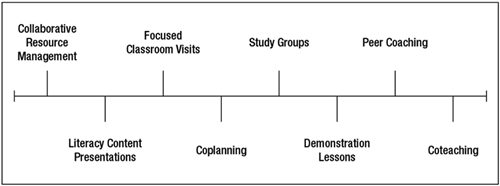
Last month, I talked about the importance of establishing and articulating a common vision at the beginning of each new school  year for the role of a literacy coach. After a vision has been shared, a coach often moves into developing and implementing a menu of service options he/she will offer throughout the course of a school year. One structure that offers a range of differentiated options is the Literacy Coaching Continuum outlined in Mary Catherine Moran’s book Differentiated Literacy Coaching: Scaffolding for Student and Teacher Success.


Of the options that this continuum presents, I find coplanning to be one of the more common ways I start my work with teachers and teams in the beginning of a school year or a coaching cycle. In my experience, coplanning can be a comfortable entry point for a coach’s work because it can feel less invasive, less personal, and overall less threatening than starting with conversations about instructional routines, practices, or philosophies. Also, I believe curriculum and planning are naturally on the forefront of teacher’s minds within the fall months, as many times teachers are still working on gathering their first pieces of classroom data, getting to know new grade levels, starting off in new positions, or even working with new team members. Finally, I also find coplanning to be a good place to start with those teachers who are having difficulty (or are reluctant to) articulate a purpose for the coaching cycle. Often, throughout the course of coplanning, questions, uncertainties, or frustrations will naturally arise. In this way, coaches can “tease” out a purpose for the coaching cycle through the conversations that originate during coplanning.


A coach can support teachers through coplanning in a variety of  ways, depending on the needs of their teacher or teams.. First, coplanning time might involve an examination of data; secondly, a teacher might work to align and plan a certain lesson or unit of instruction with a teacher or a team. In her book Differentiated Literacy Coaching, Mary Catherine Moran highlights the following four responsibilities for a literacy coach during coplanning. During coplanning, coaches may:
  • Coplan lessons and curriculum units with teachers based on a systematic study of teacher’s needs.
  • Work with teachers to align instruction to learning standards.
  • Set goals and plan lessons with teachers based on analysis of student assessment data.
  • Examine students’ ongoing performance data to identify needs, monitor progress, and modify instruction for struggling readers.

In my experiences, I have also used coplanning to work with teams in setting a protocol and structure for lesson plan writing, understand a new curriculum, tool, or resource, and lay out a systematic scope and sequence. As I mentioned above, these opportunities are especially useful for teams/teachers who have new members or new tools they are working to understand and implement. My recommendation is that coplanning occurs for a minimum of once a week up to five days a week, depending on needs and scheduling. I have found by setting aside a structured time for coplanning, acting as a collaborating member of a team or partnership, and following a structured protocol (for team planning or conversations) coplanning time is a very productive way for a coach to start off their school year. The coplanning process allows a coach to support teams or individual in building knowledge and a common vocabulary, it fosters a relationship of collaboration between the coach and the individual/team, and it helps set a purpose for future coaching opportunities. For these reasons, a coach can easily use the coplanning experiences to purposefully select additional tools or options from the coaching continuum to move into a new or deeper phase of coaching.