Showing posts with label Heather. Show all posts

Tuesday, April 25, 2017

Inviting Teachers to Share

Heather Zimmerman contributed this post. Click here for more of Heather's thinking.

As lit coaches, we can share all sorts of great resources, data, or ideas, but what ends up being the most powerful is when teachers see their teacher colleagues sharing what they are doing.  


This year, I have made it a priority to ask teachers to share what they are doing in their classrooms regarding our school initiatives.  I also ask my principal for ideas on who could share, since he gets into everyone’s classrooms.  


This has been really powerful.  Here is how I help teacher prepare:
  • When asking them I make sure to share what the great thing they are doing is that we want to see.  I make sure to be specific, so they know what we are hoping to see.
  • I make sure to tell them it’s an option. We all know it can be hard to share in front of our peers.  I never want anyone to feel like they are being forced to share and feel uncomfortable.
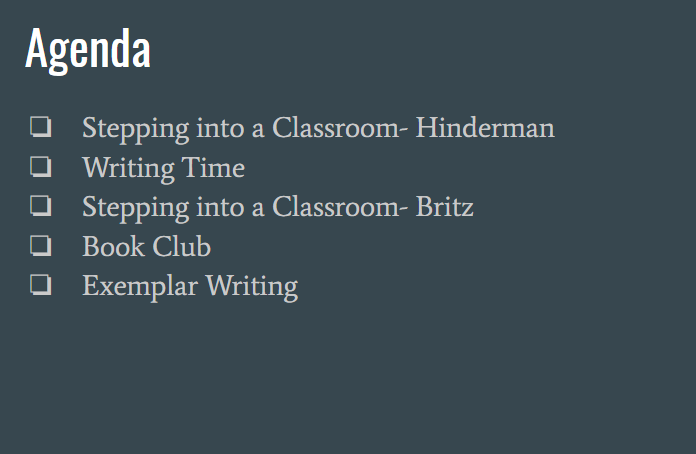
  • I share out Slides for the day, so they can add any visuals or talking points to the slides.  Then they can also see where they fall in the agenda.
  • Check in with them the day before.

Staff seem to really appreciate seeing inside their colleagues classrooms. We all know it is important to have teachers share their thinking, but making it a priority in an already full schedule can sometimes seem tricky.  When was the last time you set up a teacher to share their thinking?

Tuesday, March 28, 2017

Writing in Chorus - Gradual Release of Responsibility

Heather Zimmerman contributed this post. Click here for more of Heather's thinking.
This is part of a series of posts about writing coaching cycles, which include examples from several disciplines.


Have you ever tried to look for literacy examples for your music teachers?  It can be hard to find a lot of ideas.  


During one of my coaching cycles, I worked with our chorus teacher, Eric Britz.  We talked a lot about some of the great things he was doing regarding writing.  He had so many practices already in place.  

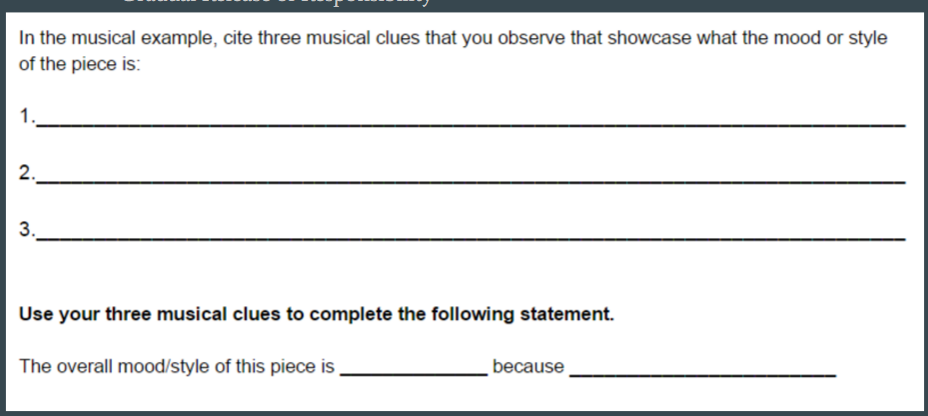
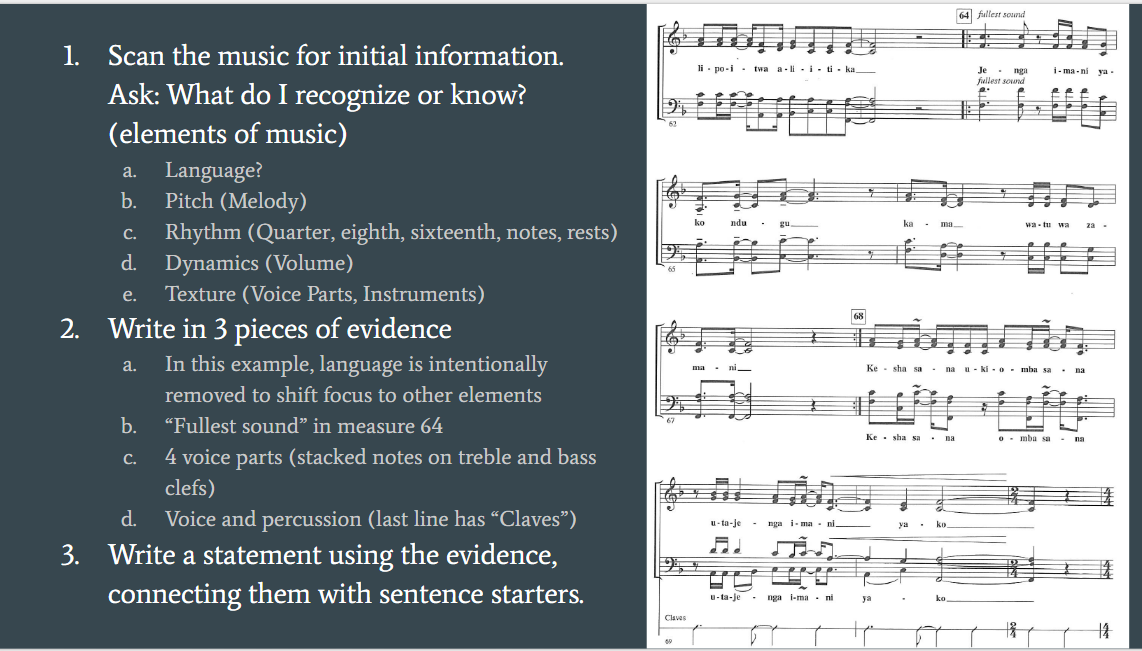
At a collaboration session, he shared with staff what gradual release of responsibility looks like in his classroom.  Take a look:


*This was an organizer to get students thinking before they wrote.

*You might notice the lyrics are not in English.  This was intentional.  He noticed students paid more attention to lyrics than to the music.  He decided to help them focus mostly on the music.


Thursday, March 23, 2017

Writing in Math- Graphic Organizer

Heather Zimmerman contributed this post. Click here for more of Heather's thinking.
This is part of a series of posts about writing coaching cycles, which include examples from several disciplines.


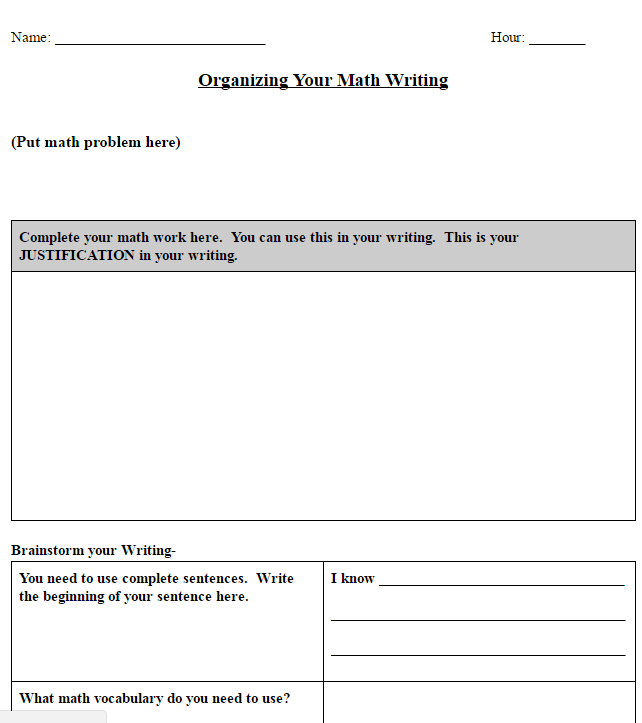
During a coaching cycle, I was working with math teacher individually.  A trend I noticed was that teachers commented on how they were looking for a tool to help organize students’ thoughts. Together, a math teacher and I, created this graphic organizer.  Click here.


One part we got stuck on was that the writing is so individual depending on the math content.  So it is hard to make a common graphic organizer.  We are hoping this is a start.  What math writing tools do you have?  Share in the comments!

Tuesday, March 21, 2017

Writing in Band- A Reflection Organizer

Heather Zimmerman contributed this post. Click here for more of Heather's thinking. 
This is part of a series of posts about writing coaching cycles, which include examples from several disciplines.

As I went through my coaching cycles, I was excited for my time to work with the music department. I did not have as many opportunities as I would have liked working with that department.  


The band teacher expressed he wanted a way for students to focus on the recording of a concert that could carry over into a reflection.  Together we (me and Brad Curran) made a checklist of ideas to look for during the viewing of the concert. The band teacher also added sentence starters.  To view the organizer, Click Here.  

Thursday, March 9, 2017

Coaching Cycle Protocol

Heather Zimmerman contributed this post. Click here for more of Heather's thinking.
This is part of a series of posts about writing coaching cycles, which include examples from several disciplines.


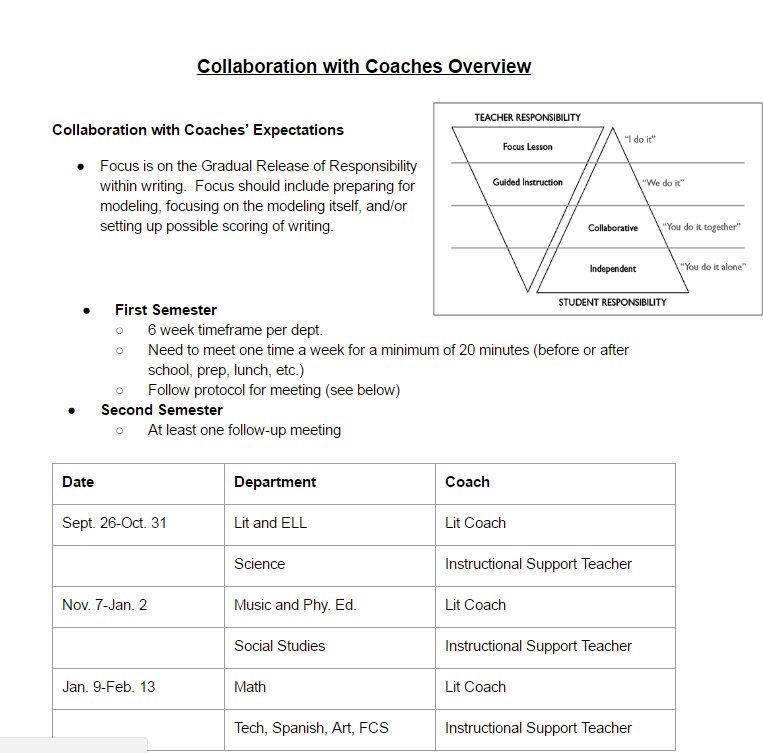
How many of you sometimes feel as if you spend more time putting out fires or doing quick coaching in the hallway during passing time?  This year our district implemented the idea of coaching cycles in grades 6-12 that focused on writing and gradual release of responsibility.  


This is how my middle school approached the initiative:
  • Everyone will meet with a coach
  • 6 week cycles
  • Meet for 20 minutes once a week.  Could be longer if needed for planning in place of the following week.
  • Work on something related to our school goal- writing.
  • Teachers met individually with a coach. If it worked, teacher could meet as a group, but due to schedules that rarely worked.

Here is the protocol sheet (created by me and my school’s IST or Instructional Support Teacher - Tom Anfinson) that was used to help organize and track time with teachers.  Click here.


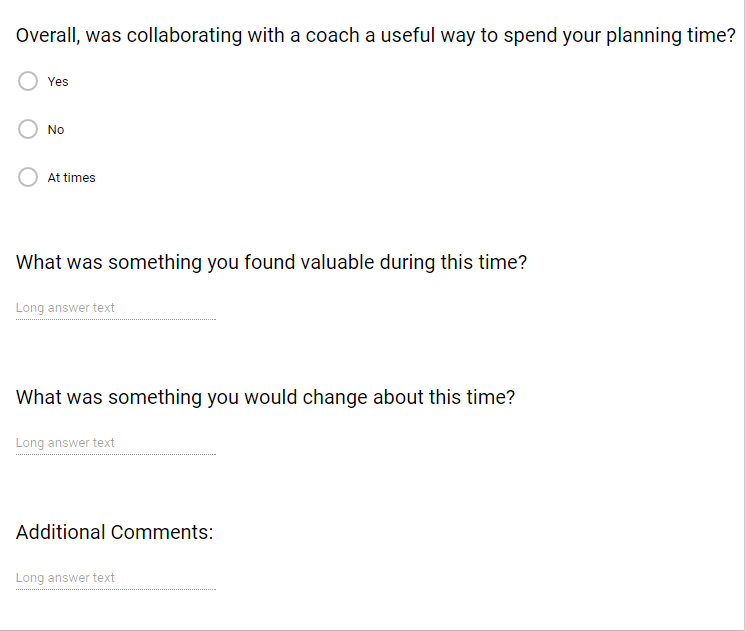
Here are questions from an optional Google form after the cycle had ended:


I loved having the more formal cycles.  It really helped to meet with everyone and the feedback has been positive from the teachers who submitted the optional form.

How does your school approach coaching cycles?  Share any resources down below!

Wednesday, June 22, 2016

Comprehension Focus Groups: With a Focus on Grammar

Heather Zimmerman contributed this post. Click here for more of Heather's thinking.


Why can’t these kids write a complete sentence?  This is a frustration that might be vented by a teacher at any grade level. This usually leads to the question: How do we fix this? What does best practice look like when grammar is taught in a consistent and strategic way while in the workshop model.  


I have tried to teach grammar in various ways.  When I was student teaching we had a textbook we used with a number of sentences that needed to be fixed depending on the lesson for the day.  In my own classroom, my high school students engaged in Daily Oral Language (DOL) on Mondays, Wednesdays, and Fridays by fixing the sentence that was on the transparency.  When I learned this was not best practice, I began to use lessons from Mechanically Inclined by Jeff Anderson.  I loved how we used examples from a text to analyze correct examples.  Eventually I started to feel like we did not have enough lessons to work through on a consistent basis, so I dabbled into a bit of DOL again using the book, Use it! Don’t Lose it! by Marjorie Frank.  I tried to tell myself this was OK, because I thought it was what was best for my students.  I also of course was analyzing student writing and trying to pull lessons from their writing.  But I kept feeling lost in grammar world- nothing felt right for us!


Am I crazy to think there must be something out there in grammar world that clicks and feels right for my students?  Maybe...  I feel part of the problem (which is the same now during intervention time, as it was when I taught 8th grade literacy) is time.  How do I effectively chunk my 50 minutes of time for vocabulary work, grammar/sentence work, read aloud time, the mini-lesson, and reading/writing workshop time?  Yes, I know that some of the grammar/sentence work should be a mini-lesson as needed for a small group or whole group.  But when it is not sticking for my whole intervention group, I know we need to give this more time.  (Is the Rolling Stones song going through your head right now? “Time, time, time is on my side.  Yes it is.”)


A friend of mine recommended the book, Grammar Keepers by Gretchen Bernabei. This book has lessons on the most common grammar problems in grades 4 through 12.  She bases her lessons off the ideas of asking students to “prove it.”  In essence, students need to back up their choices.  I decided to base a Comprehension Focus Group (CFG) using specific lessons from Grammar Keepers.  I picked lessons that I knew my students needed.  I also picked a theme for our texts that I knew would be of interest to them.  


Here are the CFG lessons:


Afterwards, I felt like we certainly did a deep dig into grammar.  My 8th graders, really started to think about the punctuation we picked and why that punctuation is used.  When they tried to find examples in mentor texts they sometimes would pick up on a different instance.  For example, commas being used for a different reason than with an appositive.   But, they were noticing the punctuation and we were talking about it, which is important.  This led to conversations about subjects and verbs- topics they have learned but have forgotten.  With my 7th graders, I picked lessons dealing with sentence structure.  We needed to work on fragments and run-on sentences.  We talked about subjects and verbs.  We also talked about conjunctions.  Students enjoyed looking for FANBOYS or AAAWWUBBIS sentences in texts, but did not always include appropriate punctuation in their writing.  This led to good discussion where I learned that sometimes students knew it was needed and sometimes they did not.  This CFG led to being consistent and strategic through the time of this intervention, but I would like to see this happen in a more consistent basis.  Was it perfect?  No.  Though, there will be parts from this book I will incorporate next year into my routines at the beginning of CFG time.  I also want to get a good system down, so I can carry that into my coaching time.

What works for you?  How do you help your teachers incorporate grammar into their classrooms?  If you are using CFGs at the secondary level, what does this look like for you?

Monday, May 16, 2016

Offering Professional Development Based on Choice

Heather Zimmerman contributed this post. Click here to read more of Heather's thinking.

We all know how powerful choice is- whether that choice be in the classroom or for our own learning. Choice is the powerful tool that leads to ownership.  When I plan professional development sessions, I always try to keep in mind choice.  Sometimes that is easier said than done.  I find a few factors play a role in this problem: time and capacity.


A few months ago, my school’s curriculum and instruction team put together some literacy-focused sessions and people signed.  The time piece was not as much of a factor as the capacity piece.  We needed to make sure all of our instructional support teachers would be available to facilitate the sessions we picked (instead of being a part of collaboration at one of their many other schools). Of course, teachers would be powerful leaders for the groups too, but that depends if there is a teacher is willing and also has the knowledge in the area of focus.  The feedback after, from the sessions, was positive and people requested the format again.  There were some sessions they wanted to attend, but had to make the choice of which one.  It is important to know teacher’s time is well-spent.  


As I was sitting down planning my next professional development time with my school, I kept thinking about the focus and how choice would fit in.  The focus for session was to look at student writing. Everyone was to bring in writing samples from their classrooms.  We had done this a few other times using a protocol the district provided.  The protocol was optional, and so I began to think about what I might do instead, so I could tie in choice.  I know my teachers are in different places when it comes to looking at student work and even providing opportunities for writing in their classrooms.  I felt the protocol was not meeting some of their specific questions or needs for collaboration to help writing instruction.


I decided to create a list of different topics (with the help of blogger and co-worker Lisa Weiss), a general protocol, and have teachers pick the topic they wanted to focus on.  I am very excited with the list and see the potential for great discussions to happen based off what the teachers want to discuss.


Click here to view the survey.
Click here to view the protocol.


How do you provide choice within professional development?

Wednesday, April 20, 2016

Comprehension Focus Groups: Looking at Child Labor with a Focus on Word Choice

Heather Zimmerman contributed this thinking. Click here to read more of Heather's thinking about Comprehension Focus Groups.


If you read my post about managing your learning, you might recall I decided this year I would have a stack of go-to texts.  With all my new learning, I sometimes feel I do not end up applying the learning in a consistent and strategic way.  I created a stack texts that would be my go-to for my lesson planning this year.  I have found this to be a successful way to manage my new learning.


One of my go-to texts is Chris Lehman’s book Falling in Love with Close Reading.  I read this book last summer and a co-worker friend of mine told me how wonderful this book is.  I decided I had to make sure to use this in a Comprehension Focus Group (CFG) this year.


The time came when I looked back at Lehman’s text to see if it could guide my student’s learning in a CFG for my 8th graders.  My school uses Lucy Calkins’ Units of Study for Writing and my 8th graders would soon be working on the informative unit and starting letters on an important issue.  I decided to get the ball rolling.  I found texts about child labor that centered around a book my students had picked from our classroom library that they wante to read- Iqbal by Franceso D’Adamo.  After digging back into Lehman’s books and thinking about my students’ needs, I decided word choice would be a powerful next step.  I also wanted to incorporate some open journaling on the topics they read about regarding child labor with a focus on their own word choice while they wrote.  


I was very happy with how this unit came together.  I felt this gave them resources for their literacy class if they chose to use the topic.  It also got them thinking about how word choice can show the purpose and tone, which can make an impact in their writing.  


Here is the outline to the CFG if you are interested:

Do you or your intervention teachers tie the intervention work to other classes?  What classes do you usually connect the work to?

Friday, March 18, 2016

Conferencing with Students: An Update on My Goal

Heather Zimmerman contributed today's post. Click here for more of Heather's thinking.

Earlier in the school year I wrote about my Professional Practice Goal (PPG) for the school year.  My goal was to work on a conferencing structure within my intervention groups that could also carry into coaching.  I just finished reflecting through my mid-year review for my PPG and wanted to share my progress with all of you.


One part of my goal was to utilize some resources.  I have heard from a lot of people the gist of How’s It Going? by Carl Anderson and hope to explore his book more on my own. My other resource I wanted to investigate was the Two Writing Teachers Blog where they talked about conferring toolkits.  I looked through all the resources on the blog and put together a system from some of their ideas.  I love that blog!


What’s Going Well-


The Format
I like the idea of giving a compliment on student work, a teaching point, and a goal for our next conference.  This keeps the conference focused on all the points I want to highlight during a conference.


Using Google Forms
As I said I was going to use Google forms to track my progress.  I really like the flexibility with Google Forms.  I have all my information in a spreadsheet, which also shares into a separate Google Doc for each student.  (Thanks to my tech coach’s help!)  


What I am Still Working On


Using My Chromebook
I find it difficult to bring my Chromebook with me and try to find a comfortable place to have the Chromebook and type into the Google form.  It is so much easier to conference with my small groups and follow the structure I have in place for a conference and then jot down notes on areas we need to work on in my lesson plan book.  But I know that is not practical for my teachers who have 130 students.  I have tried to use my iPad but it was not working out well with my Google forms. (Also my teachers do not have iPads, but all of them have Chromebooks.)  I will keep working at this- I still feel confident this format is the answer.


Anyone have any tips or thoughts on how to help me out with this?

Wednesday, February 24, 2016

Comprehension Focus Groups: Using Reciprocal Teaching within the CFG

Heather Zimmerman contributed this post. Click here for more of Heather's thinking about comprehension focus groups.

October 2015 Hot Topics at UW-Oshkosh had Lori Oczkus as a keynote speaker.  After hearing her passionately talk about different strategies during her keynote, I was hooked and decided to stay for a session she had about reciprocal teaching.  I had heard of reciprocal teaching, but never implemented it in my classroom.  But after hearing Oczkus talk about the power of reciprocal teaching, I knew I had to implement it in my next Comprehension Focus Group (CFG).


I thought my 7th grade group would benefit from Reciprocal Teaching the most.  I decided to use a graphic organizer- though she showed us this cool way to tear paper and use a sheet of paper.  I opted for a bit more writing space for my middle school students.  This was used during the informative unit where my students did some reading on the Middle Ages (before they started in social studies class).  


Oczkus talked a lot about puppets for the different roles, which I did not think my middle school students would find “cool”. I did use the Quincy the Questioner idea though- without the puppets.  My middle school students seemed to enjoy the idea of quizzing their friends.  


I thought using Reciprocal Teaching was effective in the CFG.  It provided an opportunity to review summary writing, and also through the “Clarifying” component, students were able to capture questions they still had for further research in phase 3 of the CFG.  

For those of you who are using CFGs, what graphic organizers or strategies have you found success with?

Monday, January 25, 2016

Time in the Classroom: Multiple Benefits

Heather Zimmerman contributed this post. Click here for more of Heather's thinking.


I am sure we all know the overwhelming feeling of trying to balance the many directions we are pulled in as reading specialists.  Last year was the first year I was teaching reading intervention courses and also coaching.  That dreaded feeling of not doing either role justice was common for me last year.  This year though I decided to tackle that feeling with a coaching game plan.


Last school year my district implemented the Lucy Calkins’ Units of Study for Writing into middle school classrooms.  The summer before the roll-out, I worked with a small group of 8th grade teachers on various assigned tasks to prepare for the roll-out.  This helped me get a better idea of the Calkins’ curriculum, but throughout the year I started to feel as if my depth of knowledge was lacking.  This was the first curriculum roll-out I was not a part of as a teacher.  Therefore, I did not feel like I knew the Calkins’ curriculum as well as I knew the rest of our curriculum


I made a decision that this year I was going to focus on the Units of Study with the teachers. Due to schedule conflicts, my focus this year is 7th and 8th grade, and next year I will focus on 6th grade.  I felt this made sense for a few reasons, but one primary reason was that the 6th grade teachers have three literacy teachers at their level.  Therefore, they  have a built-in team of support.  The 7th and 8th grade teachers on their own islands in my school. My plan for supporting teachers with the Calkins’ curriculum was to be in their classrooms as they were teaching the units.  I planned as best as I could to go into hours where I had intervention students, so I could also support them too.  I told the teachers I wanted to learn more about the Calkins’ units, so I could better support them too.  I let them know I would be game to co-teach or work with small groups of students.  This experience has helped me as an interventionist and as a coach.  


As an interventionist, I have been better able to help my students when they have questions on assignments even when they are not in their literacy classroom.  There has been times when I have taken 5-10 minutes to talk students through a lesson from Calkins’ or helped the student through a conference during intervention.  I also have been able to support them inside the literacy classroom.


The other benefit, which is the original benefit I was expecting, I was knowing the curriculum better so I could better help support my literacy teachers.  I feel our collaboration time is much better used when I am not paging through the curriculum book or having them give me information on what the unit is about.  We have been able to talk through questions together and brainstorm ideas.


I am so happy I was able to connect with my teachers during this first unit of Calkins.  The time commitment was so well worth it. I look forward to working with them using the same plan for unit two.  

Friday, December 11, 2015

Collaborating with Special Education Teachers: Using Goals to Grow Our Readers

Heather Zimmerman contributed today's thinking.

This year my school district is having 6-12 special education teachers use the Fountas and Pinnell Benchmark Assessment kit to determine reading levels and to use Fountas and Pinnell’s The Continuum of Learning to guide reading goals for IEPs.  


As the literacy coach I worked with the teachers in my building last year to make sure they knew how to use the assessment kit.  This year we started to test in fall.  I am so excited we are collaborating and focusing on literacy together.  I really want to make sure that my teachers get the most out of the data as possible to find it useful.  


After teachers tested and wrote goals, my principal and I met with the special education teachers and our PST (program support teacher) to discuss the goals.  I led a discussion focusing on what the assessment can tells us, reflecting on the goals picked from The Continuum of Learning, and tools to use while conferring with readers.  I told my special education teachers that they are the experts in writing goals, and I am just here with my reading lens to help them if needed.    


The Continuum of Learning was a new book for my teachers, so I wanted to make sure they felt comfortable with their goals.  As we reflected, we talked about the goals meeting the following guidelines:
  • A goal other teachers will understand. (The goal does not need to be copied word for word from the book.)
  • A goal that can be measured.
  • A goal that is generalizable.  (That way the goal can be applied to all classes.)


From there we reflected on the goals using the above guidelines.  This chart I created helped guide our thinking:


After we reflected on the goals, I shared some conferring questions and tools to track conferring both for special education teachers and regular education teachers.  I appreciated our time together and the new learning I experienced as I found out more about the IEP process and goal requirements.  I look forward to learning and growing together this year as we continue on this journey.

Wednesday, November 25, 2015

Managing New Learning

Heather Zimmerman contributed today's thinking.

Some of you may have been following me since my first year of literacy coaching a couple years back. I remember entering this role and questioning what I got myself into when I was around my other literacy coach friends.  I remember our first meeting together and they were name dropping all these gurus in education, and I did not recognize hardly any names they mentioned.   I was so grateful for their wisdom, but I also felt overwhelmed and was questioning if I was qualified.  Sure, I had read texts as I went for my masters, but these were not the same texts they mentioned.   I am pretty sure no one mentioned the Cooter/Flynt resource I had used in my assessment course.  


So I started reading some of the names they mentioned.  I checked out who Doug Fisher and Nancy Frey are and explored many titles mentioned.  Now that I am in year three of coaching, I feel like I have a better grasp on the big names in the education world.  My new problem is that I am checking out different sources, but not consistently and strategically applying what I learned from all of these great educators.


My solution this year is to take a few books that I read over this summer and create my go-to pile on top of my file cabinet.  I see them every day.  I am not going to start reading other books, unless they are a part of a book club I am doing… or Kylene Beers and Robert Probst’s new Notice and Note book comes out… or Write Like This by Carl Anderson because I am using it for my PPG (professional practice goal) … OK it is easier said than done.  Of course, I will read texts that might help out my teachers, but I am not going overboard with my own professional text reading this year until I have applied some of the wonderful things I have learned in the books I have read.


I am really trying to manage my new learning and apply the professional texts I read this summer or are continuing to use from last year.  It is hard to not start a new book beyond my list that is already listed above, but I am doing a lot of online learning through blogs and videos.  And of course, I continue to read young adult books when I can squeeze them in.  


Here is my list of my go-to books this year:


  • Engaging Students with Poverty in Mind by Eric Jensen- Book club book and enjoying it.
  • Falling in Love with Close Reading by Chris Lehman and Kate Roberts- A summer read.
  • Notice and Note by Kylene Beers and Robert Probst- Read this book awhile ago, but still use it all the time during my Comprehension Focus Groups.  Also, our literacy teachers 6-8 are reading this book this year.
  • The Reading Strategies Book by Jennifer Serravallo-This book has so much of everything.  I got this book this summer, and I look forward to using this book over the summer.
  • Read, Write, Lead by Regie Routman- A book club book that I am reading with the other 6-12 literacy coaches in my district.

How do you manage your new learning?  What are your go-to books this year?