Showing posts with label Maggie. Show all posts

Thursday, April 6, 2017

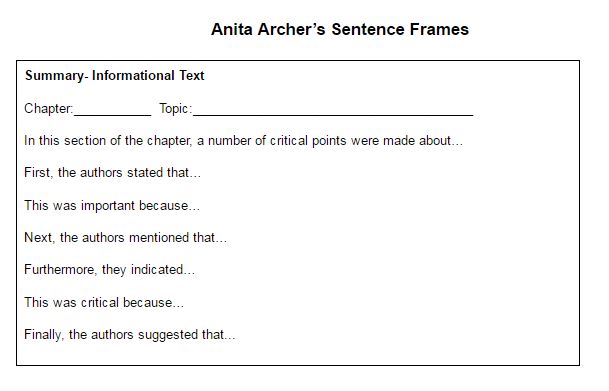
Anita Archer’s Sentence Frames

Maggie Schumacher contributed this post. Click here for more of Maggie's thinking and writing.

The following sentence frames were shared by Anita Archer at the RtI nnovations Conference in October, 2015. Anita Archer recommends the use of sentence frames as a way to give students a framework to support thinking and writing and to encourage the use of content vocabulary in writing. Sentence frames can also be used to provide scaffolding for academic language; teachers can post academic language starters in an anchor chart for students to see when having academic conversations in class.

Click here to access a template with many sentence frames.

To implement sentence frames, you first develop a frame for the type of writing you’re asking your students to complete (see examples attached). After you have the frame, you model how to use the sentence frame with your students; after, students will use sentence frames to construct their own writing. This scaffold can be very helpful for students who struggle with basic writing skills and structure. Over time, as students become stronger writers and internalize this type of academic language and structure, you would slowly fade the use of sentence frames during instruction until students can write independently.

Tuesday, March 14, 2017

WSRA Reading Convention - Take-Aways, Inspiration, and Reflections

Maggie Schumacher contributed this post. Click here for more of Maggie's thinking and writing.


I was privileged to have the opportunity to once again attend the Wisconsin State Reading Association convention this February. As always, I had so many great take-aways and pages upon pages of notes to go through after that my head is still trying to process. In this month’s blog post, I’ll reflect on my biggest takeaways and inspiration gained from the WSRA reading convention.


Mem Fox


On Thursday, the great and wise Mem Fox kicked off the conference. She shared some of her picture books with us, and she also shared some powerful messages which I have since passed along to others. Mem shared that she’s not interested in the reading level of kids; she’s interested in their level of interest. She says, “I don’t want children to understand every word I write. I want to lift them up and introduce them to language they don’t know. I want to give them wings so they can fly.” How will we help our students to understand the English language if we don’t “pour wondrous language into our children’s ears as often as we can?” Mem urges teachers and parents to read books to children often, to read stories that children love over and over again, and to read with passion. “It will change their lives. It will change yours. It may even change the world.” How could a person not be inspired?


Recommended Mem Fox Books:
Tough Boris (Fox)


Penny Kittle


On Thursday, I also was able to attend two different presentations by Penny Kittle. According to Kittle, “You can read without writing, but you can’t write without reading.” She stressed the importance of using books and texts to help our students analyze author’s craft. She encouraged teachers to ask our students to find beautiful language or interesting writing craft in their reading and to have kids write down interesting sentences or beautiful examples of the craft of writing. She says that when students copy words exactly as they’re written and write them down, it will live inside them. She also suggests having students use mentor texts to emulate poetry and prose. By doing this, we’re giving our students “shoulders to stand on” by paying attention to people who write better than they do. In addition, this writing can take students deeper into the meaning of texts. The use of mentor texts is by no means groundbreaking news, but it is a good reminder of the power these mentor texts can have to support our students as writers and as readers. The more our students read, the better writers they will be.


Kittle also spoke about the importance of independent reading and allowing for student choice in book selections. Independent reading allows teachers to personalize learning. According to Kittle, engagement is the first step to improving student achievement. There is much talk in schools about finding more rigorous and complex texts to provide to students as we prepare them to be college or career ready, but Kittle argues that the combination of student engagement plus volume of reading equates to text complexity. She says, “We are doing RtI all wrong. Our struggling readers don’t need complex texts. They need to read engaging books, and we need to increase their reading.” (Amen.) We need to provide our students with a lot of choice in what they read. Kittle and Gallagher say the balance of texts in a classroom should be 25% teacher-selected core texts and 75% student-selected for independent reading and book clubs (or literature circles). Everyone reads on a rollercoaster; sometimes we read easy books, and sometimes we read challenging books.  Kittle quoted Nancie Atwell with the reminder that “the most important statistic we have is the number of books our kids read each year.”


Recommended Penny Kittle Books:
Book Love: Developing Depth, Stamina, and Passion in Adolescent Readers (Kittle)
Write Beside Them: Risk, Voice, and Clarity in High School Writing (Kittle)


Stephanie Harvey


Continuing on with what appears to be the theme of the conference for me... on Friday I attended an engaging presentation by Stephanie Harvey. This presentation (From Striving to Thriving: The Best Intervention for a Student is a Good Book) again focused on the significance of students spending time reading books that they can and want to read. Similar to Kittle, Harvey feels strongly that the way to make sure kids become good at reading texts that they cannot read is to give them time to practice reading texts that they can. We need to surround our students with wonderful literature and give them time to read it. She says that if our kids in poverty do not have access to books or are not reading at home, then we need to make up for this in our schools. Volume continues to have the most important impact on reading skills and knowledge.


Harvey also says that text complexity is not about the length of the text or the vocabulary in the text; it’s about the issues, ideas, and societal problems. When kids have time to talk about what they read, their comprehension deepens. They need time to process what they have read and discuss it with others in reading partnerships (book clubs, literature circles, etc.). We also need to give our students a purpose for reading so they find it meaningful. We need to read to our students every day. Free voluntary reading time should be the last thing that gets cut out of our instruction, but is often the first thing to go when things come up or time runs short. Harvey shared that “what kids think, feel, and write about their reading is more important than any assessment we can or will create for them.” We need to share our reading joys and challenges with our students every day. Finally, she urges teachers and schools to get rid of reading labels and to foster a growth mindset in our classrooms. All of our students are striving readers, some just need more support than others. Let’s cultivate a love of reading within our students every single day.


Recommended Stephanie Harvey Books:
Strategies That Work: Teaching Comprehension for Understanding and Engagement (Harvey & Goudvis)
Comprehension and Collaboration: Inquiry Circles for Curiosity, Engagement, and Understanding (Harvey & Daniels)


*Check out www.wsra.org/convention for more information about the 2017 WSRA Reading Convention and to access the convention handouts.

Tuesday, February 7, 2017

Fostering a Culture of Instructional Excellence through Engagement

Maggie Schumacher contributed this post. Click here for more of Maggie's thinking and writing.


This year, I’ve been fortunate to participate in a series of workshops focused on creating a culture of instructional excellence through engagement. These workshops were offered through CESA 2 2 and are facilitated by Dr. Kevin Feldman, the director of reading and intervention for the Sonoma (California) County Office of Education and independent educational consultant. The focus of the workshops is on strengthening instructional practices across the content areas through use of student engagement.


Dr. Feldman believes strongly that there should be shared ownership of reading, writing, speaking, listening, and THINKING in every grade across every content area. All disciplines require these things in order for students to master the content. He promotes the idea that teaching our students HOW to think rather than WHAT to think would significantly improve their chances of being effective citizens in everything they do. The goal, however, is to make student thinking and learning visible. We want our students to be able to show, explain, and analyze their thinking. And we want our students to do this in every class, every day. Everyone does everything.


Throughout these workshops, Dr. Feldman has focused on essential truths for improving our schools. The first and foremost truth is that it’s impossible to improve student achievement unless we determine how to improve our teaching. How well we teach equates to how well our students learn. In other words, we haven’t taught unless our students have demonstrated this learning. As educators, we need to move away from the notion that tests are for kids. On the contrary, tests are for teachers. A good test answers the questions: What did you teach? What didn’t you teach? Who did you teach? Who didn’t you teach? True teaching takes humility. We as teachers and coaches have the power to be change agents and to raise the bar for our students. However, by raising the bar, we need to support our students so they can jump over the bar and not just run into it.


As coaches, we have the power to give our teachers the actionable feedback they need so they can improve their practice and students can improve their learning. The feedback they get should be immediate and non-threatening but should also be actionable. We need to make room for questions and wonderings. What did you notice about the lesson? What did you see and what didn’t you see? Everyone wants to improve their practice. How often do we hear teachers say, “I can’t get any better than this” when we ask how their practice could improve? Never. The goal is to create mutual trust along with developing a sense of urgency. Why is it important they change or strengthen their teaching practices? Always, the answer and the focus needs to be on the student and the learning that is happening in the classroom.


In an ideal world, students should be doing most of the work in the classroom. In reality, teachers do most of the “heavy lifting” in the classroom on a daily basis while the majority of students sit passively taking it in. But in the game of life, you have to be on the field to get better at the game. You don’t get better by sitting in the stands. We’ve given our students the message that listening means not talking, but this is not the case. Decades of research demonstrates that 20% of our students are responsible for doing 80% of the work. Our students who most need to be engaged in our lessons are chilling in the zone of minimal effort. We need to make our schools “no chill zones” and shoot for 100% engagement.


How do we do this? We structure our classes to make student learning visible. If we can’t see it, the learning is not there. Every 2-10 minutes, our students need to be saying, writing, and/or doing something related to the learning objective. We make our teaching practice intentional. One way to do this is by teaching our students the power of paraphrasing. We can teach our students how to be cognitive listeners through precision partnering and accountable listening. This takes the idea of “turn and talk” to a new level and gives it purpose. We teach students the 4 L’s of Listening: Look, Lean, Listen, and Low Voice. While one student is explaining their understanding or thinking, the other student partner is the listener. One student speaks for 90 seconds, and the partner has 30 seconds to paraphrase his/her partner’s thinking. They learn to use conversation starters such as, “What I hear you saying is…” or “In other words, you believe…” Then students switch roles. The act of precision partnering and active listening not only allows for checks for understanding for the teacher, but also builds class relationships, understanding, and empathy. Students receive immediate feedback from their peers and the teacher that feeds forward.


Through these workshops, Dr. Feldman has introduced various other methods for making learning visible in the classroom. We get as much engagement as we intentionally plan for. The good news is we can hit the “reset button” any time. “It’s a game, and it’s our job to structure the game so the students win.”

Precision Partnering Graphic

Monday, June 20, 2016

Summer Reading

Maggie Schumacher contributed this post. Click here to read more of Maggie's thinking.


Take a deep breath and relax... It’s summer break! You’ve survived the school year (hopefully in one piece) and I hope you are enjoying some downtime and all of your favorite activities. Summer brings us an annual opportunity to reenergize, rejuvenate, refresh, and do some continued learning and prep for the next school year.


Not surprisingly, one of my favorite summer activities is reading. For me, the best part about reading in the summer is that I can read books at my own pace, when and where I want to read them, and I can expand beyond my sole reading of adolescent and professional literature! There is joy to be found in these little freedoms. To me, this is relaxing. I have many books that I’ve purchased throughout the school year that have been piled high just waiting to be cracked open. As good as my intentions always are, the reality is that I never get as much time to read during the school year as I hope to get. In the summer, I can take this stack of books home and read at my leisure. I can read in the backyard, on vacation, and or a beach. I can stay up late to finish a book or I can enjoy a lazy morning reading before I venture out of bed.


It’s important to promote the importance of summer reading to our students. It’s also necessary to provide students with access to resources over the summer months. Not all of our students go home to a print-rich environment. It’s important that we inform our students (and their parents/guardians) of resources at their disposal, so they aren’t without access all summer long. In the Baraboo School District, we make sure students and parents know the location of public libraries and Little Free Libraries. Students are encouraged to utilize the e-library for both our middle school and for the public library and assistance is provided to help students sign up before the end of the school year. They can check out and return books on their personal devices with the touch of a finger. At the elementary level, books have been gathered/collected for distribution to students in a format similar to a Little Free Library. Students can take home as many books as they choose. If they bring them back, great! If they don’t, these books will have found a good home. Some schools and teachers set up summer reading challenges for students in an effort to promote more reading. Whatever ideas we have and share, we know that not all students will take advantage of literacy resources over the summer. However, for every student who does, we will have found a thin slice of success.

Just as it is important for students to read and relax in the summer, it is equally important to encourage our peer educators to read, relax, and reflect over the summer months. This could involve setting up a summer book club to discuss a professional book, adolescent book, or a book chosen for pleasure. It could also involve sending out hot summer reading recommendations or offering to have staff members check out books from the school’s or your professional collection. It might involve reading a magazine or the newspaper, an e-book or a novel, or it could be reading for professional growth, to kids, or for pleasure. What better way to escape from reality than through a good book? Regardless of whether you read or not, whatever your summer brings you, I hope it brings you joy!

Wednesday, May 11, 2016

Coaching to Support Gifted and Talented Efforts

Prior to serving in the role as a building literacy coach, I taught for seven years as a special education teacher of students with learning disabilities at the middle school level. During these years, I worked with seventh and eighth grade students with learning disabilities, as well as with students who were deemed at-risk and demonstrated difficulty with reading. I became pretty comfortable with supporting this population of students and working to differentiate instruction to meet the needs of struggling learners. After I transitioned into my new role as literacy coach, it was apparent to me that I was best able to support teachers in their instruction with strategies to support struggling learners in their classrooms. Due to my desire to support all student learning in the building, as well to become a stronger and knowledgeable resource for the teachers in the middle school, I decided to pursue my gifted and talented add-on licensure certification. I’ve now completed the first three required courses for this certification and have only my practicum remaining which will be completed this coming fall.

The courses for this certification included learning the background and foundations of gifted and talented education, the psychological issues and needs typically associated with gifted and talented students, and methods and curriculum to support gifted and talented learners in education. I found it helpful to study the psychological issues of gifted/talented students; this helped me to better understand what teachers may encounter when teaching this population of students, and provided ways to support the students, teachers, and parents. My favorite of the three classes, however, was the curriculum and methods course. I found this class to be the most useful in my role as a literacy coach, as we read about strategies and created lessons that were differentiated to meet the needs of advanced learners.

It is essential that all students receive instruction that meets their needs each and every school day. This task can seem overwhelming when you consider the diverse needs our students have. For each learner, it is important that instruction be individualized. Ultimately, the end goal for all students should be the same, but the pace and the level of repetition can be adjusted for students depending on their need. Just as we should not ask struggling learners to move onto new topics until they are ready, we should not ask gifted learners to sit through the same lesson multiple times if they are able to master it the first time through. This is where the power of pre-assessment becomes essential. If we as literacy coaches can help assist teachers to create and administer appropriate pre-assessments, we can help them determine what their students need and how to plan and scaffold instruction.

Maggie Schumacher contributed this post. Click here to read more of Maggie's thinking.

Another way coaches can support teachers is to support efforts involving differentiation.

This is a hot topic that all teachers know about, but it involves a lot of work and experience to do well. Differentiation is not something that we should be asking of brand new teachers until classroom management is in place. Students are coming into each classroom with a wide range of ability levels and learning styles. Ultimately, teachers need to ask students to meet the same standards, but the content, process, and product of how this is met can be adjusted to meet the individual student needs. While we may ask some students to read and analyze the theme of a novel, we could offer a simpler text to a struggling reader and a challenge text to an advanced reader. These students are completing the same task, but at a level that is appropriate for them. In addition, differentiated assignments such as a R.A.F.T. (Role, Audience, Format, Topic) or BINGO, or units using a Parallel Curriculum format could be offered to students. If planned strategically, each of these options allows for student choice and interests to be met within a way that allows for challenge and still meets the standards being addressed.

When it becomes obvious that a gifted student is ready for much more challenge than the regular content allows, enrichment and acceleration options should be considered. Enrichment opportunities remove students from the basic assignment and allow students to complete a task that is related but much more complex. If a student has proven on a pre-assessment that they already have mastered the content being explored, they should not be asked to complete the basic assignment and then a more complex assignment. When this happens in a classroom, students may begin to mask their abilities or talents to avoid the punishment of extra work. Acceleration is an option that should be considered for truly gifted students. This is considered to be the most effective curriculum intervention for gifted students. Gifted students may be accelerated for a single subject or for an entire grade. These decisions involve support by multiple data points and should include a team of voices, including the literacy coach, to determine the course of action to best meet the needs of the student.

Ultimately, as literacy coaches, we must provide feedback and guidance to support literacy instruction for all. If we want to help all students to be successful, we need to support teachers to provide these best practices for students each and every day. The more we can develop our own knowledge of how to support all learners, the more we will have to share with others.

Friday, April 8, 2016

Instructional Rounds

Maggie Schumacher contributed this post. Click here to read more of Maggie's thinking.

There’s nothing more powerful than teachers learning from other teachers. Instructional rounds in schools and across buildings can be a very powerful tool for supporting teacher learning. In the Baraboo School District, we utilize instructional rounds and I’m always so inspired when I participate in these rounds. Read on to learn how we organize and benefit from these collaborative opportunities at the middle school.


Once per quarter, a teacher leader in our middle school organizes instructional rounds within the building. Participation in instructional rounds is completely voluntary. A form is sent out to all teachers in the building and people can sign up to be either a host teacher or a visiting teacher. People also indicate which hours of the day they teach and an area of focus they’d like to showcase with teachers visiting their classroom. The teacher who leads these efforts then works to organize the responses into an action plan. Approximately four or five teachers visit four or five classrooms on a selected day that works for all involved. In our building, rounds typically last for about 2 class periods. The teacher leader works to create a schedule for visiting and works with building administrators to ensure the teachers who are visiting classrooms get in-building sub coverage as needed. Typically, due to high interest, we can’t include all teachers who want to participate in each round, but we rotate through who is selected so that all teachers benefit at least once if not multiple times throughout the year.


On the day of instructional rounds, the teachers participating as visitors meet with the teacher leader in a designated location. Prior to going into classrooms, the teachers discuss the expectations and preview the schedule. Some of the host teachers have left a message to be shared related to what will be observed in class that day, but this is not required. The understanding is that teachers who visit will take notes on positives only; these notes are then copied and shared with the host teachers before the day is over. The teacher group who is observing stays in each classroom for approximately ten minutes before moving onto the next room. When all classroom visits are completed, the group returns to their starting location and discusses the positive things they saw throughout the day and takeaways and strategies they plan to use in their own classrooms. They finish by writing thank-you notes to those teachers they visited. The teacher leader places these in mailboxes before the end of the day.


There are many benefits of instructional rounds. Teachers get to visit classrooms they don’t normally get to see. Teachers have opportunities to cross content areas and grade levels and see what the other side is doing. Teachers see excellent models of classroom management and student engagement. There are so many great things we do on a daily basis that we don’t really think about until someone comes in and points it out to us. We all have so much to share and so much we can learn from each other if we are willing to open our door to others.


In our building, we have had only positive feedback following instructional rounds. Teachers who have participated as host teachers have spread the word to others about what a positive experience it is to have others come in and observe because they “feel like rockstars” when all of the positive feedback comes streaming in. Visiting teachers have been inspired and have left with many excellent instructional strategies, classroom management tips, and even room arrangement ideas, some of which they’ve incorporated in their own classrooms and instruction the very next day. There is so much possibility and opportunity to be provided to teachers when they are able to learn from each other. Some of the best professional development and teacher training can come from within your very own building!


Screen Shot 2016-03-17 at 3.27.09 PM.png

Monday, March 14, 2016

Engaging the Many Facets of Literacy

Maggie Schumacher contributed this post. Click here to read more of Maggie's thinking.

This February I had the privilege of attending the Wisconsin State Reading Association (WSRA) reading convention in Milwaukee. Every year I look forward to attending this conference and I have so many take-aways that I can bring back to my district and share with others. This conference offers an annual opportunity for me to learn from others and re-energize. 

This year’s convention focus was “Engaging the Many Facets of Literacy”, and I was lucky enough to attend presentations by some inspiring presenters including Sharon Draper, Jacqueline Woodson, Michael Fullan, Samantha Bennett, Jeff Zwiers, and Chris Lehman. For this month’s blog post, I will highlight two of these inspiring speakers’ presentations in my attempt to “pay it forward”.

Michael Fullan - “Critical Issues in Education”

This was the first time I’ve had the opportunity to hear Michael Fullan present and he had some important information to convey regarding critical issues in education. Fullan recently published the book Coherence: The Right Drivers In Action for Schools, Districts, and Systems. He had a lot to share throughout his presentation related to systems change and how to shift school culture. He stressed the importance of good leadership, and also the importance of positive collaboration. According to Fullan, “If you want to change the group, you need to use the group to change the group.” He urged the importance of building the capacity of teachers to learn from each other. As literacy coaches, it’s essential that we empower teachers to learn from each other and deepen understanding collaboratively so we are not teaching and working in isolation. In his presentation, Fullan also reminded that judgmentalism doesn’t work as a motivator. As literacy coaches, it’s essential that we support and empower without judgment. For systems change, it’s essential that leaders be transparent, specific, and non-judgmental. I’m hoping to pick up a copy of Fullan’s new book soon.

Chris Lehman - “Celebrating the Absolute Awfulness of Writing”

This was the second time that I have had the pleasure of hearing Chris Lehman present, and the same as last time, he did not disappoint! Lehman spoke about the awfulness of writing in a way that was entertaining and left me inspired. Lehman reminded us that it’s not what we say and do when we’re in front of students, but it’s also what we DON’T say and do. If we’re not living our beliefs and modeling this in front of our students, our students may default to producing work that doesn’t match with our ultimate goals.

Lehman urged teachers to set measurable goals for students when it comes to writing. He also delivered the powerful message that we need to be more than writing editors for our students. We shouldn’t just be “correcting stuff”; if we limit our focus to errors with grammar and spelling, we won’t be cultivating writers. Lehman instead empowers teachers to teach writing strategies as a teacher of writing, or even better yet, to be writing “personal trainers” encouraging and motivating students to reach their writing goals. He reminded that in real life we tend to write about things we are interested in and passionate about, so we should ask our students to do the same. We need to create the right conditions for our students so that they want to write. This includes demonstrating and modeling our own writing in front of our students. If we expect our students to write for us, we should be writing for them. Another of Lehman’s conditions allows for choice. It’s important to let your students feel connected to the writing process. It’s also important that students receive frequent feedback related to their writing; this feedback should be coming from both the teacher and from peers. And ultimately, and probably most importantly, students need time to write. If you are worried about the writing skill of your students, they need to write more. Period.


Friday, February 5, 2016

Igniting a Passion for Reading

Maggie Schumacher contributed this post. Click here to access more of Maggie's thinking.

“It should be the teacher’s aim to give every child a love of reading, a hunger for it that will stay with him through all the years of his life. If a child has that, he will acquire the mechanical part without difficulty.” - E. Mayne


There’s nothing more important to me than helping to develop a culture of literacy in my school and fostering of love of reading within my students. It’s so important that teachers all feel that they have the tools they need to be successful teachers and supporters of literacy. It’s equally if not more important that students feel they have access to the resources and environment appropriate for cultivating a joy of reading and learning.


If you’ve never read Steven Layne’s Igniting a Passion for Reading, pick up a copy as soon as you can. I had the privilege of seeing Layne present at WSRA a few years back, and his message and enthusiasm have stayed with me since. Layne speaks to the importance of teaching our students the value of books and reading. I work with the teachers in my building regularly on ways they can incorporate literacy strategies into their instruction and talk to kids about reading. Every teacher gets a chance to read alongside their students during our weekly school-wide “Drop Everything And Read” period. Multiple times throughout the year, teachers in the building update their “Hot Read” posters and share their personal reading with their students. We discuss why it’s important that all students view all teachers as teachers of reading and models of pleasure reading. We understand that, for many of our students, the school day may be the only time they have access to books or see adults modeling reading.


As a middle school educator of struggling readers, I often will have students come to class at the start of the school year unmotivated and self-proclaimed as non-readers. I make it my purpose each year to show these reluctant readers what they are missing. I read aloud to them; I choose books that are engaging and a little bit edgy so they feel that there is some scandal involved in what we’re reading in class. I model my enjoyment of reading in front of these students; every day when I ask them to read for twenty minutes in class, I read right alongside them and I talk to students about what I’m reading. I get to know my students and their interests and I choose books that I think will appeal to them. Any budget I am allotted for my classroom is spent on new books or reading materials, and my students get to request the titles they want me to buy.


I have also utilized technology as a means of helping reach unmotivated students. I don’t get hung up on my students need a physical copy of the book in their hands. I have one reluctant reader this year who couldn’t focus on reading a book by himself to save his life, but I gave this same student my iPod and he now listens to audiobooks that he requests. He laughs out loud at the funny parts and every day tells me what he’s reading; he gets excited about how far he’s gotten in each book, and he has asked to borrow the iPod to listen to the book he was reading on a family road trip. To me, this was a success. Some might say that this student isn’t really reading, and I disagree. This was a student who was perfectly capable of reading the words and understanding the content, but who was disengaged and unmotivated. He now views himself as a successful reader.


Don’t get me wrong, I don’t always have this level of success with every student that comes into my classroom, but each success story keeps me energized and reminds me that it IS possible to engage the disengaged and motivate the unmotivated. Every time a student asks me to keep reading aloud or for more time to read in their own books, I know I’ve done something right.

“I may not reach everybody, but every time I reach somebody, I’m doing more than I would be doing if I were doing nothing. It’s one more thing to try, and it surely can’t do any harm.” - Steven Layne, Igniting a Passion for Reading

Wednesday, January 6, 2016

New Year’s Resolutions

Maggie Schumacher contributed today's thinking. Click here for more of Maggie's thinking.

Each year I’m constantly reflecting on those things I that I would like to change or incorporate into my teaching and coaching practices. As 2015 comes to a close, even though we’re mid-school year, I’d like to take some time to reflect on five of my priorities for the year 2016.

1. Balance work and the rest of my life.

It’s so easy to let work spill over into the rest of my life. I often will find myself responding to work emails at any hour of the day, including weekends and time spent on vacation. Advances in technology haven’t made this easy for me as I have access to my email at any given moment, and I feel this sense of guilt if I go too long without responding. Additionally, there is always time spent on Sunday afternoons engaging in activities such as lesson planning and paper grading. A goal I have for this year is to shut off from my work mode for a few hours each evening during the week. On the weekend, my goal is to avoid work with the exception of any last minute weekly planning I need to take care of to be prepared for the week ahead. It’s too easy to let work overtake my life, and my goal is to limit my working at home so I’m less inclined to burn out. I think I will find much more enjoyment during my evenings and weekends as a result of this change!

2. Balance my teaching and my coaching.

During the school day, I find it difficult to balance my roles of teacher and coach. My position includes teaching for a third of my day. I teach a reading intervention class, an intervention group, and a homeroom advisory group. I am allotted one prep period related to teaching, and the remainder of my day is spent in my literacy coaching position. I find that I often will push my own teaching, planning, and grading to the side in order to let my coaching role take priority. Creating your own schedule can be both a blessing and a curse. I’m the type who likes to make sure everyone else has what they need before I turn my focus to meeting my own needs and as a result my plans get rushed and my students don’t get the thoughtful plans and immediate feedback they deserve. Another goal for this coming year is to make my own teaching a priority so that I can best support my students’ learning and growth.

3. Incorporate new teaching strategies into classroom instruction.

I often will attend conferences and come away with so many new ideas and suggestions for best practices and ways to improve student engagement. I typically share my notes out with others and pass on ideas I’ve learned about, but days or months will pass and I will find I’ve yet to incorporate some of these great ideas into my own teaching practices. My goal for this year is to try one new teaching strategy or educational tool each month. If I don’t make the effort to use new strategies in my own teaching practices, things can get repetitive and stagnant, and it’s important to try new ways to engage students in learning. There are so many fabulous ideas that I’ve yet to discover!


4. Reflect more.  

Some teaching days can be busy and chaotic. I know I’m not the only one who feels it’s a challenge some days to find a moment to make it to the bathroom, so how can we expect to find some time to reflect throughout or at the end of the day? I always say that being reflective is important, but at the same time, I don’t know that I always give this action priority.

Recently when reading The Power of Ted: The Empowerment Dynamic, I came upon the following conversation:
“I’ve come here to think. You know, just to sit and reflect.”
“That’s good to do from time to time. It’s all too easy to run through life without reflecting. Life’s lessons can be lost if you never pause.”

This really jumped out at me and was an excellent reminder that it’s important to make time to reflect on the days and the moments. I don’t need to set aside an hour to reflect, but a few minutes here or there. I could keep a journal or notebook of ideas or thoughts I have as they occur to me. I could survey my students to receive feedback on lessons periodically to hear from them how they feel things are going or if there are ways I could make learning more engaging for them. My goal is to try to do a little of both to incorporate more time for reflection this coming year.

5. Worry less.

There is a quote I’ve heard that states, “The less you worry, the less complicated life becomes.” We could easily get hung up on so many things throughout the day - big or small. My final goal for this year is to let things go. I’m going to try to not worry about things that I cannot control. Worrying will not help with any problems I may encounter; instead I will focus on putting my energy into finding solutions.

Whatever your own resolutions may be, I hope the year 2016 brings you peace and happiness!

Wednesday, December 23, 2015

Mindfulness

Maggie Schumacher contributed today's post.

As teachers and coaches, we oftentimes don’t admit to students that we are just as excited as they are about getting a nice, long break to re-energize and rejuvenate. Over the past few weeks as the days have grown shorter, I’ve been finding my own energy dwindling, regardless of how much sleep or exercise I’ve managed. At the start of November, I attended and presented at the WATG conference (Wisconsin Association for Talented and Gifted). While at this conference, I attended a session on mindfulness. During this session, the presenter shared some important reminders on how to be mindful, and I think this session was very timely for me to attend. As coaches, it is essential that we are mindful and present in our interactions with others.


Screen Shot 2015-11-16 at 10.10.26 AM.pngMindfulness can be a challenge, as our brains are wired to be reflecting on the past and projecting toward the future. To be mindful is to pay attention and tune into the moment you are in now, in the present. This is by no means an easy endeavor for everyone; we live in a world where technology surrounds us and disruptions are frequent. It seems to be more and more difficult to tune things out and tune our focus into one person or task. In addition, mindfulness is something that should be done non-judgmentally, without interpretation. This does not mean that we completely surrender all judgment, but that we leave room to perceive the needs of others and respond in a way that will not be misinterpreted. We may intend to be helpful when delivering advice, but sometimes giving of advice can be interpreted that something is lacking. The more in tune we can be to the needs and feelings of others, the more authentic the relationship and the better the results of this collaborative engagement.


Mindfulness is challenging, temporary and takes practice. The more mindful we can be, the more we can be responsive rather than reactive: this is essential in the world of coaching. Since September I’ve had the privilege to attend two coaching presentations by Laura Gleisner, and the conversation has turned to how we as coaches can avoid the Dreaded Drama Triangle. As coaches, it’s important that we focus on how we can empower others. We are not meant to be rescuers, but rather coaches who are providing others with the tools and support they need to be successful. This cannot be done if we are not present or if we coach with judgment.


How can we be more mindful in our daily practices? Be patient, be compassionate, and coach without expectation. In order to help others be mindful, we must first be a model of mindfulness and recognize this within ourselves. It’s important to not dwell on the past or spend too much time in the future; our focus should be on how we can get the most out of today.

Wednesday, November 18, 2015

Keep Calm and Read On!

Maggie Schumacher contributed today's post. 


I consider it a pretty significant part of my role as a middle school reading specialist to keep current with young adult (YA) literature. Keeping current with literature serves a variety of important purposes; my primary reason for doing this is to build a “toolbox” that I can turn to anytime I need so that I can talk to students and teachers about current literature. It’s important to have recommendations for students that span a variety of levels, Lexiles, genres, and interests. I also need to know what’s fresh and exciting or controversial and page-turning so I can make recommendations to teachers for their classroom libraries or updating literature circle options. There’s nothing more important to me than matching a student with a good book! It’s important that students can see themselves reflected in literature.


I find out about current YA titles through various methods. If you’re looking for good titles, I’d recommend tapping into the following resources:


  1. Your school’s library media specialist.


If you are lucky enough to have one, and he or she’s as great as the one in my middle school, you need to utilize this amazing resource! This person should have access to lists of recent award winners and what’s new in YA literature.


  1. The Cooperative Children’s Book Center (CCBC) from UW-Madison. https://ccbc.education.wisc.edu/


Each year the CCBC publishes CCBC Choices, which is an annual best-of-the-year list broken down by genres and age groups. If you have the opportunity to visit the CCBC in Madison, you can hear about many new titles from those who have read and reviewed them. This can help to narrow down your reading list as well. The CCBC also has a “Book of the Week” and various book lists for reference on their website, including the Read On Wisconsin! (http://readon.education.wisc.edu/) current and past year book lists. The CCBC also should be your go-to if you are ever faced with a book challenge. Be sure to check out their information on intellectual freedom.


  1. Follow the annual award winners and visit book fairs and warehouse sales whenever you can.


There are many awards out there, but the Printz Award winners and honor books are typically where I start my list. The Michael L. Printz Award is an annual award for literary excellence in YA/teen literature (http://www.ala.org/yalsa/printz). This is my go-to list for hot titles in YA/teen reading. Last year’s winner, I’ll Give You the Sun by Jandy Nelson, was beyond moving! There tend to be some controversial topics in these titles, but sometimes edgy and mature content can hook those most reluctant of readers.


These are only a few ways I find out about great new books, but they’re a great place to start!


I know I’m not the only one who’s heard and agreed with the mantra: “So many books, so little time.”  Because we are all so busy and stretched with our time, I know some of you are probably wondering how I can find the time to read all of these great books?!


One thing that I do is read with my students every day during independent reading time. I teach one block of reading intervention every day; within this block, students have a guaranteed twenty minutes of independent reading time. This is a non-negotiable in our school. During this time, I don’t pull students or conference - we just read. When the students are reading, I read too so they see me acting as a model of independent reading behaviors. This time is sacred and students are focused and working on sustained silent reading.
Our building also has a designated Drop Everything And Read (DEAR) time during homeroom every Thursday. At this time, the expectation is that every student and teacher drops everything and reads. This helps to promote a culture of literacy in our building. I take advantage of this time to work through my reading list; I always look forward to homeroom on Thursdays!


I try to make time to read each evening before I go to sleep. Believe me when I say that some nights I only make it one page into a chapter before I’m falling asleep on my book... but my good intentions are there. Some nights I manage a few chapters, some nights I manage more, and some nights less.


I read on my device when I’m killing time waiting for an oil change or in the doctor’s office. I listen to audiobooks in my car on my drive to and home from work or my weekend travels. Sometimes I even take a break at my desk during the school day (gasp!) and just pick up a book and read. Who’s to argue that’s not in my job description? I do, after all, specialize in reading! Find a system that works for you and figure out how to incorporate reading into your schedule! Give yourself the gift of a good book and permission to read it.

It’s important that our students see us as readers. It’s important to be knowledgeable and current on hot titles in literature so we can have recommendations for students and teachers alike. To read or not to read? That’s a silly question! Read on!