Showing posts with label Carrie. Show all posts

Thursday, April 20, 2017

Learning Visually: Resources for Secondary Coaches


Carrie Sand contributed this post. Click here for more of Carrie's thinking and writing.

As a typical literacy coach, I tend to know and follow the “rockstars” of our discipline. Regularly dropping first names of these reading celebrities into conversations, one would think that I’ve been friends with these people for years. So imagine my discomfort when my library media specialist asked me to attend the annual WEMTA (Wisconsin Educational Media and Technology Association) conference, and I opened my conference program to discover I didn’t recognize a single presenter’s name! In fact, other than the brief descriptions, I found myself relying on the oohs and ahhs of my library media specialist to direct me to the best sessions. Luckily, she know the rockstars of her discipline, too, because I was fortunate to attend a session led by Diana Laufenberg.


Laufenberg’s session focused on the power of learning visually. Scouring digital resources, she curates infographics that are mindblowing! As she was sharing her resources, I immediately began thinking about the complex reading, writing, speaking, and listening skills associated with implementing any of the resources she was sharing. I was also thinking about how visual texts can be an entry point to extremely complex thinking for all students. Finally, I imagined how these technology resources could be really motivating and engaging for both teachers and students, especially at the secondary level. Each resource made me more and more excited to get back to my district and talk about these ideas with teachers. I am still excited to think about how a coaching cycle could be built around just one of these infographics!


Check out all of  Diana Laufenberg’s resources on Learning Visually here: https://laufenberg.wordpress.com/keynotespresentations/learning-visually/

In my opinion, the “The History of the Two Party Vote” and “The Gettysburg Address” are not to be missed, but the resources on the website are almost endless. My only word of warning is be prepared to lose some time in link after link!

Tuesday, January 31, 2017

What to do when your team loses its purpose….(no really, I’m asking...what do you do)?

Carrie Sand contributed this post. Click here for more of Carrie's thinking and writing.

Last year, our district leaders determined that this school year would begin a district-wide writing initiative. The leaders in our buildings created a survey which demonstrated our staff was willing and interested to take on this venture. From there, a district committee was formed to work together throughout the summer to create a multi-year plan. This committee actively searched and found training and resources which we hoped would provide a solid foundation of understanding for all committee members. Throughout the summer, we dove into our work. We read specific chapters from Regie Routman’s Read, Write, Lead and met twice to discuss the ideas they sparked. As a team, we also attended UW-Madison’s Literacy by the Lakes conference and loved it!  From these experiences,  we were able to develop a three year timeline to roll-out to staff. Our year one goals included articulating shared beliefs about writing, exploring what best practices in writing mean for our school district, defining different types of writing by creating shared vocabulary, and conducting environmental writing walk-throughs. We felt good about having a plan, invigorated by our learning, and excited to head into the new school year with a laser like focus on writing.

Cut to five months later and our progress has come to a screeching halt. We have had one meeting since the school year began and that was to plan the one inservice we had available to us as the year’s “writing training.” (Yes, a whole year’s of writing training in a 2 hour afternoon meeting.) We have not read any new chapters, engaged in any further writing discussions, or collected any new writing data. We are all overbooked and frantic and already running on empty with no extra room in our brains or schedules for our wonderfully planned writing focus.

So that’s my reality as I reflect on the first half of the school year and stare the second half right in the face.  As a district literacy leader, I’ve spent the last couple of days  wondering “Now what?!” Do we drop the team totally and wait for a year or two when the conversation will inevitably come up again and someone will wisely suggest “Hey, we should have a district committee for this!” Do we carve out some precious time and rededicate a second semester to writing even though it might the initiative that breaks the teachers’ backs? Do we gloss it over, say we “pretty much” met our year one goals (you know, because we DID do a 2 hour afternoon inservice on writing), and think about how much better we will do next year?

After drafting the first part of this blog, I spent a few more days reflecting and reading. I picked up Elena Aguilar’s book The Art of Coaching Teams: Building Resilient Communities That Transform Schools, which I’ve had for about a year, but haven’t read it as closely as her book The Art of Coaching. Using the quick chart she has in the front of the book, I skipped ahead to Chapter 4 which talked about “defining purpose, process, and product.” As I read the chapter, I felt good about many of the steps we had taken in the summer. We had a common vision; we kept student learning in the forefront of decisions; our team functioned well and did not have conflict. And, as I read the section on writing goals, I realized that while we had the year long goals, maybe we just needed to redefine those goals in smaller chunks. In the last few days, I had been thinking about this writing initiative in absolutes. How could we reach all of these goals? How could I ask all staff members to do all of these things? The ideas in those ten pages wasn’t anything groundbreaking, but it helped me take a few steps back and recommit to this writing purpose. Is it worthwhile work? Yes! Will it take time? Yes, but how can that time be spread out manageably in the course of the next sixteen weeks?

The reading and reflecting help me redefine my questions about this writing team. Instead of thinking: “What am I going to do? How will this ever work?” I’m wondering now: “What are the small steps we can take in January and February that might help us reach those large goals at the end of the year?” and “Who can take on different roles and responsibilities with this initiative?” Maybe not everyone, even those of us on the committee, need to be involved in every step or component of the year one goals. I’m hoping that recommitting to my writing team goals by using small steps will help me redefine the overall purpose and outcomes of this team. Now, it’s just taking the next small step!

Wednesday, June 15, 2016

How Do I Know If I’m Getting It Right???

Carrie Sand contributed this post. Click here to read more of Carrie's thinking.


My most recent blogs have been centered around the ideas from Elena Aguilar’s book The Art of Coaching (see "A Protocol for Empowering Teachers to Examine Their Beliefs"). As previously mentioned, I was excited to see her in Milwaukee for a coaching conference I was attending with my district’s Math Coach. As the only Literacy Coach in my district, I was glad to be able to share a common coaching experience with a colleague, and the conference was a great opportunity for us to connect about coaching ideas not specific to content. If you are a singleton Literacy Coach, I would definitely recommend getting creative about ways to learn with people in similar positions outside of your content area.


Using some of the quiet time at the conference to just sit and reflect, I found myself thinking about the quickly approaching end of the year. Here my mind went to that nagging question: “How do I know I’m getting this coaching thing right?”


In her book and at the conference, Aguilar discusses how part of the coaching work plan should focus on identifying standards and criteria with the client in order to select tools that will help determine growth. These tools may include district created measurement tools, teacher/coach selected tools, or self-created tools. In addition, a coach should determine “indicators of progress” to demonstrate progress toward the goal of the coaching cycle. Tracking indicators of progress and applying a measurement tool may help keep the coaching conversations purposeful and focused. They may also help a client see progress in a concrete way. Using indicators of progress to formatively monitor a coaching cycle and then using a tool or rubric at the end as a summative may also help me, as the coach, feel more confident in answering “Yes...I am getting some of this right!”


Another idea Aguilar presents is carving out more opportunities for formal reflection. While many coaching conversations dip into the reflective nature, scheduling time for a mid-year and end of year reflection may give a coach the chance to help a teacher refocus on their strengths and growth, especially during stressful times of the year. These reflection tools might help a teacher’s resilience and set them up to be in a place for more growth to occur. Additionally, a coach may use a personal reflection log or protocol to help ground his/her practice. This log might help a coach track things like what prompts they used or what activities they implemented in their sessions, and may even provide opportunities for the coach to dig deeper into questions like:
  • “When did your coaching feel effective today?”
  • “What was challenging in today’s session?”
  • “What do you think was “not said” by your client today?”
  • “What would help your client move forward?”
  • “What do you want to do or say in your next meeting?”


Asking teachers to provide formal feedback may also be another lens in which to reflect on our practice as coaches. A good resource from Choice Literacy, including a feedback tool, can be found here: https://www.choiceliteracy.com/articles-detail-view.php?id=300
By doing a better job of reflecting after a session rather than rushing to the “next” thing I have to do, I might be able to more consistently say “Yes….I might have gotten a little of that right.”


As a coach, our work is often under the surface. I know that I will never get it all right, all the time. However, I believe that if I am purposeful in my coaching and reflective as a practitioner, I may be able to get some of it right, some of the time. In this hectic time of year, I have to show myself the same kindness I give to others and celebrate those successes!


For more information on these tools (Midyear or End of Year Report, Midyear Report Reflection, Reflective Prompts for a Coach) and more from Elena Aguilar, please see her website, which can be found here: http://elenaaguilar.com/resources/coaching-tools/

Wednesday, May 4, 2016

A Protocol for Empowering Teachers to Examine their Beliefs

Carrie contributed this post. Click here for more of Carrie's thinking.

Last month, I mentioned that I was excited to see Elena Aguilar at an upcoming conference in May. In preparation, I’ve been reading her book “The Art of Coaching: Effective Strategies for School Transformation.” Within the book she describes a tool called The Ladder of Inference which helps her coachees examine a belief. The tool, developed by Harvard professor Chris Argyris, allows a coach to ask probing questions at each rung of the ladder to help a coachee verbalize how their belief was developed and then determine if that belief is one that he/she would like to act upon.


Intrigued by The Ladder of Inference, I enlisted a willing coachee to move through the protocol with me. We started by thinking about any situation she was facing in her classroom where she had wondering any of the following things:
  • “Is this the right conclusion?”
  • “Why am I making this assumption?”
  • “Is this really the right way to think about this?”
  • “Is this conclusion based on facts?”

As a second grade teacher, she brought up the fact that she thinks that lately her students have lost reading stamina during Independent Reading time. She feels like she spends more time monitoring behaviors, which results in her interruption of small group, conferring, or guided reading time. Compared to the beginning of the year, she doesn’t feel like her students are getting as much value from this time as they were in the beginning of the year, and she is contemplating making changes like moving students into seats during this time.  

We discussed how the interruptions were her observable data. She says that as she moves through a guided reading lesson, she feels that she has to stop at least once, if not more, on any given day. In addition, these interruptions seems to be occurring more and more frequently. The frequency of the interruption is the selected data from her observations. Because of this selected data, she has now made the assumption that students are off task and drew the conclusion that reading stamina overall is decreasing. As a result, she believes that Independent Reading time has become less valuable and actions such as making assigned seating requirements, even though this goes against her vision of what Independent Reading time should look like, might have to be enforced.

Next we moved through the ladder using some coaching prompts at each rung. This time we worked backwards through the ladder. When we got to the selected data rung, we hit something interesting. Using the question “ What was the other information that you didn’t select when you created your belief?” The teacher started to talk about what the kids were saying and doing when she eventually approached the disruptive students. She would start with something like “I’ve noticed that you two have been talking during Independent Reading time. Maybe you’ve noticed that I’ve been giving you signals from my table that you are interrupting the group by talking.” She would then direct their attention to an anchor chart about Independent Reading behaviors.  Almost every time the kids would look up at her in surprise say something to the effect of:  “But, we are talking about our books?!?”  

As she finished verbalizing her process, I used my notes to prompt her with “Could that other information lead to different conclusions?”

After a pause, she said, “I want kids to be talking about books.”  She thought about her weekly book shout-outs and the importance she places on recommending great books to other friends.  The realization, I think, hit both of us at the same time. What a mis-match of values to actions!! On one hand, she spends all year teaching students that it is really important to talk about books and recommend books to friends. But on the other hand, her actions say, only talk about books during the scheduled time. In the end, the teacher decided that she does value talking about books, but she also really values running guided reading groups without interruptions. By working through the Ladder of Inference, she has decided to change her actions. No longer is she thinking about moving students back into seats or rows. Instead her next steps involve a quick review of appropriate voice levels and a revision to her Independent Reading behavior anchor chart!!

Friday, April 15, 2016

What Students Need From a Secondary Reading Intervention Class...Unfortunately, It’s More Than Just Reading!

Carrie Sand contributed this post. Click here to read more of Carrie's thinking.


As a secondary interventionist in addition to my coaching role, I am always thinking about what works for struggling readers at the high school level. So...what does work? As evidenced by the lack of intervention options and resources available, no one really knows.  A post from a blog I subscribe to titled “When We Harm Rather Than Help-Some Thoughts on Reading Interventions” recently re-started my thinking on this topic.


In my experience, any intervention at the secondary level has its challenges. Assessment upon assessment has repeatedly reminded some students that they are “not proficient”, or in the “lowest percentile”, or not “college ready.” It is no wonder that as a result, many become disenfranchised with the experience of school. As a teacher working closely with high school students who struggle with reading, I’ve begun to think about the role of emotional intelligence within the secondary reading intervention classroom.


In recent years, terms like grit and perseverance have become popular in the world of education. I jumped on the bandwagon and started reading the books Mindset by Carol Dweck and Drive by Daniel Pink. Each of these books talked about totally different concepts, one about mindset, the other about motivation, but each made me think about the students sitting in my intervention classrooms. I especially thought about how the ideas I was reading about in these books were exactly the types of skills these students needed the most.


As I’ve done more exploration with emotional intelligence, I’ve come to learn that the traits often synonymous with success: conscientiousness, grit, perseverance growth mindset, are all malleable traits that respond to teaching. I wondered that if I could teach emotional intelligence within my classroom, in addition to the reading skills, what benefit would my students get?


So I tried it out throughout the first semester of this school year. I grounded my practice in the research of people like Dweck, Pink, and Angela Duckworth. As it is hard to determine exactly if teaching emotional intelligence was the cause, I will say that each of my students saw more growth than usual in standardized assessments and classroom grades. More importantly, students expressed through conferring that they often thought (in a variety of classrooms!) about certain strategies, such as positive self-talk and growth mindset approaches.


As a teacher working with high school readers who struggle, I think it is my duty to recognize the fact that students enter my classroom with more than just challenges in reading. While I know teaching emotional intelligence is not the magic answer to addressing students’ reading needs, by teaching these skills,I feel I am recognizing and responding to the needs of my student as person, not just a struggling reader.


Here are some resources that really helped shape some of my work in the classroom:


Growth Mindset Lesson Plan and Videos by Khan Academy:


Ted Talks:
The Power of Yet by Carol Dweck:


The Key to Success? Grit by Angela Duckworth

Friday, February 12, 2016

Focused Classroom Visits---An Additional Opportunity for Quality Professional Development


Professional development opportunities usually make me think of inservice days, attending conferences, or participating in book clubs. While the benefits to good professional development is undeniable, the problem usually lies in the factor of time. Most teachers want to continue their own professional learning, but struggle with being out of the classroom too many days to attend a conference; other times professional development is thrust upon us in a way that doesn’t feel relevant or timely.  In an effort to explore different options for professional learning and growth with the teachers in my district, I began thinking about ways to organize and set-up Focused Classroom Visits.

Focused Classroom Visits are opportunities that I organize as a literacy coach for teachers to observe one another’s classroom. These observations are structured, purposeful, and positive. They never involve evaluation of one another or usually even feedback. Instead they are observations meant to act as a springboard for conversations. They may include opportunities to witness specific routines, procedures, or instructional practices; they may help a teacher learn about literacy expectations in grades prior to or following their own classrooms; they may even be used as a reflection tool for teachers on their own classroom techniques.  In all cases, however, the Focused Classroom Visits provide teachers with learning opportunities that promote collaboration, partnerships, and common understandings.

As the coach, I work to set up the logistics of the Focused Classroom Visits. First, I try to be very transparent about the entire process. I want both the observed and observing teacher to feel comfortable and understand the purpose behind the classroom visits. I try to communicate as much about the process  to enhance everyone’s overall level of comfort. Secondly,  I am always on the look out for best practices and individual strengths in a variety of classrooms. By knowing my teachers’ areas of strengths, I am better equipped to make classroom visit recommendations.  The relationships that I work to build also ensure that teachers are willing to open their doors to other teachers. Once a visit is initiated, I work to organize a schedule for when teachers can visit other classrooms. Usually, visiting teachers go during a prep period; I also try to attend the visit with the teacher if possible. Prior to the visit, I meeting with both teachers to highlight the purpose of the visit, establish a specific focus for what we are observing, and plan for a common way to record our observations. I have a simple form that we are sometimes able to use and sometimes not, depending on what we are looking for. After the observation occurs, I set up a debrief session. This session may or may not include the observed teacher, once again depending on the purpose. The debrief session always focuses on what are the “next steps” for the observing teacher and myself. These debriefing conversations tend to be the most productive in terms of promoting action.  

Focused Classroom Visits have allowed me to promote collegiality and learning among teachers within our own school district. For years as a coach, I have been able to see the great things happening in a variety of classrooms. Focused Classroom Visits allow me to have other teachers witness the great things going on in our classrooms. This interaction empowers us as literacy leaders and works to positively promote our literacy vision within the district as a whole. In addition, I’ve found these type of observations tend to feel less threatening for both the observed and observing teacher.

With correct implementation, Focused Classroom Visits can promote a common literacy scope and sequence for all stakeholders within the district, strengthen leadership across multiple grade levels, and empower teachers to open their doors to other teachers. For these reasons, I have found Focused Classroom Visits to be a strong additional professional development option for teachers in my district.


Friday, January 15, 2016

To Observe Or To Not Observe…That Is The Question

Carrie Sand contributed today's post. Click here for more of Carrie's thinking.

When I originally started my coaching role, I expected that a good chunk of my time would be spent “observing” teachers in the classroom. While I knew that it was not my job to evaluate, I thought that one of the few surefire techniques of effective coaching was observing and providing feedback to the teachers in a non-evaluative way. As with many of my “use to thinks,” I find myself evolving in my coaching mindset on the topic of observations as part of the literacy coach's role.  

Well respected literacy coaching experts have a variety of opinions about the classroom observation. Many think that classroom observations are an essential part of the coaching cycle. Others, like Cathy Toll, caution the use of observations and only go into a teacher’s classroom when specifically invited. My position on the observation question lies somewhere in the middle. First, I think I have a unique perspective on the observation issue because of my particular schedule. Like many coaches in small districts, I also teach classes. As part of my classroom teaching duties, I am routinely and frequently observed by my administrator. Because I am passionate about my job, I want the observations to go well. No matter how confident I feel about my content area, routines, procedures, and instructional practices, during an observation there is always a seed of self-doubt that wiggles its way into my brain… “What if the lesson doesn’t go as planned?” “What if ______decides to have a melt-down?” “What if my students look at me like I’m speaking a foreign language?” Each of those seeds of doubt link back to the idea that I want to show my best to the person watching my classroom. And while, EVERYONE in education knows that not all lessons go right all of the time, when you are the teacher being observed, the logic of that statement doesn’t provide very much comfort . So with being in touch with those very real feelings as the classroom teacher, I use that perspective to shape my position on observations as a coach.

Since my first year as a literacy coach, I’ve changed my position on the observation. I use to walk into any classroom, unannounced, sit down, take some notes, and leave a little feedback “thank-you” note on my way out. After an honest evaluation of this process, I couldn’t really say that I saw a direct benefit to this approach. In fact, with 100% honesty, I was probably distancing myself from the teachers because how could that unannounced “check in” not feel like an evaluation in some way. Instead now I approach observations with the following criteria:

  1. Am I using the observation as part of a true coaching cycle? In other words, have coaching conversations given us (the teacher and I) a  specific focus or reason for the observation?
  2. Have I provided all the support I can prior to the observation? Remembering that I am not there to “catch” the teacher doing something wrong, I work to maintain the idea that I am in the classroom for the common purpose we’ve identified. It is for this reason, that often I do not do observations until later into the school year after other coaching practices have been firmly established.
  3. Is there a plan in place for after the observation? In reality, what do we want to achieve with this observation information? In my experience, it is step #3 that matters the most in terms of seeing real growth.

By thinking through the real purpose of observations, I find that even though I do them less frequently, I now use them with more effectiveness. Prior to establishing my personal beliefs and boundaries about classroom observations, I was doing observations because I thought it was part of what a literacy coach was suppose to do; now I use observations as a purposeful tool for change.

Monday, December 7, 2015

‘Tis the Season for Leading PD

Carrie Sand contributed today's post.

In my past blogs, I’ve been reflecting on the variety of roles and responsibilities a literacy coach encounters throughout the course of year. For whatever reason, I’ve personally found that the winter months become synonymous in the coaching world with leading different groups through various types of professional development. While some of this PD is mandated and some is by choice, I’ve recently realized that my approach to preparing and implementing professional development is centered around certain guiding principles. After examining my core beliefs as a literacy leader, I created a personal “gut-check” list. Below are the questions I’ve found to be useful when thinking about planning for any type of PD:

1.Am I bringing my authentic self?


Approachable, knowledgeable, passionate, real, professional….


If asked, these are some of the characteristics I would want others to use to describe me as both a person and a professional. When presenting professional development, it is my goal to bring these same qualities to my presentation. Part of this is intrinsic and done without much planning or thought; however, I also believe in the power of preparation. For example, recently, I thought through some the of following questions prior to leading a professional development training: How can I prepare for a professional development in an area where my experience might be limited? What do I do when a colleague is creating a negative environment for learning? What language (both verbal and body) do I use to interact with and respond to the workshop participants? By preparing for a variety of situations, I believe I am better able to be more present and authentic in the moment.  


2.  What can I do to be sure that my presentation is purposefully planned?


I’ll admit that I am an organization nut, and in all honesty, disorganization gives me a bad impression. Because I know that I carry that preconceived notion, I try to demonstrate my commitment and respect to my PD participants by being well planned and organized. While many situations arise that require us to “think on our feet” and quickly problem solve, I can’t think of many scenarios when I personally advocate “just winging it” as a solid PD strategy.


3. Does my PD “practice what I preach” in terms of best practices for instruction?


It seems logical to instruct adult learners in the same way we know instruction works best for kids, but how many times have we attended trainings that are “sit and get” or direct readings of slide after slide on a large screen. To me, I think of PD as a way for teachers to “observe” best practices in action. I am in charge of the “mini-lesson” and from there I plan for opportunities to allow teachers time for interaction and collaborative conversations, practice with some guided instruction, and reflection. I may take a formative check prior to my inservice, but I definitely take many formative checks for understanding along the way. I share objectives in my opening and closing so that I can maintain a purpose throughout the course of the training. By using the same techniques I advocate and look for in classrooms, I am able to not only get in a quick demonstration (maybe using a new technique or strategy that I hope someone will steal), but also I provide learning that is specific and hopefully transferable to a variety of classroom settings.


4. How would this feel from the other side of the table?


We are busy people in the educational world and one of my biggest pet peeves is leaving a meeting feeling like I just wasted my precious minutes. Therefore, as much as possible, I try to think about how the PD will feel as the recipient rather than the presenter. For example, I always want my PD to be relevant to what teachers want right now….(If we just adopted a new curriculum, do my teachers really want training on a this other really cool new resource I just discovered?)... and scheduled during a time that is not stress inducing (Is an after school meeting the day before report cards are due really my best day?). If the development is one where I can not control all the factors,  I think about the angles I can take or the connections I can make to give the topic a feel of  relevance and timeliness? Other questions I usually think through are: Am I providing real life tools and ideas that teachers can implement right away? Am I respectful of other’s time by being punctual with both my start and end time? Do I include all members in attendance regardless of grade level or content area? By looking at the presentation as someone  on the other side, I feel better able to provide training that gets implemented not forgotten.

5. What feedback will I ask for to help inform my follow-up?


It is a cruel truth, but professional development is only as effective as what happens after the participants have left the training. By thinking about what feedback I will need to collect, I am already preparing for the next steps I will take as a coach in order to support and extend the learning. While, we as the presenter, can walk away with a certain feeling about how things went, it is always good to collect honest feedback. In this way we can make informed decisions about how we proceed.

In my career, I’ve sat through some really good professional development and some really bad professional development. In all honesty, I know that I’ve led some really good professional development as well as some bad professional development. Part of my passion as a coach is to reflect and grow in my practices; using the guiding questions above allows me to do just that when thinking about PD!

Friday, November 6, 2015

Setting a Coaching Purpose Through Coplanning

Carrie Sand contributed today's post.

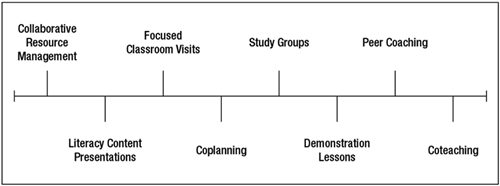
Last month, I talked about the importance of establishing and articulating a common vision at the beginning of each new school  year for the role of a literacy coach. After a vision has been shared, a coach often moves into developing and implementing a menu of service options he/she will offer throughout the course of a school year. One structure that offers a range of differentiated options is the Literacy Coaching Continuum outlined in Mary Catherine Moran’s book Differentiated Literacy Coaching: Scaffolding for Student and Teacher Success.


Of the options that this continuum presents, I find coplanning to be one of the more common ways I start my work with teachers and teams in the beginning of a school year or a coaching cycle. In my experience, coplanning can be a comfortable entry point for a coach’s work because it can feel less invasive, less personal, and overall less threatening than starting with conversations about instructional routines, practices, or philosophies. Also, I believe curriculum and planning are naturally on the forefront of teacher’s minds within the fall months, as many times teachers are still working on gathering their first pieces of classroom data, getting to know new grade levels, starting off in new positions, or even working with new team members. Finally, I also find coplanning to be a good place to start with those teachers who are having difficulty (or are reluctant to) articulate a purpose for the coaching cycle. Often, throughout the course of coplanning, questions, uncertainties, or frustrations will naturally arise. In this way, coaches can “tease” out a purpose for the coaching cycle through the conversations that originate during coplanning.


A coach can support teachers through coplanning in a variety of  ways, depending on the needs of their teacher or teams.. First, coplanning time might involve an examination of data; secondly, a teacher might work to align and plan a certain lesson or unit of instruction with a teacher or a team. In her book Differentiated Literacy Coaching, Mary Catherine Moran highlights the following four responsibilities for a literacy coach during coplanning. During coplanning, coaches may:
  • Coplan lessons and curriculum units with teachers based on a systematic study of teacher’s needs.
  • Work with teachers to align instruction to learning standards.
  • Set goals and plan lessons with teachers based on analysis of student assessment data.
  • Examine students’ ongoing performance data to identify needs, monitor progress, and modify instruction for struggling readers.

In my experiences, I have also used coplanning to work with teams in setting a protocol and structure for lesson plan writing, understand a new curriculum, tool, or resource, and lay out a systematic scope and sequence. As I mentioned above, these opportunities are especially useful for teams/teachers who have new members or new tools they are working to understand and implement. My recommendation is that coplanning occurs for a minimum of once a week up to five days a week, depending on needs and scheduling. I have found by setting aside a structured time for coplanning, acting as a collaborating member of a team or partnership, and following a structured protocol (for team planning or conversations) coplanning time is a very productive way for a coach to start off their school year. The coplanning process allows a coach to support teams or individual in building knowledge and a common vocabulary, it fosters a relationship of collaboration between the coach and the individual/team, and it helps set a purpose for future coaching opportunities. For these reasons, a coach can easily use the coplanning experiences to purposefully select additional tools or options from the coaching continuum to move into a new or deeper phase of coaching.

Friday, October 16, 2015

Defining Your Coaching Role

Carrie Sand contributed today's post.

Many literacy coaches land into a coaching position and find themselves answering various versions of the same question: “What exactly does a literacy coach do?” While coaches expect this question from people outside of the school system, I think we can be caught off guard when we encounter that question within the walls of our own buildings. Therefore, it is no wonder we, ourselves, can wonder, throughout different points in a school year, where our responsibilities as a coach begin and end.


In my experience, September is always a good time for a coach to address uncertainties and lay out a foundation for job responsibilities, even if the coach is in a returning role or building. Many coaches have a job description that is flexible in its written rules and requirements. The undeniable benefit to this flexibility is a coach’s ability to shape the role to best address the needs of the teachers and students in our school district or building. In addition, this flexibility implies an understanding and respect for us as a professional. I believe, however, different problems, including taking on extra duties, feelings of resentment or frustration from peers and colleagues, and not meeting the expectations of our administrator, may arise if we don’t work to build an understanding about our role as a coach from year to year.


Some of the guiding principles I use to shape my work as a literacy coach come from Cathy Toll’s book The Literacy Coach’s Survival Guide: Essential Questions and Practical Answers. Three of my own person philosophical beliefs regarding coaching come from the ideas Cathy Toll presents in this book. These include:


  • Coaching is a partnership between the teacher and the coach. Coaching only works in an environment of collaboration between peers and equals. Toll stresses the importance of keeping this relationship with teachers in the forefront of the coach’s role. While we all want to see student achievement raised, coaches work for and with teachers first. If an environment or situation threatens this balance of equals, a true coaching partnership can not occur.
  • Literacy coaching is different than being an interventionist, teacher, or Reading Specialist. While many coaches may hold one or more of these duties in conjunction with their coaching title, it is important to honor each job as a separate identity with different roles and responsibilities. Toll suggests that if 25 teachers is a full time coaching load, a coach who is only a certain percentage should only service a certain percentage of those teachers for a specified amount of time per day. A way to check your time as a coach is asking the following prompts: Am I in the correct % of my role? Am I getting to everyone on my coaching cycle equally? and Am I doing what I want to be doing to best serve both parties involved?
  • Coaching conversations are the most effective for creating change. Toll suggests that 50% of our time as coaches needs to be centered around the coaching conversation. She also says that the conversation is the secret to collaboration, as the teacher’s needs are the focus and all other aspects of coaching (demonstration lessons and professional development options) can grow from those conversations. Finally, Toll is firm in her belief that classroom observations have limited role in a coach’s job and should only be done for specific purposes.

Early in the year is the perfect time for a coach to be specific about their role in the building or district. Each year, I find my own duties to encompass new goals, changes, and expectations; I believe by being open and honest about the values I hold regarding what a literacy coach is and does, leaves less opportunity for misunderstandings and frustrations throughout the course of a school year.