Showing posts with label Relationships. Show all posts

Friday, May 20, 2016

I See You, I Hear You Final Thoughts: Validation

Meghan Retallick contributed this post. Click here for more of Meghan's thinking.

As I’ve traveled through my reflective journey on hearing and seeing others over the last few months, I’m left with one final thought--the heart of seeing and hearing others is rooted in validation.

Merriam-Webster states that “to validate” is “to recognize, establish, or illustrate the worthiness or legitimacy of.”  So in other words, when we hear and see others, we show with our own words and actions that they are worthy.  This brings me back to my original statement in post #1 that this does not mean that others always do as we ask or want, but that our actions and words are acknowledged and considered.

You are worthy.  You matter.  My time spent with you is not wasted.  These are all beliefs and ideals that I hope I show others in my daily actions whether it is through teaching, coaching, or collaborating.  But what happens when we feel as if we are validating others and yet no one validates us?

As I’ve thought about this over the last few months because of creeping and growing doubt about my own worthiness, a thought struck me.  Maybe how I validate others is not the same language they use to make me feel validated.  This thought came to me after lunch with one of my girlfriends in which we discussed the relationship book called The Five Love Languages by Gary Chapman.  The premise of this book is that we all feel love in five different ways, but each person has one of the five as the primary way we individually feel loved. The five possible languages are:  Words of Affirmation, Acts of Service, Receiving Gifts, Quality Time, and Physical Touch.  Yet sometimes there is a disconnect when we don’t speak the same primary love language as others we have relationships with.  The first book is written in terms of romantic partnerships, but this idea has since branched out into other books about relationships with our children and teens, in schools (grades 1-6), and workplace appreciation (I didn’t know this until I did research for this post, but now this book is on my to-read list!).  My love language is “words of affirmation,” so I feel appreciation when others praise me with words.  I find myself doing this often for the teachers I coach--giving them positive praise and encouragement verbally.  But, what if that isn’t their language?  What if my words to affirm them that mean so much to me, go on deaf ears because they aren’t in tune with the language I speak?  (I have noticed this in my own marriage as my husband speaks a different primary love language!).  What if others are showing me validation, but I’m missing the signs because they are not in the language I speak?

I think this has powerful applications in the workplace, especially in the form of coaching.  We want to be sure to see and hear how others feel validated, even if it is in a way that doesn’t work for us.  The first time I learned about validation and spent time reflecting on it was seven or eight years ago when this short movie entitled Validation went around my school district.  I share it with you now to remind us all that when we see and hear others we validate them with our words and actions.  We should also be mindful to the ways in which others are validating our work and remember that sometimes we could be missing validation if there is a disconnect in our communication styles.  I hope the end of the year brings joy and peace to you all as well as the knowledge that you are worthy and what you spent time doing this year matters.

Monday, April 18, 2016

I See You, I Hear You (Part 4): Missed Opportunities


Meghan Retallick contributed this post. Click here to read more of Meghan's thinking.

This post is part is the fourth in a series about building relationships with students:
  1. I see you, I hear you: Building Relationships with Students
  2. How do students know we see and hear them as readers and writers?
  3. Being Culturally Response = Seeing and Hearing Each Other

This morning I had an experience that took me by surprise.  One of my former students stopped in my office to visit--always something that brightens my day as I work more with teachers rather than students in this role.  This student was in my 9th grade English class for one semester two years ago, so he is currently in 11th grade.


He politely asked what my plans were for spring break (not big events--just pure relaxation!), and I returned that question.  His face became very animated as he talked about how his aunt had arranged for him and his brother to go to Ohio to visit a bunch of museums.  The one he was most excited about is the Armstrong Air and Space Museum.  This launched (ha ha…) us into a debate on the movie The Martian starring Matt Damon, and I just sat back with a smile as he expanded on what he knows and how much he loves learning about anything dealing with space.  After a 10 minute conversation, we wished each other well and parted ways.  But, I was left thinking about him the rest of the day.  I had no idea that he had that passion for learning about space.  He was a reluctant reader and writer and needed a lot of support when in my English class to stay engaged.  He had also visited me earlier this year after I observed his Environmental Science class through a coaching cycle.  When working in that class, I saw a very disengaged student and he shared that his multiple “Fs” in other courses kept him from playing hockey this season.  And yet, he will spend his entire spring break willingly and excitedly visiting museums and growing in his learning.


The overwhelming feeling I had was one of a missed opportunity.  Why didn’t I learn about his passion for space sooner?  I had never seen him as engaged and excited in conversation as he was this morning.  If I would have known this as his English teacher, maybe I could have channeled that passion into further learning.  How many other opportunities for growth had I missed with my former students because I didn’t take the time to see and hear them in casual conversation?  


I can’t change the past and obviously still created a positive relationship with this student as he still comes to visit me, but I take with me this small lesson in finding out who our students really are.  I remember that even when our minds are filled with so many other pressures and worries, taking the time to stop and listen to what drives them will drive us all to higher learning.  Creating authentic and engaging experiences that ensure student choice and can fuel their passions are always the key to creating amazing learning opportunities.  I move forward, more aware and on the look-out for these possible opportunities as well as sharing that awareness with the teachers I coach.


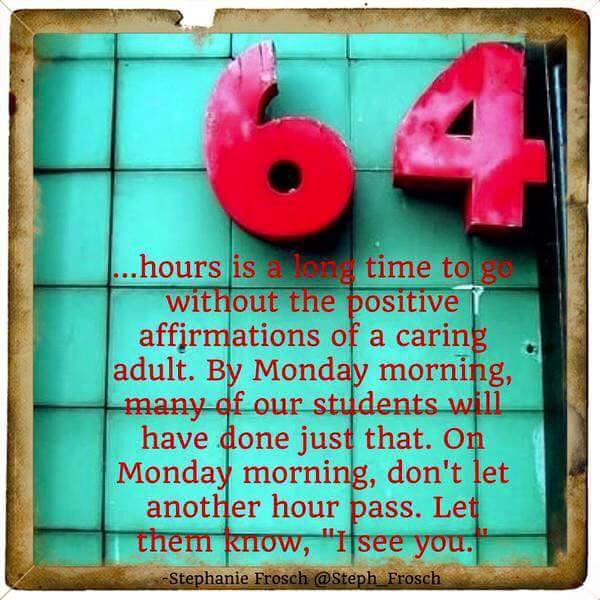
Last, but not least, since my last post in the series (see prior Parts 1-3), I saw the image below on Facebook and couldn’t help but see the connection to this series.  We never know when the opportunity will present for us to show students that we see and hear them and how much they might just really need us to do so.  It is our responsibility as educators to be vigilant about keeping our ears and eyes open, preventing missed opportunities.

12272_10154663260773677_4985141521542679907_n.jpg

Friday, April 15, 2016

What Students Need From a Secondary Reading Intervention Class...Unfortunately, It’s More Than Just Reading!

Carrie Sand contributed this post. Click here to read more of Carrie's thinking.


As a secondary interventionist in addition to my coaching role, I am always thinking about what works for struggling readers at the high school level. So...what does work? As evidenced by the lack of intervention options and resources available, no one really knows.  A post from a blog I subscribe to titled “When We Harm Rather Than Help-Some Thoughts on Reading Interventions” recently re-started my thinking on this topic.


In my experience, any intervention at the secondary level has its challenges. Assessment upon assessment has repeatedly reminded some students that they are “not proficient”, or in the “lowest percentile”, or not “college ready.” It is no wonder that as a result, many become disenfranchised with the experience of school. As a teacher working closely with high school students who struggle with reading, I’ve begun to think about the role of emotional intelligence within the secondary reading intervention classroom.


In recent years, terms like grit and perseverance have become popular in the world of education. I jumped on the bandwagon and started reading the books Mindset by Carol Dweck and Drive by Daniel Pink. Each of these books talked about totally different concepts, one about mindset, the other about motivation, but each made me think about the students sitting in my intervention classrooms. I especially thought about how the ideas I was reading about in these books were exactly the types of skills these students needed the most.


As I’ve done more exploration with emotional intelligence, I’ve come to learn that the traits often synonymous with success: conscientiousness, grit, perseverance growth mindset, are all malleable traits that respond to teaching. I wondered that if I could teach emotional intelligence within my classroom, in addition to the reading skills, what benefit would my students get?


So I tried it out throughout the first semester of this school year. I grounded my practice in the research of people like Dweck, Pink, and Angela Duckworth. As it is hard to determine exactly if teaching emotional intelligence was the cause, I will say that each of my students saw more growth than usual in standardized assessments and classroom grades. More importantly, students expressed through conferring that they often thought (in a variety of classrooms!) about certain strategies, such as positive self-talk and growth mindset approaches.


As a teacher working with high school readers who struggle, I think it is my duty to recognize the fact that students enter my classroom with more than just challenges in reading. While I know teaching emotional intelligence is not the magic answer to addressing students’ reading needs, by teaching these skills,I feel I am recognizing and responding to the needs of my student as person, not just a struggling reader.


Here are some resources that really helped shape some of my work in the classroom:


Growth Mindset Lesson Plan and Videos by Khan Academy:


Ted Talks:
The Power of Yet by Carol Dweck:


The Key to Success? Grit by Angela Duckworth

Friday, February 19, 2016

I See You, I Hear You (Part 2): How do students know we see and hear them as readers and writers?

Meghan Retallick contributed this post. It is the second part in a series. Click here for the first post.


My reflection around this question has grown in the last two months as a coaching cycle has developed into a full-scale action research project.  A few months ago, I began working with a high school social studies teacher to incorporate supports for struggling readers within in his 9th Grade Global Studies course.  We decided to try a push-in model of support by conferring with readers during the independent reading time he has incorporated into his class structure.  First, I cannot give him enough “props” for taking a risk three years ago and incorporating independent reading time into his classes.  Now all Global Studies teachers have used this model, so each freshman in our high school has this as a part of their Global Studies experience.  Our coaching goal is to refine this process and support students who are struggling with motivation, stamina, and engagement.


After reading Cathy Toll’s book on coaching, I decided that the opening conversation with students should take a similar approach as I get to know them as readers.  You can read my post from last month to find out what happened when I first introduced myself to students.  I do not have a daily relationship with them, so my questions must be ones that allow me to learn about who they are and direct our focus for conferring.  The two questions I opened with were:
  • How do you view yourself as a reader?
  • When you think about your success in reading, what gets in the way?


An amazing thing happened in the very first interview.  This student is one that has been talked about in teachers lounges as unmotivated, edgy, and sometimes defiant.  When I asked her these questions, she didn’t even bat an eye as she went into a detailed description about the differences for her as a reader outside of school vs. inside of school.  Her comments were living proof of all the research I’ve read about adolescent reading motivation.  Here was a student who has been written off by many tell me that her and her friends spend hours writing through an app, critiquing each other's work and publishing their work online.  She certainly sounded like a motivated writer to me!  


She shared her story in such a way that I could not capture in writing and do her justice, so she inspired me to take the next step in my conferring process--to audio record all my conversations with students.  This led to conversation after conversation of insights from students.  I still can’t believe how asking two simple questions opens the door to these conversations.


My work now is to put this together in a format to share with a large audience.  I was sharing my plan with a few other teachers from the high school and the assistant principal the other day.  The assistant principal asked me if most of the responses I heard from students were that they viewed themselves negatively as a reader.  I, surprisingly, have found that this is not the case.  Many students consider themselves to be okay readers if they are reading about something interesting to them.  What was clear to me from the interviews I’ve done is that many students don’t understand why they are reading what they are reading.  The purpose is unclear.  I was also surprised by the number of students that labeled themselves as lazy and unmotivated when it comes to school reading.  As one student said, “I know I could do more as my teacher tells me all the time.”  My response was, “What do you think is keeping you from doing more?”  This is the heart of what I would like to uncover with my continued interviews and research to find better ways to support both students and staff in increasing reading motivation.  


My biggest take-away from the initial start to this process is that two simple questions unlocked all of this thinking and further research.  In the first interview with students, those questions allow me to truly hear and see them as readers.  We can grow from that first meeting to set a goal and monitor their progress together.


As I continue this research, I can’t wait to see where it leads.  Look for more in my coming posts on how being culturally responsive fits into this process.


How do you show students that you see and hear them as readers and writers?

Monday, January 18, 2016

I See You, I Hear You (Part 1): Building Relationships with Students

Meghan Retallick contributed this post. Click here for more of Meghan's thinking.

Between my reading for my graduate courses, the professional development sessions I’ve attended, and the online reading I’ve stumbled upon (See: See Each Other:  A New Year’s Resolution for 2015), one big idea has taken up space in my brain this month:  How do we show others that we see and hear them?  For this month, I’d like to reflect on how this happens when we first build relationships with students.  I’ll be continuing this idea in future blog posts :)


First, I’ve realized that all we really want, whether we are a teacher, student, coach, child, parent, spouse, administrator, etc., is to feel that we are seen and heard.  This does not mean that others always do as we ask or want, but that our actions and words are acknowledged and considered.


So, how do we show students that we see and hear them the very first time we meet them?  An interesting experience inspired by professional development with Laura Gleisner, an ICF certified life and leadership coach, helped give me some insight into this.  In her session, she used an activity to promote positive culture.  We all shared our 180 Song--a song that when you hear it, immediately elevates your mood, turning your outlook around 180 degrees.  Sharing the songs in small groups served two purposes:  1)  The mood of the room immediately lifted as people shared their songs.  2)  We were able to gain some insight into individual’s personalities, thus seeing and hearing a piece of them, when learning their 180 Song.


Shortly after this, a colleague expressed interest for my support within his ninth grade Global Studies class.  We came up with a plan to support readers in his neediest class period that would have me co-teaching 1-2 times a week.  The first step in this process would be establishing a relationship with these students, many of whom don’t see themselves as readers.  I knew that before I could have open conversations with them around their reading behaviors, I needed them to see me as a regular part of the classroom, even though I’m not there daily.  We were a few weeks into the school year and this class had already established a culture.  What I noticed in my first few minutes of this class was, first, even though many students seemed disengaged from the learning process, they loved and respected their teacher.  Second, when I was introduced as a reading specialist/literacy coach, many openly expressed their dislike for reading, i.e., there was a lot eye rolling going down.  


[Side Note:  Something important to know about me is that I love eye rolling!  Maybe this is why teaching eighth grade is my favorite?  I see an eye roll as a challenge--a challenge for me to figure out what will engage the person rolling their eyes at me, a challenge to build a trusting relationship with someone who has different viewpoints from my own, a challenge to push us to grow in our learning together.  My most common response when seeing someone roll their eyes at me is some version of the following statement (tailored to my audience):  “I’m sensing some discomfort.  Please be open with me about how you are feeling.  I want to know your true thoughts on this because then we can figure out a way to approach the situation together and in a way that makes us both feel comfortable.”]


So, back to the ninth grade class groaning and rolling their eyes at me…


After explaining my role, I made clear that the purpose for my visit today was to get to know them.   All they had to do was think of their 180 Song and I would be checking in with them during the class period about it.  I’m sure I made a fabulous impression on them when I shared my current 180 Song--”Bad Blood” by Taylor Swift.  I then spent the whole class period walking around the room, stopping by students to meet them, learn their name, and ask them the title and artist of their 180 Song.  I then wrote it down in my notebook.  That was it.  No hard questions about their reading habits, likes and dislikes, etc., just their name and 180 Song.  The conversations all were short, simple, and went well--except one.  When I met Cole (name changed), he was talking with his neighbor when he was supposed to be reading, he didn’t have his materials with him, and he answered my questions with questions while giggling, trying to impress the girl near him.  The conversation was pretty much a wash, but after repeating myself calmly a number of times, I got his 180 Song and name out of him.  I could have gone into a lecture on what he was supposed to be doing; I could have asked him to treat me with respect; I could have addressed the girl he was giggling with, but I didn’t.  I wrote down his name and the song and thanked him, knowing a little more about Cole than just those two things.  At the end of the class period, I announced to the whole group that my goal was to listen to each one of their songs by the next time I was in class.  This statement was also met with a lot of groaning and eye rolling.


So then, I listened to the songs, paying special attention to Cole’s song.  It was a challenging song to listen to, and very different from my musical tastes, but I worked really hard to figure out one positive thing to say about it in case the time came to share it with Cole.


A week flew by and I found myself back in Cole’s class.  The goal for my work today was to help the students pick independent reading books.  (You might be asking yourself, “Independent reading books in Global Studies class?”  More about the exciting things our Global Studies teachers are doing in future posts!)  We were meeting in the library, and I was going to support them in their book selections, reading along with them for the class period.  Before we dispersed to find books, I told everyone that I listened to their songs.  Cole immediately perked up in his seat, and stated, “Even mine?!  What did you think?”  Thankfully prepared, I answered, “Yes, I did!  At first it was really mellow and then it got really intense.  That is quite a song!”  A look of awe came over Cole’s face that I can’t explain.  I, meanwhile, was doing a mental fist pump.


About twenty minutes later, as I chatted with a group of girls about their book selections, I felt a presence behind me.  I turned around and came face to face with Cole.  I looked over his shoulder and saw a group of his friends goofing off in the corner of the library, but then asked him if I could help him with something.  He mumbled that he needed a book.  I asked him about his reading interests and if he was looking for longer or shorter texts, and he mumbled back that shorter would be better, never making eye contact (can those of you familiar with adolescents picture this?!).  I escorted Cole over to the magazines as I thought that this would be a good type of text to start with.  This also helped him get out of the direct eyesight of his friends (still goofing off in the corner).  Once we got to the magazines, I asked him about his hobbies and the floodgates opened.  In the next five minutes I learned that Cole lives with his dad on acreage in the country, loves hunting and dirt biking, struggles with staying focused while reading, gets frustrated in school, misses his mom, and is fairly new to the area.  Cole walked away with a dirt bike racing magazine and settled in a corner away from his friends to read.  I, meanwhile, was mentally dropping the mike and walking off stage.  Just kidding, I was in shock at what had just happened!


Did I cast some magical spell over Cole that made him want to spent the class period engaged in reading?  I literally knew the kid for five minutes and he did today exactly what we expected and wanted after being the most challenging student last week.  How could this be?


My theory is this:  By listening to Cole’s 180 Song, I saw and heard him.  The relationship of trust began to build on something that simple.  I took three minutes out of my day and listened to a song that hurt my ears, trying to find something positive to let Cole know that I found value in his song choice.  For three minutes, I saw and heard him loud and clear.  And, to be honest, what I learned from those songs about all the students helped me understand them more deeply than I expected.  It has become a starting point of conversation many times as I continue to work in the classroom.


I wish I could tell you how Cole is doing now, but he moved away two weeks after this conversation.  Would he have continued this trend if he had stayed?  Would our relationship have grown to support deeper conversations around his challenges with school?  I don’t know, but I’d like to hope that it would have.  I hope wherever he is, the idea of a 180 Song has stuck with him.


And, I hope the idea of asking people about their 180 Song sticks with you!  Who knew such a simple question could be a foundation for great relationships?  Thanks again for this golden nugget, Laura!


So, I leave you with two final questions:


  • What is your 180 song?
  • How do you show students you see and hear them when first building a relationship?

P.S. - My current 180 Song is “Alive” by Sia.  When things are so challenging, it is so important to remember that “I’m still breathing...I’m alive.”  It is dance party time whenever I hear this song!

Friday, November 27, 2015

Principals as Literacy Leaders

Julie Schwartzbauer contributed today's post.


"Through a lifetime of working in schools, one of my most powerful insights and core beliefs is that teachers must be leaders, and principals must know literacy.  Without a synergy between literacy and leadership and a committed, joint effort by teachers and principals, fragile achievement gains do not hold."
Regie Routman


I am very excited to share some great work we are doing in Appleton.  

If you are a literacy coach, you know who Regie Routman is.  And if you understand the importance of principal as instructional leader you have read her latest book Read, Write, Lead.  


Recently, I was fortunate enough to attend a dessert and conversation with Regie where participants engaged in an informal conversation regarding school change strategies, challenges, and successes.  One of the big Ah-ha's that came out of that evening was related to sustainable change and how the principal and literacy coach must work collaboratively to fully support teachers.  


In working as a district literacy coach in Appleton, I have learned that while  all principals come into their position with a vast array of knowledge, their background does not always include a foundation in literacy.  According to Regie, “without deep knowledge about literacy, principals remain restricted in their quest to raise reading and writing achievement across a whole school.”


Recently, three of our principals expressed interest in participating in ongoing professional collaboration with their building literacy coach.  Their goal is to increase expertise in literacy and create a solid infrastructure in their school.


Appleton Area School District is large and it takes time to build sustainable change.  It is our hope that by using Regie’s book as a starting point, with just a few schools, we will be able to move the connection between literacy and leadership to the forefront.  We will meet monthly with the three principals and their coaches, to lay the foundation which will lead to more effective literacy instruction, and ultimately accelerate and sustain student achievement.

Monday, February 24, 2014

How Do I Get in the Classroom to Model Lessons?

Today's post is brought to you by Jaimie Howe.

Every month I collaborate with each grade level (K-5) in my building.  These monthly grade level meetings have come to be a sacred time for me.  It is a time in which I can solely focus on one particular grade level and give them my undivided attention in the area(s) that they need support in the most.  Over the past three years, I have realized; however, that I am only able to scratch the surface with this one half hour time slot per month.  I am able to share new ideas and research and get the teachers excited about new materials and ideas; however,  that is, unfortunately, as far as it goes.  I can give my teachers as many resources as I want and they can ‘want’ to use them and integrate them as much as I want them to, but the reality of a classroom teacher’s life in today’s world, is chaos.  They ultimately DO NOT have any extra time to read and ‘figure out’ how to try these new things.


As literacy coaches, we talk all the time about how hard it is to get into classrooms and get teachers on board to try new things.  We struggle to reach all teachers and all grade levels.  I truly believe that one of my top priorities as a literacy coach is on-going professional development.  I have struggled to figure out my role as a literacy coach over the last three years and find ways to provide this on-going professional development. Over the last three months of this school year, I have acquired some pretty huge realizations and am finally feeling like I am a true literacy coach.  I believe my role has evolved and that in everything we do it takes time to feel comfortable and confident in the roles we are in.


These are the realizations I have had that cause me to believe that I am now a true literacy coach.


1. I have taken the time to establish relationships.  As I began my role as a literacy coach three years ago, I dreaded my 4th and fifth grade collaborations.  I wasn't confident with these grade levels since my experience had all been in PreK-first grade.  On top of that, I didn't know the teachers well and was new to the position.  The last two months, as I walked away from from my fourth and fifth grade level collaboration meetings, I had a smile on my face.  I felt excited, rejuvenated, and confident.  These are now two of my favorite grade levels to work with.


2. I have made collaboration a non-negotiable: This is the only permanent time I have with each grade level to share and plan.  If I have to cancel a collaboration meeting, it is rescheduled.  As I stated earlier, though, these collaboration meetings are not enough.  I use this time to share new ideas, get teachers excited, and now I make sure that I plan for a time for me to come into the classroom to show them how to use or implement the new material, skill, or strategy.  I have made it clear to teachers that I am their support and resource.  I may not be the best at using the new resource, but I take the time to learn about it and plan for the teaching, so the teachers don’t have to.  This has been probably the largest realization for me - if I can take the pressure off of the teacher and just come in and show them how something is used- this isn’t degrading, it’s helpful.  I do not force any material on teachers.  I merely say, “Hey can I come in and show you how this works?  If you think it would benefit your class, great!”


3. I am in the classrooms frequently: Just last week I was trying to schedule a classroom lesson with a fifth grade teacher.  I had to use the line, “I’m now booking into March for classroom visits, what day/time would work best for you?”  I had to laugh.  I felt like I was scheduling appointments at a doctor’s office.  What an amazing problem to have . . . a full schedule of classroom visits providing on-going professional development.

My advice to you is, take your time, build relationships, and collaborate.  All of a sudden, you will find yourself a permanent fixture in the classroom and believe me, it is such a GREAT feeling!

Tuesday, February 18, 2014

Nature, Nurture, and Collaboration

The next few posts are "Coach's Choice." Each coach selected what she wanted to write about.

Today's post is brought to you by Barb.

In preparing for a meeting that had the potential to be, um, very challenging, a most-favorite (and very wise) colleague reminded me that collaboration is a learned behavior. She was suggesting - in a soft and helpful way that she is a master at - that the meeting might be more productive if the group learned how to collaborate.

This quick conversation has spiraled me into thinking a whole lot about exactly how people learn to collaborate

For a chosen few, it does seems natural; collaboration can be a function of nature. We all have those people in our personal and professional lives who just know how to function on a collaborative team. Maybe it's a function of being a middle child. Maybe it has something to do with their zodiac sign. Maybe it's genetic. Maybe it's the result of many years of therapy. I'm not sure. I am sure, though, that I appreciate having the "natural" collaborators as part of my team.

It seems, though, that for many people - me included! - effective collaboration is more a function of nurture than nature. Collaboration is something we learn to do. How, though, do we learn?

We can learn to collaborate by observing those around us. We watch others for cues about expected and accepted behavior and language, and we mimic their behavior. It's a way to be part of the group, and a way to help the group continue moving forward. 

What happens, though, if what we observe and mimic is not productive? Worse yet, what happens if it's toxic? 

I would argue that learning to collaborate needs to happen through explicit teaching and learning.

I have been part of more meetings than I can count that were dedicated to learning to collaborate. Primarily, these meetings were about establishing norms. I'm part of one group that even prints the norms on the back of each team member's nameplate, so the norms stare at the person through each and every meeting. The sad truth, though, is that the team with the nameplate norms rarely follows those norms!!

How, then, do we explicitly learn to collaborate successfully? I recommend a professional learning module - Facilitating Learning Teams - from Learning Forward. I used the module with a struggling learning team with great success. The team established norms, discussed potential challenges to those norms, and were explicit about communication expectations. 

The team also devised a meeting schedule that included specific times for checking-in on application of its norms and procedures. (That's right - there are regularly scheduled meetings about how the meetings run.) Those meetings - which include equal amounts of celebration and honest feedback -  keep the team honest and committed to its norms and procedures.

Explicit teaching and learning about collaboration helped that team be more productive and healthy (nurture over nature).

Thursday, October 17, 2013

How do you build a relationship with an administrator?

Today's post is brought to you by Lisa Weiss.


When I think back to some of my most successful relationships with administrators, they were with administrators who were up front about literacy not being an area of strength for them. I appreciated that honesty—both times when it happened--because as coaches, we need to remember that most administrators started out as teachers, and it is likely that they had a focus area, and it may not have been literacy. The honesty and vulnerability it takes for a building leader to say, I need help in this area, is great because it allows for the element I think is key in building a relationship with an administrator: vision.

In both situations where my administrators were uncertain about what a literacy-focused school improvement goal should look like, I was able to provide the vision—the big picture, the details, the accountability measures, and the celebrations. The best part about having a hand in creating the school plan is that there were places where I could set up all-staff sessions, break out sessions focused on the literacy goals each teacher set for himself/herself, and small group and individual coaching sessions. The plan was heavy on coaching—I was responsible for much of the load, but since it was my vision, I had to accept responsibility for the action in carrying out the vision, using the administrators for support (and to send the administrative messages); using the teacher leaders on the school literacy team to provide professional development alongside me. Through the entire process of implementing the vision, I was coaching the administrators and developing teacher leaders in the literacy team while providing job-embedded professional development for the teachers!

Having a vision is important, but a vision without action and accountability is simply a good idea. I think these two pieces—action and accountability—also are administrator dazzlers. Beyond providing the long-term and short-term vision, are the steps to getting to the end goal! Administrators need to see that you can carry out the vision, that you can work with people, and that you can work through challenges. When they see you doing what you said you’d do, and seeing the results of what you do, they become believers that a school cannot thrive without a literacy coach! It is important to make the time to meet with your administrators so you can talk about progress and difficulties, so that 1) they are crystal clear on what you are doing, 2) they can support you through the mud when you are stuck, and 3) they can celebrate the small successes with you along the way.

When you can provide a vision, and show that you have the ability to gently lead teachers in the direction of the goal, your administrators become your cheerleaders! And let’s face it, literacy coaching is tough work-- we could all use a cheerleader!

Wednesday, October 16, 2013

Building Relationships with Principals

Today's post is brought to you by Bobbi Campbell.


As I began to think of ideas for this blog post, I struggled to choose an approach that would speak to readers.  My first idea was to write about the twelve principals I work with, comparing each one to a well-known cartoon character. The idea was to highlight their strengths as an instructional leader, while comparing them to the trait of the carefully chosen character.  I knew I was doomed from the start when my first cartoon character I chose was Homer Simpson.  No matter how much I love Homer, I am not sure it would send the right message. Therefore, I began thinking about other ways to write about the complexities of building relationships with principals – especially when there are twelve of them.
First, I started my walk down memory lane thinking about all the principals I have worked with as teacher and now coach. Why did I have a better relationship with _________ than I did with ___________.  I began to wonder about the commonalities among the principals of whom I forged strong relationships.  What was it about them that so many people, including me, felt it easy to build and keep productive and beneficial relationships with the leader of the building?
I cannot move forward without mentioning my very first principal, Vincent Maloney. We still exchange holiday cards, even though we have not worked together in over 18 years. He no longer serves in this grand profession but will always hold a special place in my heart and has definitely made a lasting impression on my approach to building relationships with principals.  Unfortunately, he spoiled me for all the rest…
The qualities he possessed made it easy to build a strong professional and productive relationship.  He shared many characteristics outlined in an article by GreatSchools, 2013.
1. Great principals take responsibility for school success.
Vince Maloney knew how to do this, while making everyone in the building responsible, too.

2. Great principals lead teaching and learning.

This was not his strength so he relied on key staff that could help him lead.   
3. Great principals hire, develop, and retain excellent teachers.
I think this was his strongest asset as a building leader. He empowered his teachers and coaches in the building to lead and be instructional leaders whenever he could.
4. Great principals build a strong school community.
Vince knew that building a strong school community meant he had to have relationships with his teachers.  He was invested in knowing his staff personally as well as professionally.  He knew that by doing this, he would build safety and trust within his staff so that he could have the hard conversations.  It was always a problem/solution based conversation.
So how does sharing my story help guide other coaches in developing relationships with principals?
I believe knowing how your principal sees himself or herself, regarding the four characteristics mentioned, will help guide you to a reciprocal and productive relationship. Reciprocal in respect, but also trust – the foundation of leadership that fosters growth in staff and students.
Depending on your situation, you might come right out and ask your principal’s opinion about the four characteristics every good principal share; however, most of us will not feel comfortable handing our principal a piece of paper outlining the four characteristics. Personally, I like the direct route, but I have found that is like playing Russian Roulette– some respond favorably, and some need a little more time to adjust to a 5”2  energetic (some say overly enthusiastic) short lady with attitude.
Instead, the more reasonable of us will have to take the other route – be patient and collect data as you observe your principal in action.  Use the characteristics as a guideline for collecting data to be used as a catalyst to spark conversations.  Knowing how he or she sees himself or herself as leader, will help you understand how your principal sees you as instructional coach in your building.  Ultimately, this will guide your work together, creating a true learning community.  
My repertoire of skills has hit an occasional brick wall. I am having a bit of bad luck with two of the twelve principals I work with, so I challenge you, readers, to share your trick, approach, or magic of how you successfully won over YOUR Principal Ed Rooney (Principal in Ferris Buehler’s Day Off).