Showing posts with label Intervention. Show all posts

Thursday, May 4, 2017

Intervention/Classroom Connection

Jaimie Howe contributed this post. Click here to read more of Jaimie's thinking.

Providing interventions and coaching all in one day has always been a struggle for me since I began this journey six years ago.  I have come to realize, however, the power of combining both of these roles.  


With the implementation of the new Lucy Calkins's Reading Units of Study this past fall, I have found myself extremely involved in the planning and teaching of these new units in several grade levels. This close involvement has improved the success of my intervention instruction greatly. The connections I can make for students during intervention to what they are currently doing in their classroom has been invaluable.  


One of the largest benefits I have realized, is my ability to use common language to support the transfer of skills from intervention to the classroom. For example, in first grade, students learn to be “word detectives” and are taught specific language for using strategies.  In kindergarten, students learn that they have superpowers (sound power, pattern power, picture power, etc.)  and are “super readers”, so this is the language I incorporate into my interventions with these kids. I have linked two bookmarks that are used in the classroom that I incorporate into my interventions to create common language. They have worked wonders to support our students.


Thursday, April 6, 2017

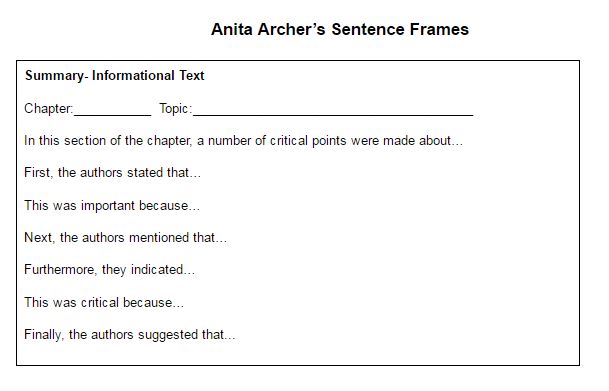
Anita Archer’s Sentence Frames

Maggie Schumacher contributed this post. Click here for more of Maggie's thinking and writing.

The following sentence frames were shared by Anita Archer at the RtI nnovations Conference in October, 2015. Anita Archer recommends the use of sentence frames as a way to give students a framework to support thinking and writing and to encourage the use of content vocabulary in writing. Sentence frames can also be used to provide scaffolding for academic language; teachers can post academic language starters in an anchor chart for students to see when having academic conversations in class.

Click here to access a template with many sentence frames.

To implement sentence frames, you first develop a frame for the type of writing you’re asking your students to complete (see examples attached). After you have the frame, you model how to use the sentence frame with your students; after, students will use sentence frames to construct their own writing. This scaffold can be very helpful for students who struggle with basic writing skills and structure. Over time, as students become stronger writers and internalize this type of academic language and structure, you would slowly fade the use of sentence frames during instruction until students can write independently.

Friday, April 15, 2016

What Students Need From a Secondary Reading Intervention Class...Unfortunately, It’s More Than Just Reading!

Carrie Sand contributed this post. Click here to read more of Carrie's thinking.


As a secondary interventionist in addition to my coaching role, I am always thinking about what works for struggling readers at the high school level. So...what does work? As evidenced by the lack of intervention options and resources available, no one really knows.  A post from a blog I subscribe to titled “When We Harm Rather Than Help-Some Thoughts on Reading Interventions” recently re-started my thinking on this topic.


In my experience, any intervention at the secondary level has its challenges. Assessment upon assessment has repeatedly reminded some students that they are “not proficient”, or in the “lowest percentile”, or not “college ready.” It is no wonder that as a result, many become disenfranchised with the experience of school. As a teacher working closely with high school students who struggle with reading, I’ve begun to think about the role of emotional intelligence within the secondary reading intervention classroom.


In recent years, terms like grit and perseverance have become popular in the world of education. I jumped on the bandwagon and started reading the books Mindset by Carol Dweck and Drive by Daniel Pink. Each of these books talked about totally different concepts, one about mindset, the other about motivation, but each made me think about the students sitting in my intervention classrooms. I especially thought about how the ideas I was reading about in these books were exactly the types of skills these students needed the most.


As I’ve done more exploration with emotional intelligence, I’ve come to learn that the traits often synonymous with success: conscientiousness, grit, perseverance growth mindset, are all malleable traits that respond to teaching. I wondered that if I could teach emotional intelligence within my classroom, in addition to the reading skills, what benefit would my students get?


So I tried it out throughout the first semester of this school year. I grounded my practice in the research of people like Dweck, Pink, and Angela Duckworth. As it is hard to determine exactly if teaching emotional intelligence was the cause, I will say that each of my students saw more growth than usual in standardized assessments and classroom grades. More importantly, students expressed through conferring that they often thought (in a variety of classrooms!) about certain strategies, such as positive self-talk and growth mindset approaches.


As a teacher working with high school readers who struggle, I think it is my duty to recognize the fact that students enter my classroom with more than just challenges in reading. While I know teaching emotional intelligence is not the magic answer to addressing students’ reading needs, by teaching these skills,I feel I am recognizing and responding to the needs of my student as person, not just a struggling reader.


Here are some resources that really helped shape some of my work in the classroom:


Growth Mindset Lesson Plan and Videos by Khan Academy:


Ted Talks:
The Power of Yet by Carol Dweck:


The Key to Success? Grit by Angela Duckworth

Wednesday, February 24, 2016

Comprehension Focus Groups: Using Reciprocal Teaching within the CFG

Heather Zimmerman contributed this post. Click here for more of Heather's thinking about comprehension focus groups.

October 2015 Hot Topics at UW-Oshkosh had Lori Oczkus as a keynote speaker.  After hearing her passionately talk about different strategies during her keynote, I was hooked and decided to stay for a session she had about reciprocal teaching.  I had heard of reciprocal teaching, but never implemented it in my classroom.  But after hearing Oczkus talk about the power of reciprocal teaching, I knew I had to implement it in my next Comprehension Focus Group (CFG).


I thought my 7th grade group would benefit from Reciprocal Teaching the most.  I decided to use a graphic organizer- though she showed us this cool way to tear paper and use a sheet of paper.  I opted for a bit more writing space for my middle school students.  This was used during the informative unit where my students did some reading on the Middle Ages (before they started in social studies class).  


Oczkus talked a lot about puppets for the different roles, which I did not think my middle school students would find “cool”. I did use the Quincy the Questioner idea though- without the puppets.  My middle school students seemed to enjoy the idea of quizzing their friends.  


I thought using Reciprocal Teaching was effective in the CFG.  It provided an opportunity to review summary writing, and also through the “Clarifying” component, students were able to capture questions they still had for further research in phase 3 of the CFG.  

For those of you who are using CFGs, what graphic organizers or strategies have you found success with?

Friday, March 6, 2015

Comprehension Focus Groups: Deeper Thinking

Heather Zimmerman contributed today's post. More of Heather's posts about comprehension focus groups can be found here.


Donalyn Miller and Chris Lehman.   These are the two people I saw at Wisconsin State Reading Association's (WSRA) annual convention that got my mind rolling in a million different directions thinking about their ideas and how I was going to implement them.  Are you ever listening to a speaker and hear things that are so obvious, but yet you question if you do them or wonder why you never thought of that?  I had some of those moments.  And, I also had those moments where I was thinking, “Wow, that is brilliant!”


I could go on and on about my learning from the two of them, but in this blog, I am going to focus on some key take-aways from Chris Lehman’s session titled, “Making Reading Visible: Writing about Reading that Promotes Deep Thinking and Student Growth”.  The take-aways I am going to share, I plan on using in my Comprehension Focus Groups (CFGs).


Lehman focused on deepening thinking and pushing learned.  He talked about deepening conversations and also ways to deepen students' thinking in writing.  One idea he shared to help with this process is to think about leveled books and the characteristics of books at a certain level.  He encouraged teachers to think about this and also to see how this lines up with standards.  To show his thinking on this process, he asked, “What do different bands have kids do?”  Here is an example that he shared:


  • N, O, P, Q (P= Magic School Bus)
    • Main character (lots of times one, sometimes a few)
    • Characters don’t change (sometimes their feelings do, but not them)
    • Lots of support with setting


  • R, S, T (T= Diary of a Wimpy Kid)
    • Complex important setting
    • Secondary characters are important


  • U, V, W (U= Wonder V= Harry Potter)
    • Complex characters
    • Changing setting


(I included the title examples, so if you are not familiar with Fountas and Pinnell’s leveling system, you could still get a general idea with the titles.  Most levels I looked up on Scholastic’s website.)


Lehman points out that this thinking can tie back to the feedback teachers give students.  He shared that teachers can read student writing and think what level are the students writing towards. Sometimes their thinking shown through their writing might be lower than their text reading.  If this occurs, Lehman suggests saying, “Can I teach you something?  I know something about this book that…”


This was one of those moments when I was thinking how obvious this is, but how brilliant.  I have a general idea of what happens at different levels of texts, but never thought about it in this specific way.  I feel if I think about texts in regards to the leveled bands and then focus (when needed) on character and setting that will really help me push my students writing and thinking about the texts they are reading and writing about.

Friday, February 27, 2015

I'm a Struggling Reader

I'm in school - I'm always in school. Right now, I'm taking a course about quantitative research - specifically, advanced quantitative research. And, friends, I can't lie. It's hard. It's crushingly hard.

Every single week (multiple times each week, actually) I am reminded that I am a struggling reader. Scratch that. I'm not just a struggling reader; it's more than that. I'm a struggling learner.

The reading assignments for class go something like this:

Step 1. When I can't possibly delay the reading assignment any longer, I create the perfect conditions for reading. This usually involves a food-related incentive schedule and lots of self-talk ("If I read two pages, I can have a square of chocolate" or "I will treat myself to an afternoon at a coffee shop and a whole milk latte while I read this assignment.")

Step 2. Read two paragraphs and declare that I cannot possibly do this. Go on the internet to review the drop deadline for the course. Remember that I can't drop the course without significant consequences for my checkbook and transcript. Chastise myself for immediately wanting to give up. Remind myself that I'm not a quitter. This step is generally repeated multiple times throughout the reading process.

Step 3. Get serious about reading the assignment. I've noticed this involves a few strategies:

  • Skip many, many words, sentences, and paragraphs while looking for sentences with words (instead of numbers and other symbols) that have main ideas. Underline these even if I don't understand them.
  • Keep a list of terms and symbols that I don't understand. Sometimes I Google these right away; sometimes I just write them down. It depends on how frustrated I am.
  • Resign myself to not understanding much of the text. Be okay with that.
  • Text a friend. Sometimes to bemoan how awful the reading is - sometimes to ask a question. I've even texted pictures of the text to my own personal mathematics coach.
Step 4. Do some work after reading. This usually involves that personal mathematics coach I mentioned earlier. I see him and immediately teach him anything I managed to understand from the reading. He gives me real-life examples and clarifies.

Step 5. Reflect on what would have helped me be successful with the reading assignments. I realized that I really need:
  • Vocabulary lessons. It's all Greek. Seriously. Greek. I don't know what to call any of the symbols (I make up names for them based on what they look like). There isn't a glossary in any of the texts. And that's just the symbols. There are also lots of real words. I don't understand those either.
  • Learning targets. When text is difficult, I need some statements to tell me what I'm supposed to know, understand, and be able to do after I read. I don't just need targets for each text; I need targets for the course, too. I have no idea what the big ideas are and no clue how they fit together.
  • Discussion. Time to talk. Collaborative conversation. I don't need a protocol or a role sheet or teacher-provided text-dependent questions. I just need some time to talk to my peers, hopefully, peers that are knowledgeable about the topic.
Despite the fact that I'm a smart and capable person,  I'm a struggling learner in this environment, this context. 

This experience has reminded me that I don't struggle very often. In fact, I've realized I struggle so little that I don't even know how to do it! I haven't mastered much (or really any!) content of the course, but I've learned a lot about who I am as a reader and learner. 

And, for this reason, I encourage you to struggle. Find a really difficult concept you know nothing about it and study it - not just for a couple of sentences or a quick Google search, really study it. Notice what you do to understand. Notice what supports would have been helpful to you. Notice how you feel. Then, change something - something about yourself or something about how you work with students or adults - because of your experience.

Monday, February 16, 2015

Comprehension Focus Groups: Using Leveled Texts


Heather Zimmerman contributed today's post. All of Heather's posts about implementing comprehension focus groups with middle school readers who are struggling can be found here.

As I have been talking with others about my experiences this year with implementing Comprehension Focus Groups at the middle school level, one question that comes up is about leveling texts.  This was one challenge that I encountered early on in the school year.  I wanted to share with you how I tackled this challenge.  On a side note, the way I approached this is not “by the books” necessarily, but it is practical and what needed to be done to make CFGs work for me.

In my CFG, I have anywhere from five to nine students.  (The way we work our intervention time is there cannot be more than 10 students in an intervention.)  At the beginning of the year I had students ranging from a level R to a level V.  I started asking myself how the CFG would run and look if I split them all by level into different CFGs.  I also wondered how my 50 minutes of time would look.  When I met with one CFG, what would the other students do that was effective?  I was told a CFG is supposed to last at a minimum 30 minutes to keep 80% fidelity, I could not meet with two group in one 50-minute period.  So would I only meet with a group two to three times a week?  What would be the most beneficial for students?  And what could I make work?  (All while keeping in mind the three phases, and wanting to keep them all meaningful.)

As I searched for texts, as many of us who search for middle and high school texts know, many of the middle school appropriate texts are not leveled.  I decided to meet my students in the middle...I chose a range of levels for the three independent texts my students would work with.  By doing this though, I make sure to scaffold for those students who needed it and challenge students who are ready to dig to a different level in a text.  

As I reflect on my work with CFGs and have a frame for a few groups, next year, I will continue to add different levels of texts to my library.  I wanted to have a range, but knew that as I started the year, I might not have all that I need in place.  But even though not all the texts are perfectly leveled, teacher expertise is just as important.  I think my students have had just as powerful experience in CFGs as I help meet their needs as individual learners looking at the same text.

Friday, January 30, 2015

Comprehension Focus Groups: An Informational Lens

Heather Zimmerman contributed today's post. More of Heather's posts about comprehension focus groups in middle school can be found here.

We finished up the first Comprehension Focus Group (CFG) and are now in full swing of the second CFG.  I decided for the second CFG that we would focus on informational texts.  I really wanted to tie in another class to this learning, so the students could be frontloaded with new information to come.  I had looked at the curriculum for social studies and science and was able to find the most in regards to leveled texts for the social studies curriculum that is covered second quarter.


In 7th grade, students cover the Middle Ages and in 8th grade students learn about about American Revolution.  I spent a lot of time trying to find books that would best meet the needs of all of my students, help them learn the curriculum, and also interest them.  At the beginning of the unit we looked at text structures (description, sequence and order, compare and contrast, cause and effect, and problem and solution) and practiced using a few articles to see if they could choose an effective text structure to take notes with.  I ended up using the text structures as part of our discussion during phase two.  We also reviewed text features during the preparing phase to review titles, headings, bold faced words, the glossary, etc.  As we know, students know about these features but do not always see the importance in using them.


I also did quite a bit of research to see what graphic organizers I wanted to use.  For graphic organizers, I decided to look at Doug Buehl’s work on “Questioning the Author.”  Part of the reason for turning to this strategy was because our district literacy coordinator is planning on sharing this with staff during this school year, and I had no experience using it.  I figured I would build my knowledge with this strategy for the coaching side of my role.  I also looked at Stephanie Harvey and Anne Goudvis’ work in “The Comprehension Toolkit.”  I created a graphic organizer for students to hold their thinking through the CFG.


The plan for students was to use the graphic organizer to deepen comprehension and also to keep track of questions they had.  This would then be used during the writing phase, as a way to research unanswered questions and create a pamphlet for social studies teachers’ classrooms.  


Here is a list of texts I used.  Some were certainly better than others, but they all worked.  We also, did not read the books cover to cover.  We started off together, but I also gave them choice throughout phase one.


Middle Ages (Studied in 7th grade)
  • Knights and Samurai by Vicki Tyler Wilt (Mentor text)
  • The Black Death by George Capaccio
  • The Middle Ages by Allison Lassieur
  • The Magnificent Medici by Erin Ash Sullivan (Focused on the Renaissance)


American Revolution (Studied in 8th grade)

  • If You Lived at the time of the American Revolution by Kay Moore (Mentor text)
  • George vs. George by Rosalyn Schanzer
  • The Revolutionary War by Elizabeth Raum
  • Those Rebels, John & Tom by Barbara Kerley

Wednesday, January 21, 2015

Smiles and Positives: Creating a Positive Small Group Atmosphere at the Middle School Level

Heather Zimmerman contributed today's post. More of Heather's posts about small group intervention at middle school (using comprehension focus groups) can be found here.

I had a student who was recently added to my literacy skills class.  I felt bad because he lost his elective course when he was put in this class.  But he still came in with a shy smile and said he was excited to join our group.  I smiled at his happiness that he was looking forward to joining the class. That is such a warming feeling.  


I spent the first month of September establishing routines and working hard to get to know my students.  I find it extremely important that (especially) with a small group intervention that students feel safe and comfortable within our learning environment.  Middle school is already a trying time, and I want to make sure my students feel welcome in my room.


Last week was his first day and I re-established our classroom expectations, and I flooded with tickets (PBIS).  I could sense a little uneasiness when he joined our Comprehension Focus Group. Not because of anything he was doing, but because someone new was inside our circle.  The students were not sure if they had to impress him or not.  I would make a comment about how this is middle school, but I think this is a pretty typical behavior of all humans when change occurs.  I will continue for about a week to flood with tickets, so students can continue to be reminded with of our classroom expectations, and also work on building a relationship with him, so he too feels welcome in our group.


Here are some ways I built positive rapport with my students these first few months:
  • Clearly posted expectations that were reviewed more than once.
  • Flooding of tickets when needed to reinforce these positive behaviors.
  • When I built routines I did not try to do too many things at once.  Yes, I wanted to jump in and assess my students.  Yes, I wanted to start to conference with my students.  Yes, I knew that was not the time.  I modeled what silent reading looked like by reading with them.  I flooded tickets and gave positive remarks to the expected behaviors.  Once I saw they could handle this on their own, then I could do other things such as conference with them.
  • I started a birthday club.  I know it is middle school, but who does not like when their birthday is recognized?  Since I have such a small amount of students, when it is their birthday month they can choose with their other birthday-month buddies a treat, and I bring it in to celebrate.
  • I make sure to meet them at the door with a smile on my face and acknowledge each of them.  At the beginning of the year, I made sure it was every day.  Now there might be a reason it does not happen every day, but for the most part it is.  
  • I greet them at the beginning of the hour and go over clear expectations and goals for the day.  Routine is important.
  • I am very clear with them about why I do each part of the intervention.  They know what phase we are in and why we do it.  They know why I have a mentor text and why we read three texts in phase one.  I think it is important for them to know that everything we do has a purpose.
  • I also have them be a part of the routines.  Someone waters my plant (because they know I will kill it otherwise), someone passes out our folders and notebooks, and someone flips the sheet to a “A” day or a “B” day (because they know I always forget.)  They appreciate being a part of the group.

I believe we need to do what works best for us.  But I know that even when the days get long or tough, it is still important to give 100% to building a positive classroom environment to have a successful learning environment.  I know we as educators have tons of amazing things we do every day!  What things do you do in your classroom to help build a positive classroom environment?

Wednesday, December 3, 2014

Implementing Comprehension Focus Groups at the Middle School Level

Today's post was contributed by Heather Zimmerman.

My role as a literacy coach changed a bit this year.  Instead of coaching at two middle school buildings, I am only at one building.  Yay!  But my new role involves both coaching and teaching two of our literacy skills focused classes.  One of these classes is at the seventh grade level, and the other class is at the eighth grade level.  I also push into a sixth grade classroom to work with struggling readers.  With the shift in my role, I am trying to learn how to balance both of these worlds. It is a difficult task to find the time to give 100% to both positions.  I am sure many of you can also relate to the feeling of knowing what is best for kids now as a reading specialist and feeling the need to be able to accomplish this on a daily basis with my students from amazing lesson plans to data analysis.

I was debating if I wanted to talk coaching or teaching, and I decided to go the teaching route.  I know literacy coaches have very different roles and some might appreciate my thoughts, either as a teacher or as a coach working with teachers.

This summer the grades 6-12 literacy coaches in my district went to a training by Carla Soffos on Comprehension Focus Groups (CFG).  This would be the set-up for our literacy skills classes. Besides reading a little blurb on CFG in Interventions that Work, I knew very little about CFG.  After the training my colleagues and I quickly started talking about how this might look at the 6-12 level. Besides collaborating with colleagues, the internet is usually my best friend when it comes to planning. From what I found though, there is very little out there on CFG at the secondary level.  I hope to share with you my journey this year with CFG.  I hope this provides a starting point for you, ideas to possibly implement, thoughts to think about, or probably some mistakes to avoid that I learned from.

I knew I wanted to use Notice and Note as a resource and implement Kylene Beers and Robert Probst’s signposts.  Since I read that book last year I was looking forward to working with teachers in using the signposts in their own classrooms.  I decided to teach all of the signposts first.  I was wondering if this was too much for my students.  I also was learning with the students, which was helpful and exciting as we started pulling out our first signposts together.  I liked that I taught all the signposts at first because it gave them many different options to look for.  It was also helpful because then the next day they could look for the signposts in their choice books, and I had time to do beginning of the year assessing.  (Of course we took some time establishing routines to make this successful.)  Studying the signposts also gave me insight on various mini-lessons I wanted to start with including theme, plot, and point of view.  I had to reassure my students that we would continue practicing the signposts and they would be easier to spot.  As we entered the first CFG my students were starting to find the signposts on their own.  I still go back and forth if I would teach all the signposts at once, but I feel the process is allowing for success in different ways.  I was able to finish testing by allowing them time to dive into their choice books and practice finding signposts, and students are now having time to work on finding the signpost and digging into the anchor questions. After looking at the advantages and disadvantages, I plan on keeping this part the same for next year.

In my next blog post, I will dive deeper into the first CFG.  After spending weeks looking for texts, I hope you will find some of my ideas helpful!