Showing posts with label Job description. Show all posts

Friday, October 16, 2015

Defining Your Coaching Role

Carrie Sand contributed today's post.

Many literacy coaches land into a coaching position and find themselves answering various versions of the same question: “What exactly does a literacy coach do?” While coaches expect this question from people outside of the school system, I think we can be caught off guard when we encounter that question within the walls of our own buildings. Therefore, it is no wonder we, ourselves, can wonder, throughout different points in a school year, where our responsibilities as a coach begin and end.


In my experience, September is always a good time for a coach to address uncertainties and lay out a foundation for job responsibilities, even if the coach is in a returning role or building. Many coaches have a job description that is flexible in its written rules and requirements. The undeniable benefit to this flexibility is a coach’s ability to shape the role to best address the needs of the teachers and students in our school district or building. In addition, this flexibility implies an understanding and respect for us as a professional. I believe, however, different problems, including taking on extra duties, feelings of resentment or frustration from peers and colleagues, and not meeting the expectations of our administrator, may arise if we don’t work to build an understanding about our role as a coach from year to year.


Some of the guiding principles I use to shape my work as a literacy coach come from Cathy Toll’s book The Literacy Coach’s Survival Guide: Essential Questions and Practical Answers. Three of my own person philosophical beliefs regarding coaching come from the ideas Cathy Toll presents in this book. These include:


  • Coaching is a partnership between the teacher and the coach. Coaching only works in an environment of collaboration between peers and equals. Toll stresses the importance of keeping this relationship with teachers in the forefront of the coach’s role. While we all want to see student achievement raised, coaches work for and with teachers first. If an environment or situation threatens this balance of equals, a true coaching partnership can not occur.
  • Literacy coaching is different than being an interventionist, teacher, or Reading Specialist. While many coaches may hold one or more of these duties in conjunction with their coaching title, it is important to honor each job as a separate identity with different roles and responsibilities. Toll suggests that if 25 teachers is a full time coaching load, a coach who is only a certain percentage should only service a certain percentage of those teachers for a specified amount of time per day. A way to check your time as a coach is asking the following prompts: Am I in the correct % of my role? Am I getting to everyone on my coaching cycle equally? and Am I doing what I want to be doing to best serve both parties involved?
  • Coaching conversations are the most effective for creating change. Toll suggests that 50% of our time as coaches needs to be centered around the coaching conversation. She also says that the conversation is the secret to collaboration, as the teacher’s needs are the focus and all other aspects of coaching (demonstration lessons and professional development options) can grow from those conversations. Finally, Toll is firm in her belief that classroom observations have limited role in a coach’s job and should only be done for specific purposes.

Early in the year is the perfect time for a coach to be specific about their role in the building or district. Each year, I find my own duties to encompass new goals, changes, and expectations; I believe by being open and honest about the values I hold regarding what a literacy coach is and does, leaves less opportunity for misunderstandings and frustrations throughout the course of a school year.

Friday, February 20, 2015

What Is Our Role?

Jaimie Howe contributed today's post.

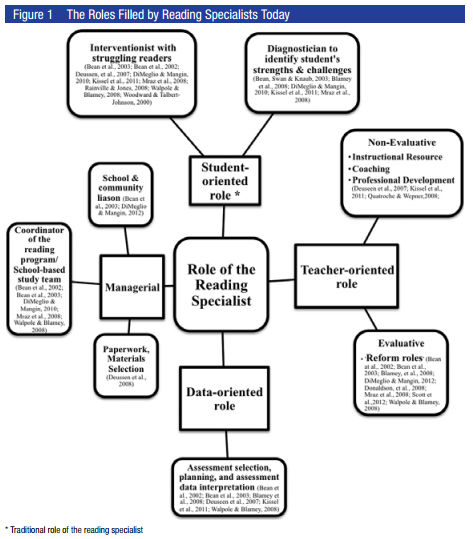
I recently read an article from The Reading Teacher titled “Leader, Teacher, Diagnostician, Colleague, and Change Agent: A Synthesis of the Research on the Role of the Reading Specialist in This Era of RtI-Based Literacy Reform,” by Emily Phillips Galloway and Nonie K. Lesaux. What a mouthful, I know. However, isn’t that truly what our jobs, as literacy coaches/reading specialists, are?  A smorgasbord of responsibilities. We have so many roles and our roles look so different across the state, within districts, and even across schools within the same district.  This article helped me to truly reflect on what my role as “Literacy Coach” entails and how it has evolved.  

In the past, I was always frustrated at the idea of our roles being so inconsistent; however, the more I reflect I understand why that is and why it may be “okay”.  Every building, every district, is at a different point in their journey.  The literacy coach needs to meet the needs of their current situation to move their building/district forward. As I've said before in my posts, we need to differentiate in all that we do, not just with our children.  It doesn't pay to move too fast, putting teachers/staff in a position they’re not ready for (frustration); however, we can’t  move too slow either. A  little push into the discomfort zone is how change happens. Think Vygotsky . . . Zone of Proximal Development.  The idea holds true in all that we do. Change does not happen overnight.  It takes time.

The charts and quotes below are from the article.  I used them to help me reflect on where my current reality is as a literacy coach in my building/district.  I looked at the first chart (Figure 1: The Roles Filled by Reading Specialists Today) and said, “Yep, I do all of these things.”  However, the most meaningful to me was looking at the second chart (TAKE ACTION!) and filling in what my role looked like for each of the 4 years I’ve been a literacy coach.  It is amazing to see how it has evolved. I’ve really done all of these jobs each year, but the percentage spent in each area has completely changed. I challenge you to take a look at your role and reflect on where you have been, where you are now, and where you want to go.

“The role of today’s reading specialist is highly influenced by school type (elementary or secondary), school performance, and the professional culture in the building.”

“Assuming the role of reading specialist in an era of school reform, requires skill
in managing uncertainty and in seeing the possibilities that exist.”

“If this review suggests anything, it is that reading specialists in an era of RtI-based reform,
remain dedicated to supporting students to become readers.”

Galloway, Emily P. & Lesaux, Nonie, K. (2014)  Leader, teacher, diagnostician, colleague, and change agent: A synthesis of the research on the role of the reading specialist in this era of RtI-based literacy reform.  The Reading Teacher, 67(8).

Wednesday, November 26, 2014

Small District + Big Goals

Today's post is contributed by Carrie Sand.

Small District + Big Goals = Varied Roles for a Literacy Coach: 
How to provide effective and efficient coaching when time is tight?


Another school year means tweaks to and changes in my role as a Literacy Coach. Depending on the semester, my work as the District Literacy Coach (4K-12) may also be in addition to teaching classes of intervention and high school English classes. Such is the schedule of a small district employee; no longer does the budget allow for single area experts, but calls for teachers and coaches who are adaptable, flexible, and knowledgeable about best teaching practices for all students.


While I love the wide range of experiences, students, and situations I encounter within the scope of my job, and the mental demands always keep me challenged and sharp, I am constantly think about new and improved ways I can be more effective and efficient as a coach. As I reflect on the upcoming year, I think about goals that will help me continue to develop and grow. This year, these goals include:


  • What formats best allow me to deliver professional development that is meaningful, engaging, and timely?
  • How can I create a system of observation and beneficial feedback when I am limited on time and responsible for a large amount of classrooms?
  • In what ways can I help implement a district-wide standards based universal curriculum, delivered with best instructional practices in literacy, which ensures all students an equitable literacy experience?
  • How can I support the continued development and use of formative and summative data to drive meaningful instructional decisions and intervention options?

Like many, I am striving towards reaching big goals on a small budget (of both time and money)! For this reason, I  am going to spend my year reflecting on effective and efficient coaching practices. Over the course of the year, I invite you along on my journey as I try out new ideas, share successes, and reflect on improvements for next time. I look forward to the adventure ahead.  

Friday, November 1, 2013

David Tutera, Literacy Coaching, and Pixie Dust


Today's post is brought to you by Lisa Weiss.


One of my guilty pleasures of the television nature is David Tutera: Unveiled. I love that guy! I like to think we’d be friends if I lived in Los Angeles, but that is a delusion I will save for another time. Every time I view an episode, I am amused by the connections between his work and mine, his attitude and mine. Our end products are grossly different, but the journey to our end products, and the roles we play throughout the journey, are freakishly similar!


I’ve written about this before, but it is worth repeating: we need to be visionary! While the lovely David Tutera envisions over-the-top floral arrangements, sparkle, and fancified receptions, we also must be visionary in terms of what we want our students to know and be able to do independently, and then devise a plan that is collaborative with teachers, in order to meet that goal. David’s fundamentals in include a venue, a dress, and a theme, while a coach’s fundamentals include a vision, a plan for implementation, and accountability. Both require thinking, creativity, collaboration with others, individual planning, and reflection.

As it turns out neither David nor literacy coaches are licensed practitioners of fortune telling, so it is impossible to know when plans will derail, but there are often warning signs; wise wedding planners and literacy coaches will have an awareness of those warning. However, there are times, in planning weddings and planning professional development, when things go catywampus, and when that happens, there are many roles to be played. Most popular is that of the therapist, assessing the root of the problem via listening, and using the data to be a problem-solver. David Tutera often finds himself in the middle of controlling brides and pushy family members, but he handles those situations by listening to both parties, and considering what he can do to make everyone happy. He’s a problem-solver, a therapist, and a mediator when these issues arise. Much like a coach is in these sticky situations, he is a soft place for a frazzled bride to land, just as a coach is that soft spot for the frazzled teacher.

David’s show really is about him—his work, his business, his life outside of work, but as a wedding planner he knows when the spotlight is “on” him, and when it should not be on him; he understands that there is a boundary. While the show is all about him, he understands that a wedding is all about the bride. He knows that, at the wedding festivities, he needs to step back, be still, and enjoy what he created. The same is true of a wise coach; she invests in the professional lives of her colleagues, and then sets them up for the spotlight when they are ready. An astute coach knows that there are times that she will live in the spotlight (and sometimes the hot seat as well), but because she has worked so hard with teachers, there is a time for the teachers to be in the spotlight, with the coach silently cheering those teachers on!

While there are many similarities between David’s work and that of a coach, I do feel as though there is one area where we are quite different. His work, without fail, ends in perfection, jaw-dropping perfection. The journey is often messy for both David and literacy coaches alike, but his final events appear to be without a flaw (or maybe they are just edited out of the program). His magic wand actually works, but mine must be low on pixie dust because, although I am not dissatisfied with the professional development I offer, mine are never the picture of perfection that David’s are. The upside of this is that each opportunity brings new learning for me; it’s just a shame that I can’t forever edit out the messy parts…

Wednesday, October 30, 2013

The [Rolls] Roles of a Literacy Coach

Today's post is brought to you by Penny Antell.

The Rolls Roles of a Literacy Coach

Where does one begin, with no job description that can truly ever contain the tasks a literacy coach is involved in, the job becomes all encompassing.  This is awesome!  It allows me, as a coach to reach farther, stretch and learn in new ways, and forces me to think outside the box while problem solving with teaching staff. 

So, let’s begin with a few adjectives and verbs to define the roles of a literacy coach: supportive, flexible, creative, leader, listener, follower, cheerleader, friend, empathizer, data collector and analyzer, comforter, observer, teacher, learner, and guide. 


I would add to these terms baker and cook as well.  I find when I provide treats to my team, there is a comfort that comes along with this.  The comfort provided through sustenance for my teachers and therapy for me as I am preparing the rolls, muffins, cookies, granola, etc.

Coaching is truly a job of service and growth for all involved.  The quote “It takes a village to educate a child,” fits well in the realm of coaching.  Everyone has different strengths and areas that can be further developed which they bring to the table for discussion and learning.  The literacy coach has the opportunity to strengthen weaknesses through modeling in classrooms, meeting with teams of teachers to discuss data trends, celebrations and concerns, to open the door to talking about what best practice instruction involves, and introduce new learning. Through modeling, observing and guiding instruction, areas where confidence is lacking are strengthened and areas of strength are shored up to higher levels.    While working with teachers, coaches listen for the unspoken as well as to the clearly stated beliefs and values the teachers hold.  They build on this with each teacher through careful listening, and carefully selected language.  They build relationships with the staff developing trust through their interactions.  They celebrate successes and grieve losses together, but more than anything, coaches support, guide, lead and teach.  By teaching and guiding teachers, a larger audience is being impacted.  Coaches have the unique role of creating shift among a vast population by working with those who are working writing our future.


Yes, it takes a community to teach a child the ways he should go.  Sometimes, as a coach, I represent each of these hands depending upon the setting/purpose of the current situation.  However, I could not do this job alone.  I need the community of learners at my side to learn and grow with me.  Together we make a difference and all roles are filled.


Tuesday, October 29, 2013

The Many Roles of the Literacy Coach

Today's post is brought to you by Bobbi Campbell.

Role, Roll, Role


For this particular post, I informally interviewed several fantastic, multi-talented coaches. The work they do on a daily basis never ceases to amaze me. Here is why…


(Note:  I have changed the names to protect the coaches mentioned in this blog.)
Image taken from this source.
The Cheerleader:  Peppy Patty spends part of her day giving a shout out to a teacher over the loud speaker, as moral is way down and Patty needs to boost it.  She also spends some of her time sending out positive emails about shifts in the CCSS, best practice and the use of researched strategies, curriculum writing, new books in the library, and professional journals for check out.
Image taken from this source.
Disciplinarian: Prudent Patty keeps a tight ship, especially when she is covering for her colleague who does the regular discipline. I see Peppy Patty peeking out every so often, but then I see the pursed lip, straight spine, hands deflecting bad behaviors and I know that Prudent Patty has returned? 
Image taken from this source.
The Defensive Line Coach: Packs-a-Punch Patty delivers her coaching with fervor and precision.  She is determined to articulate a plan, deliver it, and have a post conference recap and sets a new plan in motion without taking one breath. 
Image taken from this source.
The Wonder Woman: Permeating Patty is like diffusion across a semi-permeable membrane – seeping in every crevice, focus, and agenda, that involves instruction. She does it all: facilitates team meetings, discipline specific meetings, whole staff meetings, and district meetings.  She has just enough time to show off her excellent skills with a whistle and ball bin when she monitors students during combat, I mean, lunch duty.
Image taken from this source.
The Data Analyst: Proficient Patty constructs data sets for teams to analyze for use in informing instruction. She helps teachers to make decisions based on evidence and tracks progress towards those goals derived from the data.
Image taken from this source.
Magician: Plentiful Patty finds a way to carve out time even when we all know there are only 24 hours in a day. No task is insurmountable for Patty; no task unbeatable; no task puts Patty up against a brick wall – she, like master of allusions, can make magic happen right before your eyes.
Image taken from this source.
Hats off to coaches across the state – they are many things, but most of all, they are appreciated for their brave endeavors, their daunting tasks, and their burning passion for all things literacy.

Monday, October 28, 2013

The Mystery of the Literacy Coach Role

Today's post is brought to you by Heather Zimmerman.

What is the role of the literacy coach?  (Or… reading specialist, reading coach, reading instructional coach, or literacy resource teacher.)  This seems to be a question from not only teachers but administrators.  This position looks different not only in different districts, but sometimes within the district.  

For a graduate class we had to look for the job description of a literacy coach in the district we work in.  It was amazing what a task that was for some of the people in the class.  Every job description, if they were found, looked different.  Some descriptions even had wording along the lines of “...and any other tasks…”  My class began to notice that literacy coaches become the “Jack of all trades.”

I emailed teachers at the beginning of the year an email that explained how we can work together, I received a few emails thanking me, because they were not sure how literacy coaches could be of assistance. 

Since educators are confused by the role, it is understandable why students or parents might be confused by the role.  I received an email at the beginning of the year from a former student.  She was confused because she heard that I left the classroom and took a role as an assistant.  She seemed a bit relieved when I told her what a literacy coach does.  

I do think that literacy coaches, however you define the role, have to be willing to drive literacy forward in schools to increase student achievement.  Literacy coaches are apart of teams.  They help administrators establish the literacy goal and plan professional development.  They are apart of the teacher team and work together with teachers to discover how literacy plays a role in all classroom.  And they are apart of the student team and help students find success in all parts of literacy.  (The student piece looks varies for literacy coaches.  This might be working with small groups in the classroom, modeling a lesson, working with an individual student, etc.)   The key to the literacy coaches role though is to build relationships and work as a team.  

There is a YouTube video where a speaker, Simon Sinek talks about relationships in the business world. What he talks about can easily be applied to education.  The video is worth watching if you if you ever have an extra 15 minutes.


Direct link to Simon Sinek's Vistage Presentation on YouTube.

One quote I really liked he cited from an African proverb.  “To go fast, go alone.  To go far, go together."  This applies to not only the literacy coach role but all roles in school.  Working together will make the most impact for students.

Friday, October 25, 2013

This Week's To Do List

Today's post is brought to you by Andrea Reichenberger.


  • plan and deliver the last of 4 full days of professional development for all the 6-12 ELA teachers and co-teachers (ELL, SWD) on best practices in literacy instruction aligned to the CCSS.
  • check the teacher exit tickets from the Day 3 trainings and try to meet requests for teachers' need
  • observe, coach, and offer feedback to the 4 teachers who set up appointments with me this week to ensure they are implementing our 6-12 ELA program with fidelity
  • model close reading in a science classroom
  • help the new ELA teachers with their lesson planning
  • meet with the intervention class teacher for the 6 week progress monitoring check - look at data and develop the plan for the next 6 weeks based on students' needs
  • finish the design "look for" lists and protocols for peer, coach, and administrative classroom observations  (This week is Purpose and Modeling look for tool.)
  • attend the Secondary Leadership Team (principals, asst. principals, directors, and superintendent) meeting and communicate what they should be looking for in the classrooms
  • set agenda and meet with my building principal
  • meet with the technology department chair to plan creation of READ posters
  • meet with the high school math coach and the director of curriculum to design the end of the month staff development for both the middle school and high school on Standards Based Learning (more specifically on Assessment and Feedback) (Bring notes from last week's brain storming session)
  • design and finish the write up of the interventions for the RtI menu
  • figure out how to use the ALPINE system to triangulate the data and look at which students qualify for interventions (Almost done!)
  • train teachers (those who asked first) on how to read their data since MAP testing is almost complete. (Um...not sure I will accomplish this? May have to push off until next week.)
  • attend the FOCUS team meeting this week to evaluate and modify our current school goals
  • review and order books for our Parent Literacy Night and for the ELA dept. (Working with Scholastic so I can get points to order more books!)
  • finish writing grants and figure out other clever ways to build classroom libraries (see above item).
  • set up training for the social studies dept. on the disciplinary literacy standards. (Done.  Just need to attend the training and make sure the same message is delivered from all sides. Thanks to the consultants at DPI!)
  • check out the latest reviews for YA literature titles and schedule a visit from the Youth Services Librarian from the public library to do book talks.  (Need to get input from the ELA teachers about upcoming dates.)
  • order professional titles and find articles to share with teachers. (On-going)
  • meet with the district K-12 math, literacy, GT, ELL and technology coaches as a large group. (No meeting this week! Phew!)
  • meet with the K-12 district literacy coaches. (No meeting this week! Phew!)
  • plan for late start discussion about ELA curriculum spiral and encourage team members to have conversations and come to agreements about what they should be teaching and assessing.
  • eat (Only if there is time.)
  • use the restroom (Only if there is time.)
  • write my blog post for the Literacy Booth coaching blog! When am I going to find the time to do THAT too?

Thursday, October 24, 2013

What Hat Will I Wear Today?

Today's post is brought to you by Carrie.

I think about the hats I’ve worn in my lifetime: a tiny pink knit cap the day I came home from the hospital, one especially memorable white Easter bonnet I wore for many weeks after the holiday season, the baseball cap during my years of playing college softball. Each of these hats represents a unique “part” of what makes up the “whole.” I view my work as a Literacy Coach in much the same way; year by year, day by day, hour by hour, or, at times, minute by minute, I change my “hat” to fit the need or situation. This ability to adapt and change and adjust is what makes the role of a Literacy Coach both invigorating and challenging.
In my experience, no one coach has the exact same “role.” In fact, year to year, I find my own role as a coach within the district changing. In my four years of work, at one time or another, I’ve been a: curriculum writer, instructor, interventionist, test proctor, substitute teacher, advisor, mentor, team member, and presenter.
As much variety as the role includes, I also work to define a consistent image as a coach. First and foremost, I still classify my role as “teacher.” Not only am I a teacher of children or young adults, but also a teacher of teachers. I value quality instruction, utilize best practices, and check for understanding. I work to build a climate of trust, respect, and communication. All of the values I held as a classroom teacher, I build into my role as a coach. Good teaching practices are good practices whether they are for children or adults. In this way, I believe my strength as a coach lies in my teaching expertise. Teachers in my district know that my strengths lie in curriculum planning, instructional techniques, and assessment.
For me, the struggle of my job as a Literacy Coach is keeping the “teacher hat” in the forefront. The day to day grind of paperwork, meetings, committees, and planning teams often leaves me feeling like a secretary. At times, the most important tasks that are real, true “teaching” fall second to filling out another purchase order or making another benchmark assessment copy. I continue to struggle to keep my priorities straight versus checking something off my ever growing list.

As a Literacy Coach, variety is both the strength and struggle of the job; but, at the end of the day, nothing is more rewarding than being brave enough to try on a new hat and finding that it fits just right!

Wednesday, October 23, 2013

Many Hats

Today's post is brought to you by Jaimie Howe.


Image taken from this source.

Like the peddler in Caps for Sale (retold by Esphyr Slobodkina), I wear many hats as a literacy coach.  The hats that I wore when I first started as a literacy coach have evolved over the last few years.  The hat that I wore most often in my first year as a literacy coach was interventionist.  I spent probably 75% of my day working with struggling readers.  The other 25%  of my day, I wore a few other hats: mostly staff developer and data analyzer. The staff developer portion of my job was solely tied to supporting the K-5 teachers in my building in using our new curriculum.  The data analyzer portion of my job was just that - analyzing a lot of data and not a lot of sharing or using of the data.  I had many other hats that I wanted to wear such as coach, mentor, collaborator, modeler, observer, and leader.

At times I put them on and tried to “sell” them like the peddler in Caps for Sale did.  Similar to the peddler,  I didn’t have many takers.  A large part of the problem I believe was a lack of understanding  of what the title “coach” meant not only by the teachers in my building, but by district personnel as well.  When I became a literacy coach, it was the first year the district had coaching positions.  There were 13 of us; one at each elementary school.  The good news was we were all learning together and collaborating as coaches.  The first year was spent building relationships with the teachers in our buildings and the administrators we each worked under.  As our relationships grew, the understanding of what we wanted our coaching to look like grew as well.

I started my second year as a coach with the intention of wearing my interventionist hat 50% of the time or less and wearing my coaching hat for a majority of the remainder of my time.  The percentages didn’t necessarily add up to what I had hoped; however, my coaching position did evolve.  A major step forward in my second year was establishing grade level collaboration meetings with the teachers in my building.  I met with each grade level once a month.  I tried to focus these meetings more on the Common Core State Standards (CCSS) and assessment.  I was a collaborator, facilitator, professional developer, and even a coach at any given time during these meetings.  The district I work for also sent all of the literacy coaches and elementary principals to Wisconsin’s RtI Systems Coaching six day workshop as well as a six day Professional Learning Community (PLC) workshop.  I used information gleaned from these workshops to support and enhance my grade level collaboration meetings.  About half way through the year I started using a protocol.  At first, the protocol helped me remember each month where I had left off the month before, pretty much just keeping  me organized.  I also learned to differentiate my coaching based on the specific needs of each grade level.  I met them where they were and tried to show them that I was a support for them, not just someone else telling them what to do.  Through these collaboration meetings, I was continuing to build relationships and build the teachers’ understanding of my role as a “coach” and/or support.

As I began my third year as a literacy coach this year, I was hopeful, yet unsure of exactly how much more coaching I would be able to do.  I was relieved and somewhat surprised to find most of the teachers in my building refreshed as the school year started.  They had the summer to recuperate and were ready to start anew.  I had teachers wanting to know more, wanting to understand how they could take the CCSS and immediately implement best teaching practices into their classrooms, wanting to understand how they could create common formative assessments that would align to the CCSS and their grade level report card.  I was invited in to help, support, teach, model, and ultimately “coach.” I was ecstatic, overjoyed, and ultimately overwhelmed.  My schedule has never been more booked.  I am teaching (modeling) each of the six  Notice and Note signposts in all 3rd-5th grade classrooms and our monthly collaboration meetings focus around a book study of this book (Notice and Note: Strategies for Close Reading by Kylene Beers and Robert E. Probst) and how it aligns to CCSS, formative assessment, rigor, etc.  I am modeling and observing lessons based around the components of balanced literacy for eight weeks in first grade and eight weeks in kindergarten.  I would say that my role has almost flipped from my first year as a literacy coach.  I am now spending at least 75% of my time actually “coaching.”


Image taken from this source.


As I venture further into this third year of literacy coaching I relate to this photo from Caps for Sale.  The monkeys are the teachers (I know great analogy ☺) and they are wearing many of my caps.  They have asked for my support (my caps)  and are using what they have learned through my modeling, observing, and collaborating to improve their teaching and increase student learning.

In my collaboration meetings I now use a more focused protocol based on the four essential questions.  We actually use the data that I analyze.  We analyze it together and use it to inform instruction. This new protocol keeps our meetings focused, data driven, and student centered as well as continues to keep me organized.


Click on the link above and view a sample of the protocol that I use.  Let me know what you like about it, what you may use, and what could be added to make it better.  

Tuesday, October 22, 2013

What Do You Do Anyway?

Today's post is brought to you by Julie Schwartzbauer.

My school district has 16 elementary schools, and within each school we have building coaches.  Many coaches are 50% coach and 50% interventionist.  I serve as the K-2 District Literacy Coach.  We also have a 3-6 and 7-12 District Literacy Coach.  Last year’s professional development targeted best practices through the workshop model.  All building coaches received training.

This year we plan to focus our professional development on specific needs within each building.  We (District Literacy Coaches) are committed to meeting with our building coaches on a bi-monthly basis.  

As we work with our coaches we find that the staff in their building are uncertain about the purpose of literacy coaching and often question their role.  Some teachers might ask “What do you do anyway?”  We want to make certain our coaches are equipped with the information they need to address this question.  Our district has put together a job description for Literacy Coaches, but that is not necessarily what classroom teachers are looking for.  Classroom teachers want to know how a coach can support their work in the classroom.  Teachers need to understand how they might work with a coach and how that will benefit them.

The first thing we recommended was for the coaches to submit a needs survey to their teachers.  We created a rubric which reflects the components of the workshop model.  The rubric asks teachers to look at the components and rate themselves based on how confident they feel in each area.  We felt that this would be a great way for coaches to get a sense of the teachers and their interests and needs.

We also shared the Literacy Coaching Continuum with our building coaches.  The continuum's differentiated formats of professional learning acknowledge that teachers are individuals who need and want various kinds of support depending upon content, circumstances, personal experience, and timing (Moran & Powers).  Just like we differentiate for students, we also need to differentiate for our teachers.  We recommended that our coaches share the Coaching Continuum with their teachers. We suggested they ask their teachers where on the continuum they would like support.  The Coaching Continuum seemed to lift the weight of trying to be everything for everyone.  They were now able to build on their strengths as a coach as well as the needs of the teacher.