Showing posts with label Writing. Show all posts

Thursday, April 6, 2017

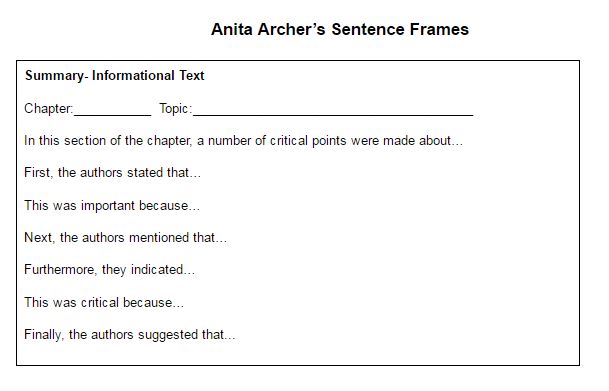
Anita Archer’s Sentence Frames

Maggie Schumacher contributed this post. Click here for more of Maggie's thinking and writing.

The following sentence frames were shared by Anita Archer at the RtI nnovations Conference in October, 2015. Anita Archer recommends the use of sentence frames as a way to give students a framework to support thinking and writing and to encourage the use of content vocabulary in writing. Sentence frames can also be used to provide scaffolding for academic language; teachers can post academic language starters in an anchor chart for students to see when having academic conversations in class.

Click here to access a template with many sentence frames.

To implement sentence frames, you first develop a frame for the type of writing you’re asking your students to complete (see examples attached). After you have the frame, you model how to use the sentence frame with your students; after, students will use sentence frames to construct their own writing. This scaffold can be very helpful for students who struggle with basic writing skills and structure. Over time, as students become stronger writers and internalize this type of academic language and structure, you would slowly fade the use of sentence frames during instruction until students can write independently.

Tuesday, March 28, 2017

Writing in Chorus - Gradual Release of Responsibility

Heather Zimmerman contributed this post. Click here for more of Heather's thinking.
This is part of a series of posts about writing coaching cycles, which include examples from several disciplines.


Have you ever tried to look for literacy examples for your music teachers?  It can be hard to find a lot of ideas.  


During one of my coaching cycles, I worked with our chorus teacher, Eric Britz.  We talked a lot about some of the great things he was doing regarding writing.  He had so many practices already in place.  

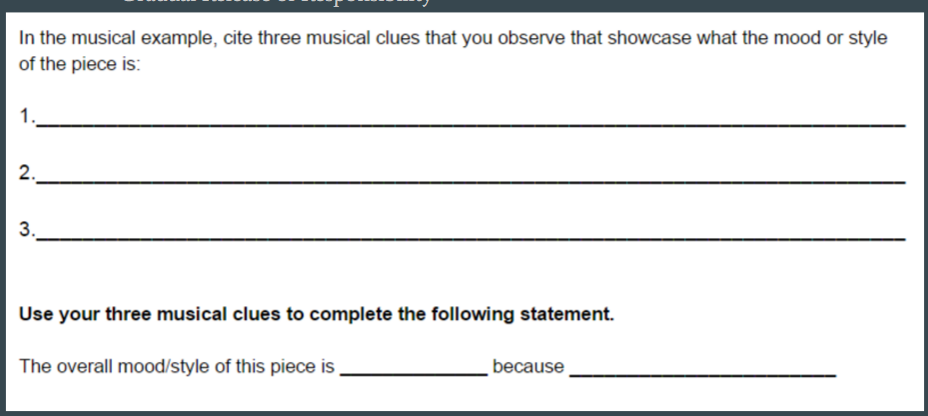
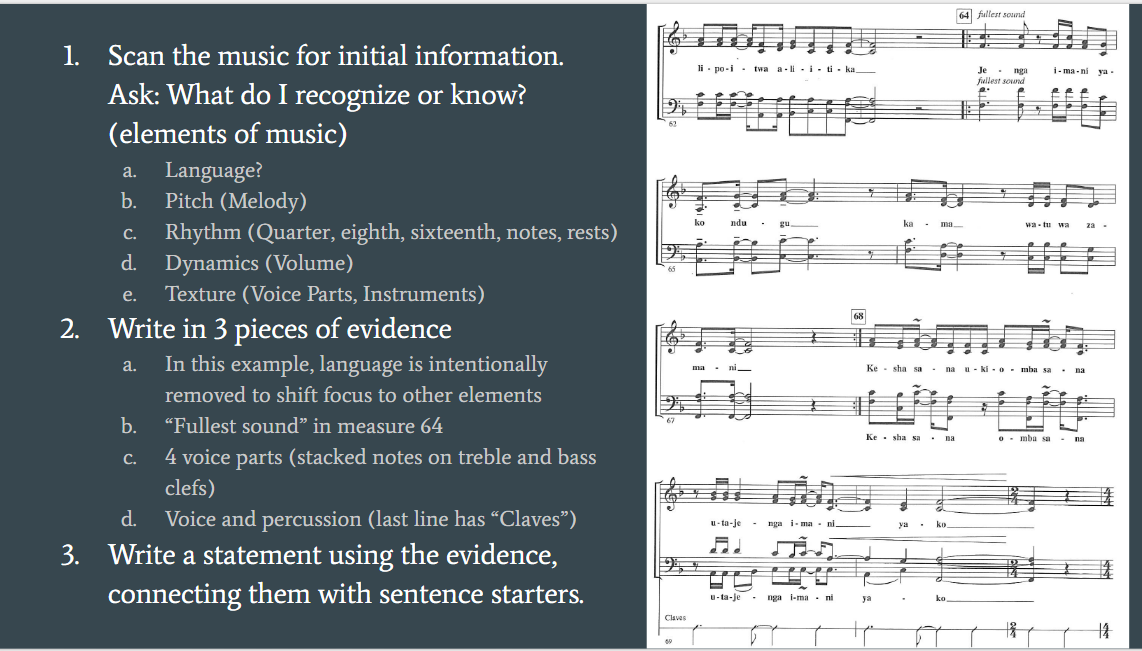
At a collaboration session, he shared with staff what gradual release of responsibility looks like in his classroom.  Take a look:


*This was an organizer to get students thinking before they wrote.

*You might notice the lyrics are not in English.  This was intentional.  He noticed students paid more attention to lyrics than to the music.  He decided to help them focus mostly on the music.


Thursday, March 23, 2017

Writing in Math- Graphic Organizer

Heather Zimmerman contributed this post. Click here for more of Heather's thinking.
This is part of a series of posts about writing coaching cycles, which include examples from several disciplines.


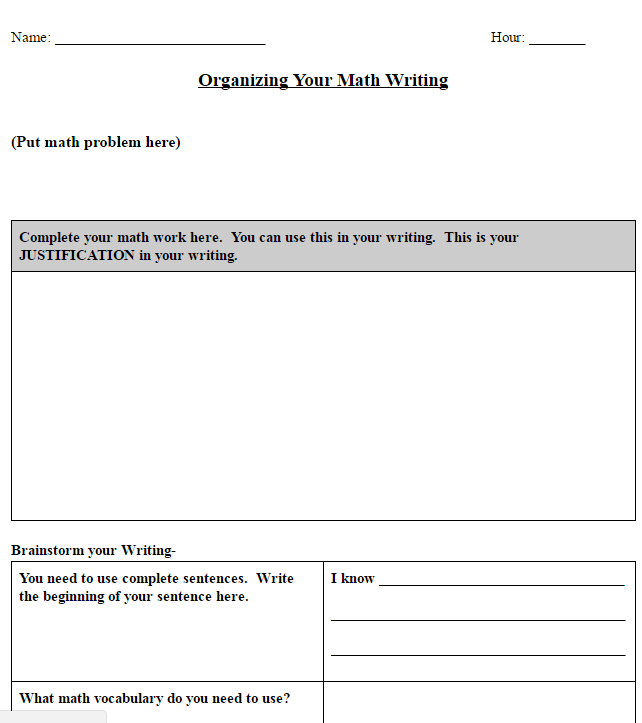
During a coaching cycle, I was working with math teacher individually.  A trend I noticed was that teachers commented on how they were looking for a tool to help organize students’ thoughts. Together, a math teacher and I, created this graphic organizer.  Click here.


One part we got stuck on was that the writing is so individual depending on the math content.  So it is hard to make a common graphic organizer.  We are hoping this is a start.  What math writing tools do you have?  Share in the comments!

Tuesday, March 21, 2017

Writing in Band- A Reflection Organizer

Heather Zimmerman contributed this post. Click here for more of Heather's thinking. 
This is part of a series of posts about writing coaching cycles, which include examples from several disciplines.

As I went through my coaching cycles, I was excited for my time to work with the music department. I did not have as many opportunities as I would have liked working with that department.  


The band teacher expressed he wanted a way for students to focus on the recording of a concert that could carry over into a reflection.  Together we (me and Brad Curran) made a checklist of ideas to look for during the viewing of the concert. The band teacher also added sentence starters.  To view the organizer, Click Here.  

Tuesday, January 31, 2017

What to do when your team loses its purpose….(no really, I’m asking...what do you do)?

Carrie Sand contributed this post. Click here for more of Carrie's thinking and writing.

Last year, our district leaders determined that this school year would begin a district-wide writing initiative. The leaders in our buildings created a survey which demonstrated our staff was willing and interested to take on this venture. From there, a district committee was formed to work together throughout the summer to create a multi-year plan. This committee actively searched and found training and resources which we hoped would provide a solid foundation of understanding for all committee members. Throughout the summer, we dove into our work. We read specific chapters from Regie Routman’s Read, Write, Lead and met twice to discuss the ideas they sparked. As a team, we also attended UW-Madison’s Literacy by the Lakes conference and loved it!  From these experiences,  we were able to develop a three year timeline to roll-out to staff. Our year one goals included articulating shared beliefs about writing, exploring what best practices in writing mean for our school district, defining different types of writing by creating shared vocabulary, and conducting environmental writing walk-throughs. We felt good about having a plan, invigorated by our learning, and excited to head into the new school year with a laser like focus on writing.

Cut to five months later and our progress has come to a screeching halt. We have had one meeting since the school year began and that was to plan the one inservice we had available to us as the year’s “writing training.” (Yes, a whole year’s of writing training in a 2 hour afternoon meeting.) We have not read any new chapters, engaged in any further writing discussions, or collected any new writing data. We are all overbooked and frantic and already running on empty with no extra room in our brains or schedules for our wonderfully planned writing focus.

So that’s my reality as I reflect on the first half of the school year and stare the second half right in the face.  As a district literacy leader, I’ve spent the last couple of days  wondering “Now what?!” Do we drop the team totally and wait for a year or two when the conversation will inevitably come up again and someone will wisely suggest “Hey, we should have a district committee for this!” Do we carve out some precious time and rededicate a second semester to writing even though it might the initiative that breaks the teachers’ backs? Do we gloss it over, say we “pretty much” met our year one goals (you know, because we DID do a 2 hour afternoon inservice on writing), and think about how much better we will do next year?

After drafting the first part of this blog, I spent a few more days reflecting and reading. I picked up Elena Aguilar’s book The Art of Coaching Teams: Building Resilient Communities That Transform Schools, which I’ve had for about a year, but haven’t read it as closely as her book The Art of Coaching. Using the quick chart she has in the front of the book, I skipped ahead to Chapter 4 which talked about “defining purpose, process, and product.” As I read the chapter, I felt good about many of the steps we had taken in the summer. We had a common vision; we kept student learning in the forefront of decisions; our team functioned well and did not have conflict. And, as I read the section on writing goals, I realized that while we had the year long goals, maybe we just needed to redefine those goals in smaller chunks. In the last few days, I had been thinking about this writing initiative in absolutes. How could we reach all of these goals? How could I ask all staff members to do all of these things? The ideas in those ten pages wasn’t anything groundbreaking, but it helped me take a few steps back and recommit to this writing purpose. Is it worthwhile work? Yes! Will it take time? Yes, but how can that time be spread out manageably in the course of the next sixteen weeks?

The reading and reflecting help me redefine my questions about this writing team. Instead of thinking: “What am I going to do? How will this ever work?” I’m wondering now: “What are the small steps we can take in January and February that might help us reach those large goals at the end of the year?” and “Who can take on different roles and responsibilities with this initiative?” Maybe not everyone, even those of us on the committee, need to be involved in every step or component of the year one goals. I’m hoping that recommitting to my writing team goals by using small steps will help me redefine the overall purpose and outcomes of this team. Now, it’s just taking the next small step!

Wednesday, June 22, 2016

Comprehension Focus Groups: With a Focus on Grammar

Heather Zimmerman contributed this post. Click here for more of Heather's thinking.


Why can’t these kids write a complete sentence?  This is a frustration that might be vented by a teacher at any grade level. This usually leads to the question: How do we fix this? What does best practice look like when grammar is taught in a consistent and strategic way while in the workshop model.  


I have tried to teach grammar in various ways.  When I was student teaching we had a textbook we used with a number of sentences that needed to be fixed depending on the lesson for the day.  In my own classroom, my high school students engaged in Daily Oral Language (DOL) on Mondays, Wednesdays, and Fridays by fixing the sentence that was on the transparency.  When I learned this was not best practice, I began to use lessons from Mechanically Inclined by Jeff Anderson.  I loved how we used examples from a text to analyze correct examples.  Eventually I started to feel like we did not have enough lessons to work through on a consistent basis, so I dabbled into a bit of DOL again using the book, Use it! Don’t Lose it! by Marjorie Frank.  I tried to tell myself this was OK, because I thought it was what was best for my students.  I also of course was analyzing student writing and trying to pull lessons from their writing.  But I kept feeling lost in grammar world- nothing felt right for us!


Am I crazy to think there must be something out there in grammar world that clicks and feels right for my students?  Maybe...  I feel part of the problem (which is the same now during intervention time, as it was when I taught 8th grade literacy) is time.  How do I effectively chunk my 50 minutes of time for vocabulary work, grammar/sentence work, read aloud time, the mini-lesson, and reading/writing workshop time?  Yes, I know that some of the grammar/sentence work should be a mini-lesson as needed for a small group or whole group.  But when it is not sticking for my whole intervention group, I know we need to give this more time.  (Is the Rolling Stones song going through your head right now? “Time, time, time is on my side.  Yes it is.”)


A friend of mine recommended the book, Grammar Keepers by Gretchen Bernabei. This book has lessons on the most common grammar problems in grades 4 through 12.  She bases her lessons off the ideas of asking students to “prove it.”  In essence, students need to back up their choices.  I decided to base a Comprehension Focus Group (CFG) using specific lessons from Grammar Keepers.  I picked lessons that I knew my students needed.  I also picked a theme for our texts that I knew would be of interest to them.  


Here are the CFG lessons:


Afterwards, I felt like we certainly did a deep dig into grammar.  My 8th graders, really started to think about the punctuation we picked and why that punctuation is used.  When they tried to find examples in mentor texts they sometimes would pick up on a different instance.  For example, commas being used for a different reason than with an appositive.   But, they were noticing the punctuation and we were talking about it, which is important.  This led to conversations about subjects and verbs- topics they have learned but have forgotten.  With my 7th graders, I picked lessons dealing with sentence structure.  We needed to work on fragments and run-on sentences.  We talked about subjects and verbs.  We also talked about conjunctions.  Students enjoyed looking for FANBOYS or AAAWWUBBIS sentences in texts, but did not always include appropriate punctuation in their writing.  This led to good discussion where I learned that sometimes students knew it was needed and sometimes they did not.  This CFG led to being consistent and strategic through the time of this intervention, but I would like to see this happen in a more consistent basis.  Was it perfect?  No.  Though, there will be parts from this book I will incorporate next year into my routines at the beginning of CFG time.  I also want to get a good system down, so I can carry that into my coaching time.

What works for you?  How do you help your teachers incorporate grammar into their classrooms?  If you are using CFGs at the secondary level, what does this look like for you?

Monday, June 6, 2016

Coaching with Kindness Reflection via Free Verse Poetry

Lisa Weiss contributed this post. Click here to read more of Lisa's thinking.

I spent time rereading what I wrote this year, and in doing so, I started to play with phrases and lines that jumped out to me. This post is my expository writing from the year, reinvented as free verse poetry, using only the blog posts about coaching with kindness. There are many ways to go about this, but I pulled the six posts, highlighted the words and phrases that felt most powerful and/or carried importance, and then wrote them, in the order they occurred in the texts. But then, the organizational nut that lives in my head had to do some rearranging of the original words and phrases...great way to show students how expository writing can be repurposed into creative writing.


Honesty is the kindest move
Uncomfortable, but necessary
Navigating the uncomfortable territory
Providing honest feedback
with kindness
facilitates change


Commitment: Investing in the professional lives of teachers
Responsibility to provide feedback
given with integrity and kindness.
Feedback as an act of kindness


Courageous conversations
Brave conversations
Crucial conversations
Critical conversations
Uncomfortable conversations


What would I do if I wasn’t afraid?
Name the issue
Gently,
Respectfully,
Kindly,
A philosophy of coaching with kindness


Two permeating questions
What is the expectation?
What did I see?
Just the facts!
Just the facts!
Just the facts!


I’d avoid these conversations altogether
But…
Our purpose far too great!
I owe it to students
I owe it to teachers
But…
provide it kindly.
Gently coach back into the tracks,
Partnering,
Putting teacher back in position to SHINE!


But...
Sometimes
Even truth covered in kindness
stings.
Up to the teacher to embrace it...or not
Issue does not belong to me


Listening intently
Identifying defense mechanisms:
Excuses
Blaming
Topic -hopping
Challenging: What would you do?


Calmly thinking
Pondering the next question, thinking through the conversational map
Facilitate thinking through the defensiveness
Maintaining focus
Fears disappear: It’s not about me!
It’s about students, advocating for them
Knowing they deserve the best possible teacher


Had to hold the courageous conversation


Craving peace and
healthy relationships
Knowing feedback to teachers is
Unavoidable for
Effective coaches,
Even when peace will erupt
Knowing I am doing what is right for kids
Knowing I am doing what is right for the teacher, and
Knowing I am doing what is right for me

Peace returns

Friday, April 29, 2016

Authors Writing Badly and Inviting Us to do the Same (Part 3)

Marci Glaus, English language arts consultant at the Wisconsin Department of Public Instruction, contributed this post.

In the video trailer for Wisconsin Writes, you will hear Nickolas Butler say “you can’t be a good writer unless you’re a reader.” Through the author interviews and in review of the footage, I noticed a trend developing among most of the authors who participated in the project saying the same thing. The basis for such agreement is simply the idea that we can learn how to write by reading great writing. But it is so much more than just reading.

How many times have your read something and just let the story wash over you with little thought to the structure, word choice, or what the writer was doing to help you get lost in the text? I do it all the time. I found that I really have to step into a text much more purposefully when I am reading with a writer’s craft in mind if I am going to learn anything about writing. If I want to make my own writing better, I need to understand and be able to name what other writers have done so that I can try it out for myself if I find it useful. Even then, my writing can come in fits and starts while I try to tackle what the pros have done in a way that fits with what I am trying to do. It takes practice, but it is possible. Take, for example, speaker and writer Tasha Schuh and company. She talks about trying to start her first book several times, but growing frustrated each time before figuring out how to plan and put her ideas together. She states that while she loves to read, she had to find examples of books that she could use as models for her own. They helped her get started in her writing process which ended with her first book and landed her here, in this video series, working on her second.

Linda Godfrey advises students not only to “write, write write, and write some more,” but to “read, read read, and read some more.” She says this based on her own experience as a writer who ended up writing about things she never thought she would. Through extensive reading and writing experiences, she was able to step into different genres with success. This holds true with other writers who participated in Wisconsin Writes.

Stay tuned for the end of this school year when Nickolas Butler is featured, writing in a genre very few people (including himself) would expect to find him. 

Wednesday, April 27, 2016

Authors Writing Badly and Inviting Us to do the Same (Part 2)

Marci Glaus, English language arts consultant at Wisconsin Department of Public Instruction, contributed this post.

I love perusing the “What are you Reading” Literacy Booth blog posts for several reasons, but mostly because I like to see the diverse genre and topic choices. I have made more of an effort not only to track what I am reading, but to purposefully break out of what has become my established reading norm which is usually fiction, preferably with a strong female lead. The Wisconsin Writes project was an excellent method to help me branch out. By making it a point to read something from each writer before meeting with them, I not only experienced new and different genres/topics, but found a heightened sense of appreciation for the excellent work produced in the state of Wisconsin.

The biggest reading stretch for me was Patrick Rothfuss because he writes fantasy which is a genre in which I tend not to partake. Once I did my research, I very quickly found out how big of a deal he and his beard are and I ordered his first book. I (somewhat grudgingly) started it, but 722 pages later decided that I really was a geek (in the best way possible—watch his writing process video), and declared myself a fan. When I bought his second book, I geeked out with the cashier at Barnes and Noble for as long as it takes for people waiting in line to become annoyed.

A second reading stretch for me came through the works of two Wisconsin authors who (among other things) write for the Wisconsin Historical Society Press Badger Biography Series. Both Karyn Saemann and Stuart Stotts have published in the series. At first I was leery because again, here are texts that are not catering to my established genre and character needs, but I ended up learning so much about Wisconsin’s first public school teacher, Electa Quinney, and activist Father Groppi through texts that are written for younger readers. Coming in to these books with very little background knowledge, I appreciated the writing style for the series and the assumed audience.

Beyond the texts above, I viewed the Wisconsin Writes project as a method for taking stock of how many Wisconsin authors I have actually read. I obviously loved to meet some of the writers from our state in person, but I also loved meeting them in their writing. 

Monday, April 25, 2016

Authors Writing Badly and Inviting Us to do the Same

Marci Glaus, English language arts consultant at Wisconsin Department of Public Instruction, contributed this post.

When I sat down to talk with Wisconsin author and investigator Linda Godfrey about the hardest part about writing, I felt as if I had struck gold. She delivered the biggest, most valuable nugget when she said that the best thing she can do for herself as a writer is “giving myself permission to write horrible things badly.” Here, a professional writer admits that she has to get out of her own way and just write—no matter how awful it might come out the first time. Linda is not the only professional writer to say this. Wisconsin Poet Laureate Kimberly Blaeser admits “I think it’s that need to do it perfectly instead of messily… and I still struggle with that because I want to sit down and I want to keep at it until I get it how I want it to be, and a lot of times you simply can’t do that.”

Although there were several, one of the happiest discoveries through the Wisconsin Writes project was that of writers showing how messy, recursive, and hard writing can be. They help unlock part of the mystery of writing, showing us, in the words of writer and educator Molly Magestro, “you don’t just sit down and spit something out and it’s golden.” The icing on this literary cake is that when each Wisconsin writer shows part of his/her writing process in the videos, they share an established assumption that they will go back during and after their writing process to make their writing better. Stuart Stotts agrees. He shares part of his process while editing two books that are almost done. He admits that all of his books have taken at least four or five drafts to complete, and states “I don’t know anybody who just sits down and writes and ‘here it is, my book it’s done.”

There is power in showing students that even the best writers in the room have to stop, think, try on, delete, and get over the idea that polished, good writing will just flow every time they sit down. Whether it is an author, an educator, or a peer, students learn valuable lessons each time they experience someone else’s thinking. Sharing our thinking as we write is a great strategy to explicitly teach students different parts of a writing process, whether they are working on brainstorming, putting a writing plan into action, or revising.

Seventh grade teacher and writer Pernille Ripp provides some important advice for us, and especially for students in Wisconsin: “Just get that horrible first whatever it is out of us…you can go back and change it.” She encourages us to just write, no matter what level or how awful because revision is such an important part of a writing process. 

Monday, January 25, 2016

Time in the Classroom: Multiple Benefits

Heather Zimmerman contributed this post. Click here for more of Heather's thinking.


I am sure we all know the overwhelming feeling of trying to balance the many directions we are pulled in as reading specialists.  Last year was the first year I was teaching reading intervention courses and also coaching.  That dreaded feeling of not doing either role justice was common for me last year.  This year though I decided to tackle that feeling with a coaching game plan.


Last school year my district implemented the Lucy Calkins’ Units of Study for Writing into middle school classrooms.  The summer before the roll-out, I worked with a small group of 8th grade teachers on various assigned tasks to prepare for the roll-out.  This helped me get a better idea of the Calkins’ curriculum, but throughout the year I started to feel as if my depth of knowledge was lacking.  This was the first curriculum roll-out I was not a part of as a teacher.  Therefore, I did not feel like I knew the Calkins’ curriculum as well as I knew the rest of our curriculum


I made a decision that this year I was going to focus on the Units of Study with the teachers. Due to schedule conflicts, my focus this year is 7th and 8th grade, and next year I will focus on 6th grade.  I felt this made sense for a few reasons, but one primary reason was that the 6th grade teachers have three literacy teachers at their level.  Therefore, they  have a built-in team of support.  The 7th and 8th grade teachers on their own islands in my school. My plan for supporting teachers with the Calkins’ curriculum was to be in their classrooms as they were teaching the units.  I planned as best as I could to go into hours where I had intervention students, so I could also support them too.  I told the teachers I wanted to learn more about the Calkins’ units, so I could better support them too.  I let them know I would be game to co-teach or work with small groups of students.  This experience has helped me as an interventionist and as a coach.  


As an interventionist, I have been better able to help my students when they have questions on assignments even when they are not in their literacy classroom.  There has been times when I have taken 5-10 minutes to talk students through a lesson from Calkins’ or helped the student through a conference during intervention.  I also have been able to support them inside the literacy classroom.


The other benefit, which is the original benefit I was expecting, I was knowing the curriculum better so I could better help support my literacy teachers.  I feel our collaboration time is much better used when I am not paging through the curriculum book or having them give me information on what the unit is about.  We have been able to talk through questions together and brainstorm ideas.


I am so happy I was able to connect with my teachers during this first unit of Calkins.  The time commitment was so well worth it. I look forward to working with them using the same plan for unit two.  

Friday, December 4, 2015

Kids Must Write Every Day!

Jaimie Howe contributed today's post.


“It has become increasingly clear that children’s success
in many disciplines is reliant on their ability to write.”
—Lucy Calkins


For those of you that have read my previous blog posts, you are probably aware of my sincere passion for writing instruction, workshop model, and ultimately Lucy Calkins.   This post is no different . . . I can’t seem to meander into any new territory because these topics are always at the forefront of my mind.  

So today, I reflect on a blog post written by Lucy herself, as part of Heinneman’s, The Writing Master’s Series: (#WritingMasters).


Lucy starts her post with an analogy to mathematics instruction:


“When a child enters your school, what is the promise that you make to the child and her parents about the writing education that she will receive?” I point out that chances are good that in math, the school essentially promises that child, “Whether or not your teacher likes math, you’ll be taught math every day. You won’t need to be lucky to get a teacher who teaches math. And the course of study that you receive from one teacher won’t be all that different from what you’ll receive from another teacher.” Given that writing is one of those subjects that affects a learner’s ability to succeed in every other subject, the promise a school makes to youngsters as writers probably shouldn’t be that different from the promise made to children as mathematicians.”


So why is it that writing instruction seems to be treated so differently than other subjects? Is math easier to teach?  Do teachers understand math instruction more than reading/writing instruction? Are teachers scared to teach writing because they are not confident writers themselves? Have teachers not seen first hand the huge impact writing can have on student achievement?

These are questions I seem to ask quite often and finding the answers seems to be becoming more urgent.  I have been a literacy coach, reading specialist, and interventionist for the last five years and have watched reading/writing scores stay stagnant or drop each and every year. Why?  I keep coming back to writing instruction. I know teachers believe writing instruction is important; however, I truly don’t think many teachers like teaching writing, so it’s the first thing to get cut from the day if they need to find room for something else..  This post by Lucy Calkins has once again made it clear to me, how much I need to advocate for writing instruction and help teachers understand the urgency for students to be proficient writers.  Writing needs to be a constant topic of conversation and hold just as important of a role in instruction as any other subject.  The first place to start is making it a non-negotiable: KIDS MUST WRITE EVERY DAY!


Monday, November 23, 2015

Success in Postsecondary Writing: Flexibility

Marci Glaus, DPI's English language arts consultant, contributed today's thinking.

Recently, the UW System hosted a webinar on college readiness focusing on senior year English. Four English professors/instructors from different postsecondary institutions in Wisconsin shared their views regarding expectations for college writing. I took part in the webinar for obvious reasons, but I also wanted to compare their message with the writing resources we have available through the Wisconsin Department of Public Instruction. While I appreciated the overall vision of the webinar, especially because it was based heavily on the Framework for Success in Postsecondary Writing, it is difficult to encapsulate college readiness for anything in one hour or less.

I perked up toward the end of the webinar when educators were allowed time to ask questions. There were not many, but one question in particular caught my attention because of the way the professor responded. A teacher asked what kinds of writing they expect students to be able to do in different college courses. In response, the professor talked about the idea that students should really be able to write for a wide variety of audiences, and to do this, they actually have to write for different authentic audiences. I threw a fist pump in the air and thought about all of the writers I have worked with over the last several months and their focus on audience.

Most of you have heard me gush (probably more than once) about Wisconsin Writes, a project that provides a glimpse into various Wisconsin writers’ processes as they plan, put a writing plan into action, revise, or edit—not in that order, and never in a linear fashion. Each writer is completely aware of audience for his/her writing whether or not they are published. Audience is a built assumption related to a writing process and drives so much of what they do. For example, while revising a poem, Wisconsin’s poet laureate Kimberly Blaeser, talks about having to do research to make sure her writing is historically accurate. She works at length on just one line of a poem she created to ensure its accuracy for readers.

Molly Magestro’s process includes thinking through whether or not her writing makes sense to readers. As she works on the sixth draft of her novel, she has to keep character details straight. She describes how changing a minor detail about one character, created repercussions in other parts of the book that she wasn’t expecting. She had to go back and revise so that her audience would not be confused.

Silvia Acevedo talks about gathering feedback related to different audiences. One audience can provide feedback on accuracy of the mythology she leans on in her story. Her main audience is kids, so when possible, she has them read her work for feedback to make sure they understand it and find it entertaining. Another audience is a writers group she is a part of for a different kind of critique. They offer feedback for revision purposes. She keeps all of these people in mind as she writes.

Authentic audience can change so much for students when they write. From our youngest students to those getting ready to move into college and/or careers, there are myriad audiences they can access for their writing in almost any genre or subgenre. Revisiting writing tasks in classrooms with an emphasis on audience can do several things. First, it provides a built-in purpose for writing. Second focusing on audience broadens the mode and media students might use to write: in most cases, the same task does not have to be done the same way. For example, a book review can be written with pencil and paper and turned in for a grade, but it can also be published inside library book covers for other people to access when choosing books. Students can write book reviews through a Goodreads account, or Amazon. They could even write and produce a podcast or other type of recording freely available for other people to access in the future in a space to collect the recordings. Each method accomplishes the writing goal for students, but establishes different audiences as well.

If our ultimate goal for students is to adjust the way that they communicate through writing based on different audiences or contexts, then they have to practice recognizing and writing in different contexts. Fortunately, we have a growing collection of author stories building on the Wisconsin Writes website offering windows into different writing contexts for students to see. Our next Wisconsin author, Patrick Rothfuss will be the first in the project to share his context for writing persuasively and the myriad audiences he has to keep in mind to reach his goal. His beard is also a reason for tuning in, along with his ancient keyboard that requires two adapters just to plug into his laptop. And goats. Lots about goats. Intrigued? Well, I know my audience.