Showing posts with label Disciplinary Literacy. Show all posts

Tuesday, March 28, 2017

Writing in Chorus - Gradual Release of Responsibility

Heather Zimmerman contributed this post. Click here for more of Heather's thinking.
This is part of a series of posts about writing coaching cycles, which include examples from several disciplines.


Have you ever tried to look for literacy examples for your music teachers?  It can be hard to find a lot of ideas.  


During one of my coaching cycles, I worked with our chorus teacher, Eric Britz.  We talked a lot about some of the great things he was doing regarding writing.  He had so many practices already in place.  

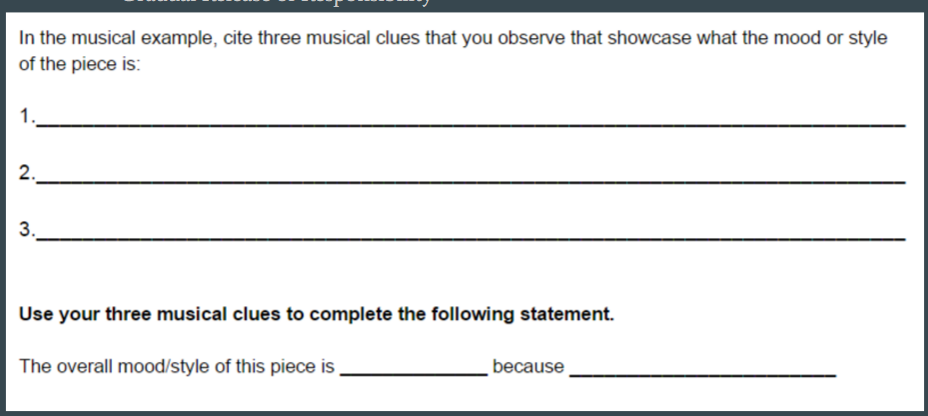
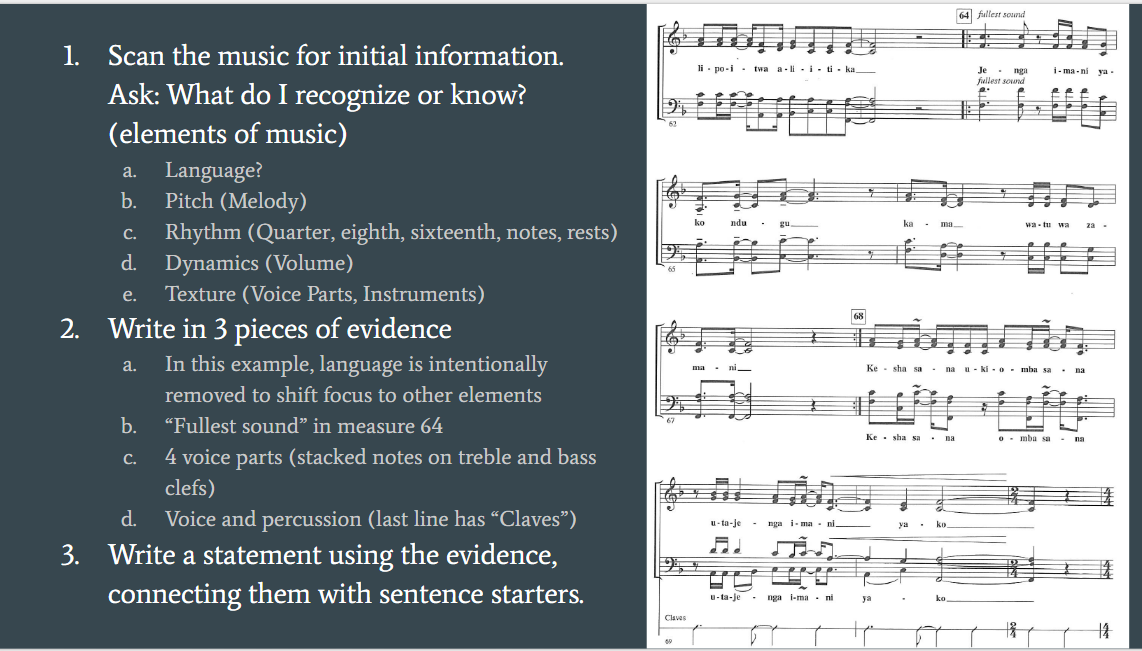
At a collaboration session, he shared with staff what gradual release of responsibility looks like in his classroom.  Take a look:


*This was an organizer to get students thinking before they wrote.

*You might notice the lyrics are not in English.  This was intentional.  He noticed students paid more attention to lyrics than to the music.  He decided to help them focus mostly on the music.


Thursday, March 23, 2017

Writing in Math- Graphic Organizer

Heather Zimmerman contributed this post. Click here for more of Heather's thinking.
This is part of a series of posts about writing coaching cycles, which include examples from several disciplines.


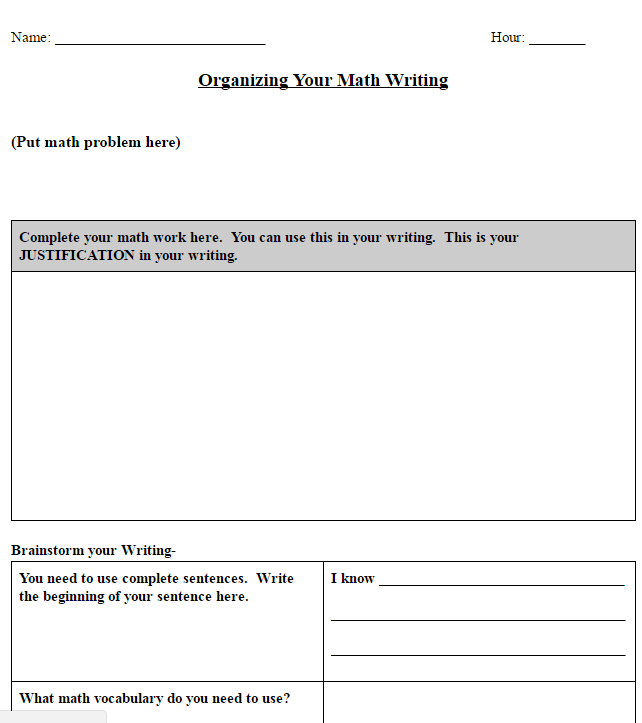
During a coaching cycle, I was working with math teacher individually.  A trend I noticed was that teachers commented on how they were looking for a tool to help organize students’ thoughts. Together, a math teacher and I, created this graphic organizer.  Click here.


One part we got stuck on was that the writing is so individual depending on the math content.  So it is hard to make a common graphic organizer.  We are hoping this is a start.  What math writing tools do you have?  Share in the comments!

Tuesday, March 21, 2017

Writing in Band- A Reflection Organizer

Heather Zimmerman contributed this post. Click here for more of Heather's thinking. 
This is part of a series of posts about writing coaching cycles, which include examples from several disciplines.

As I went through my coaching cycles, I was excited for my time to work with the music department. I did not have as many opportunities as I would have liked working with that department.  


The band teacher expressed he wanted a way for students to focus on the recording of a concert that could carry over into a reflection.  Together we (me and Brad Curran) made a checklist of ideas to look for during the viewing of the concert. The band teacher also added sentence starters.  To view the organizer, Click Here.  

Thursday, March 9, 2017

Coaching Cycle Protocol

Heather Zimmerman contributed this post. Click here for more of Heather's thinking.
This is part of a series of posts about writing coaching cycles, which include examples from several disciplines.


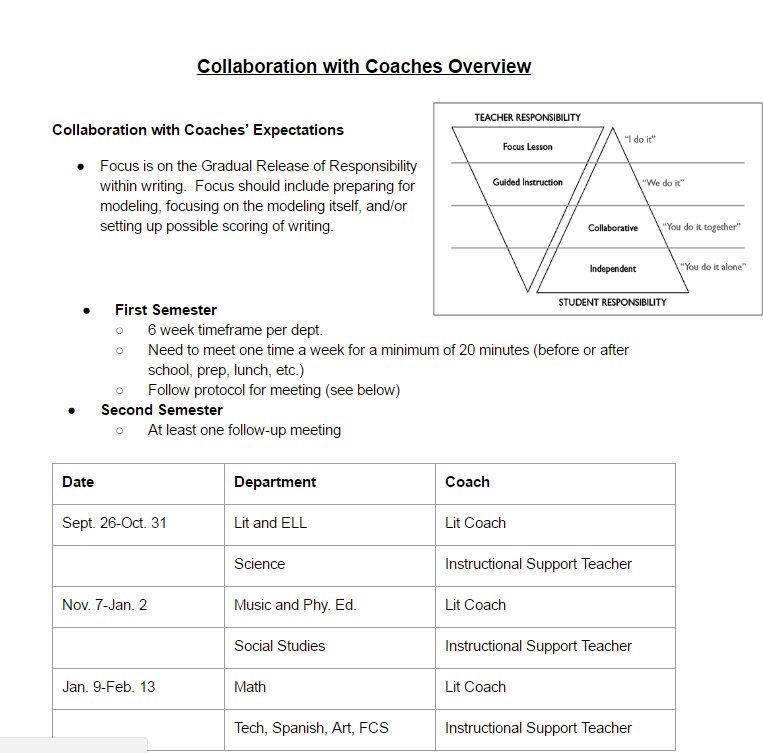
How many of you sometimes feel as if you spend more time putting out fires or doing quick coaching in the hallway during passing time?  This year our district implemented the idea of coaching cycles in grades 6-12 that focused on writing and gradual release of responsibility.  


This is how my middle school approached the initiative:
  • Everyone will meet with a coach
  • 6 week cycles
  • Meet for 20 minutes once a week.  Could be longer if needed for planning in place of the following week.
  • Work on something related to our school goal- writing.
  • Teachers met individually with a coach. If it worked, teacher could meet as a group, but due to schedules that rarely worked.

Here is the protocol sheet (created by me and my school’s IST or Instructional Support Teacher - Tom Anfinson) that was used to help organize and track time with teachers.  Click here.


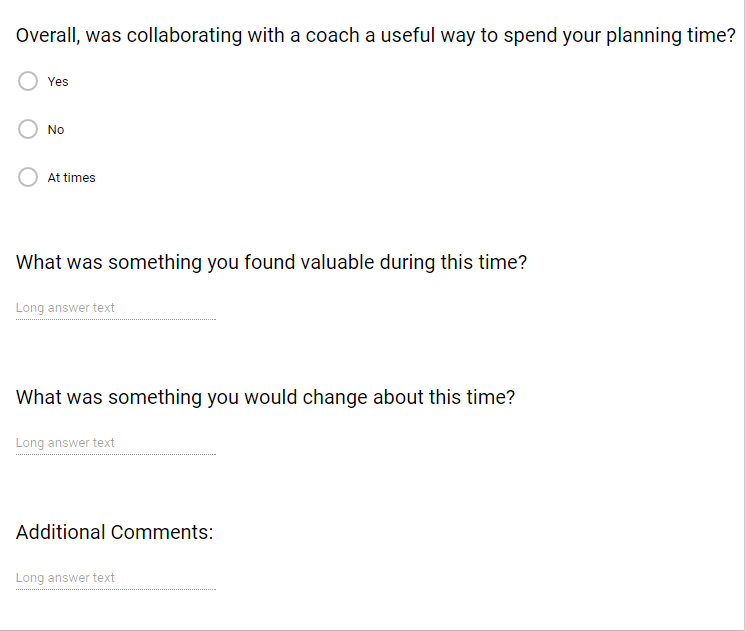
Here are questions from an optional Google form after the cycle had ended:


I loved having the more formal cycles.  It really helped to meet with everyone and the feedback has been positive from the teachers who submitted the optional form.

How does your school approach coaching cycles?  Share any resources down below!

Wednesday, May 18, 2016

Whole Class Novel: Part Deux

Andrea Reichenberger contributed this post. Click here to read more of Andrea's thinking.

Click here to read Andrea's previous post about the whole class novel.

A few months ago I shared my thoughts about using the whole class novel in the ELA classroom.  Although I’m certainly not a proponent, I argued that it could be done, but only when used in the correct context.  Recently, I had experiences with two different schools asking me the same question: Should the whole class novel be used in a science and/or social studies classroom?

Admittedly, the teachers’ hearts are in the right place.  Of course we want to encourage students to read and of course we want teachers to incorporate literacy into their classroom instruction, but using a whole class novel--especially in science or social studies isn’t the way to go about it. There are more authentic ways to promote literacy within these areas.  

Let’s start with the standards themselves. The Next Generation Science Standards (NGSS) are very content-driven and if you’ve looked at them, there are a significant amount of topics to cover.
 
If you use the National Council for Social Studies (NCSS), you are lucky, as the C3 framework clearly outlines the connections to the literacy standards. However, the ELA standards also clarify specific literacy skills in that should be addressed in science and technical subjects as well as in History and Social Studies.

(History and Social Studies) ELA-LITERACY.RH.9-10.1
Cite specific textual evidence to support analysis of primary and secondary sources, attending to such features as the date and origin of the information.

(Science and Technical Subjects) ELA-LITERACY.RST.9-10.1
Cite specific textual evidence to support analysis of science and technical texts, attending to the precise details of explanations or descriptions.

Novels are not primary sources or technical texts, but maybe we need to remind teachers that literacy isn’t just about reading.  The reading-writing connection also needs to be addressed in all disciplines. The writing standards for both science/technical subjects and history/social studies are the same. What types of text should we use in science and history when we review the writing standards listed below?  

ELA-LITERACY.WHST.9-10.7 Conduct short as well as more sustained research projects to answer a question (including a self-generated question) or solve a problem; narrow or broaden the inquiry when appropriate; synthesize multiple sources on the subject, demonstrating understanding of the subject under investigation.
ELA-LITERACY.WHST.9-10.8 Gather relevant information from multiple authoritative print and digital sources, using advanced searches effectively; assess the usefulness of each source in answering the research question; integrate information into the text selectively to maintain the flow of ideas, avoiding plagiarism and following a standard format for citation.
ELA-LITERACY.WHST.9-10.9 Draw evidence from informational texts to support analysis, reflection, and research.

There are better ways to promote literacy in the science and social studies classrooms.  Do a book talk. If you are a reader, share the books you are reading with your students (both novels and informational texts). If you read The Martian and 1984 and think they would be great books for students to read as an extension--share that with them!  If you find an excerpt that ties in with your content, take a few minutes and read it aloud or provide a copy and have the students write a response or reflection and then talk about it!  Collaborate with an ELA teacher or literacy coach in your building if you need more ideas.

As a science or history teacher, you could certainly use a novel excerpt that aligns with a topic in your content area. Use it to create a close read with text dependent questions.  Then have the students do a close read of an informational text (maybe something from their textbook) on the same topic to make intertextual connections. Develop questions that align with both the literacy and the discipline standards.

I strongly encourage teachers to use authentic mentor texts from within their content area.  Scientists don’t use novels when researching.  The discussion about the texts we use needs to begin with not only the type of text, but also with the standards.  There is so much to choose from!  Photographs, video clips, research documents, journal articles, charts, graphs, diagrams, polls, law documents, personal accounts, newspaper articles, artifacts, and the list goes on and on.  A rich literacy experience can be created within any classroom without using a whole class novel.

Wednesday, March 9, 2016

Music and Literacy (Part 2)

Sharon Seely contributed this post. Click here to read more of Sharon's thinking.

This past fall one of our district music teachers, Kathy Wacker, attended the American Orff Schulwerk Association National Conference.   When I saw her on her first day back, as I asked, “Hey! how was the conference?” she smiled and excitedly answered, “We need to talk.  I have so much to share with you.” She was so fired up about what she had heard/learned about the correlation between Music and Literacy.  This was the beginning of a learning opportunity.

We have now presented at two district-wide training opportunities for K-8 teachers.  It has been an amazing partnership. I have learned so much from her and she tells me that it goes both ways. 

So, what are we sharing about Music and Literacy…. (Part 2)

Putting new information to music helps students retain the information for years to come through repetition…songs get stuck in our head and those new synapses extend into long-term memory…imprinting the information.  Adding body percussion or other kinesthetic action further cements the new information. 

Sound Stories are a great way to introduce new vocabulary, improve fluency and engage students. Sound Stories contain highlighted vocabulary words represented by sound options, chosen and created by student volunteers. The object is that the sound in some way represents the meaning of the highlighted vocabulary word.

Sequenced sound effects can be retold in story format; written, shared and story-line variations discussed.

Songs are for everything:  rules, motivation, informational facts, reading strategies, plus so much more.

Songs can be re-worded and melodies reused:

Comprehension Songs (from Capo Unified School District):
Visualize…to the tune of “Jingle Bells”
Visualize, Visualize
I can visualize!
Words make pictures in my head, of all that I’ve just read!

Visualize, Visualize
I can visualize!
People, places come alive when I visualize!

Questioning….to the tune of “Are You Sleeping”
I ask questions,
I ask questions,
As I read –
As I read –

Who… what, where, when and why
I’ll find answers.

I’ll find answers.

Monday, March 7, 2016

Music and Literacy (Part 1)

Sharon Seely contributed this post. Click here to read more of Sharon's thinking. 

This past fall one of our district music teachers, Kathy Wacker, attended the American Orff Schulwerk Association National Conference.   When I saw her on her first day back, as I asked, “Hey! how was the conference?” she smiled and excitedly answered, “We need to talk.  I have so much to share with you.” She was so fired up about what she had heard/learned about the correlation between music and literacy.  This was the beginning of a learning opportunity.

We have now presented at two district-wide training opportunities for K-8 teachers.  It has been an amazing partnership. I have learned so much from her and she tells me that it goes both ways. 


So, what are we sharing about music and literacy….

Music and Reading Comparison Chart

Reading Skills
Music Skills
Example Songs
Letter Recognition
Note Recognition
ABCs
Sound/Symbol Association
   (decoding)
Sound/Symbol Association
ABCs
Decoding YouTube
Syllabication
Performing Rhythm Patterns
Raps
Vocabulary Development
Vocabulary
Dr. Seuss (color coding rhyming words)
Rhyming
Rhyming Lyrics
Down By the Bay
The Ants Go Marching
Nursery Rhymes
Parts of Speech
Elements of Music
Schoolhouse Rock-Grammar
Sentence Structure
Phrase Structure
Schoolhouse Rock
Punctuation
Articulation
Five Little Monkeys Jumping on the Bed
Story Writing
Composition
Song Lyrics
Comprehension
Aural Analysis
Song Lyrics
Silent Reading
Audiation
Song Lyrics
Fluency
Fluency
Over the River and Through the Woods
Phoneme Awareness
Pitch Awareness
Apples and Bananas
Letters, Words and Sentences
Notes
Bingo
Phrasing
Phrasing
Shoo Fly
Visual Focus
Visual Focus
Row, Row, Row Your Boat
Expressive Skills

Stomp
Speech Signals
Listening Skills
Auditory Signals
Pop Goes the Weasel
Witch Doctor
Choral Presentation
Rhythm
Rhythm
Chants (word wall)
Communication
Communication
Abiyoyou
Thinking  - higher level questioning
Thinking – higher level questioning
Adding/changing lyrics
Writing new song/story
Memorization
Memorization
Fifty Nifty – states song

By Linda Brown, May 21, 2008 National Association of Music Education
Kelsey Tarbert 2012 Oneota Reading Journal Learning Literacy Through Music
Jean McIntire, Developing Literacy through Music

Wednesday, May 27, 2015

We've Seen the Model - Now What?

Lisa Weiss contributed today's post. For more information, read Lisa's other posts about her district's "laser-like focus on the intentional use of literacy in service of our contents."

My vision of how this would play out changed once we returned from winter break. I thought that once teachers had the look and feel of the gradual release, the next steps would be planning for that same process of modeling and guiding writers. Time was provided each week during January collaboration times for such planning, and I had February 4th set as a time for teachers to come together to look at student writing--to see how their modeling, and use of GRR worked for their students.

By mid-January teachers were asking for more time to prepare. As I had conversations with teachers it was clear that this was an entirely new way of providing instruction, and fear was ruling. It became abundantly clear that we do not have a culture of learning established in our secondary schools. While it was not a shocking revelation, it was an insight that forced me to reflect on how starting with belief statements, or starting to build a culture of learning, would have been wise. Since I missed the boat on that critical aspect of professional development this year, I considered how we might be able to lead teachers into that culture shift next year. Turns out this was a glaring problem to many of the secondary leaders, and we are currently engaged in the messy work of planning how to foster that culture with teachers next year. More on that in the fall...

Back to January: I have the sense about me to listen to what the teachers say, and they were saying, “Slow down!” I knew it was necessary to pull back, and allow more time for teachers to plan for writing models, but applying the brakes was a disappointment because there was a tradeoff of time involved. To provide more time on the GRR, we were not going to be engaged in learning about and practicing close reading with the depth I had envisioned. I also felt, in some ways, that by allowing more time that some teachers might think we were sending the message that we do not need to continue using the GRR when the message was quite contrary. The message was this: We’ve heard you. We’re going to slow down and allow for more time to plan. We will not throw a new strategy at you in April, but….we need to continue practicing the GRR when modeling writing because the GRR is not going away, nor is our focus on writing.

The revised plan created more time in January for learning about the GRR with articles, videos, excerpts from Better Learning, and additional teacher demonstrations of modeling student writing--all dependent upon what teachers needed in each building. February was the new time frame to be engaging students in GRR when teaching writing; reading the writing students completed was also an expectation.

March 11th was the date that was designated for reviewing student writing and having conversations about the writing. I created a student work protocol, and placed teachers in small groups, with an English teacher or a literacy or instructional coach in each discussion group. I felt the English teacher was critical to the success of the conversations because, as teachers of writers, they hold the most insights when analyzing student writing. In the end, feedback was overwhelmingly positive! Many coaches reported that people, again, were saying that this was the best professional development session they had been to--we had similar feedback in December! The literacy coaches who were sharing this feedback, all commented about the depth and quality of conversations that took place. It was a time devoted to thinking about students, their writing, and the feedback that could be offered to students, and teachers appreciated the process.

We spent March engaging students in another round of writing, so the April literacy-focused professional development session was an additional opportunity to read, converse, and analyze student writing. The last (May) collaboration session of the year will focus on our data from English and social studies classes, the data sources for W4 and W9 goals; I am excited to receive all of it, as I have had many conversations with excited literacy coaches--boasting about the writing growth students have made this year. I’m anxious to see what that means as a district, and wondering what that means for professional development next year...