Friday, November 29, 2013

The CCSS: Making Sense of Argumentation!

Today's post is brought to you by Bobbi Campbell.

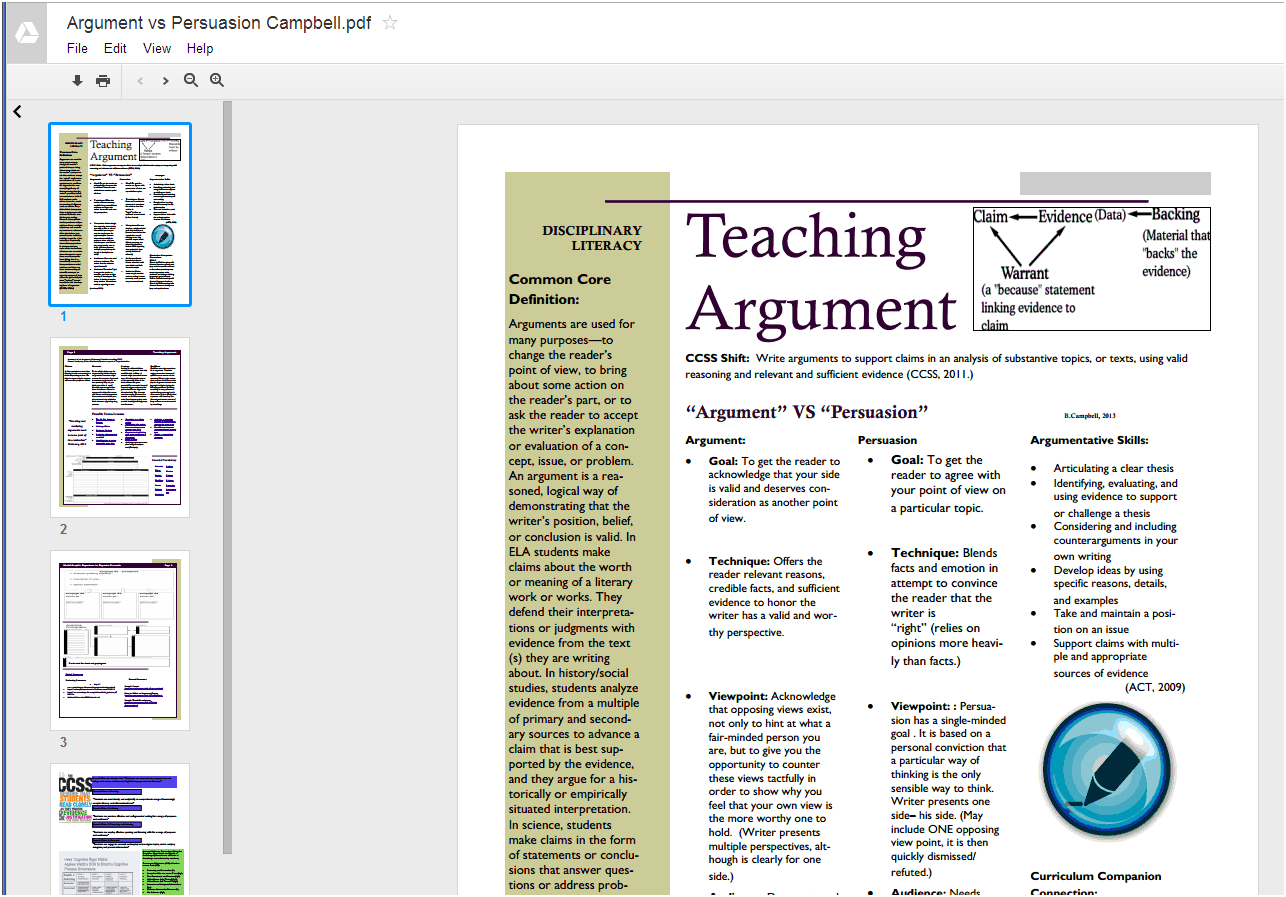
Planning for instruction takes time, so I wanted to develop a tool that would support coaches and teachers in planning for instruction – specifically, planning for a shift in teaching and learning from persuasion to argumentation.  

Before I could jump into resources regarding this shift, I wanted to provide the research supporting this shift; hence, the reason for the development of this handy dandy resource in the form of a newsletter/hot-linked document.  This document’s purpose is to provide the research supporting the shift from persuasion to argumentation, as well as to light a fire under students’ butts to get them excited about digging into text, while tracing arguments, analyzing the rhetoric and style of some authors, and eventually towards writing their own fantastic and dynamic arguments.  

Who knows, we may create a mutation of argumentationators (disclaimer:  argumentationators is not really a word, silly.) There are links to possible focus lessons, vocabulary, and graphic organizers.  Knock yourself out and choose the resources that best match your style, kids, and/or teachers. 

(Note: Image below is a screenshot. Click on hyperlinked text above to view the PDF in GoogleDrive.)

My only request is if you use this resource, please post comments and feedback  so I can revise.

Wednesday, November 27, 2013

No Argument Here

Today's post is brought to you by Andrea Reichenberger.

There is a lot of sensation surrounding the Common Core State Standards, and it isn't just in our state. While on Facebook, I noticed that The New Republic posted an article written by a University of Iowa English professor entitled "Federal Bureaucrats Declare 'Hunger Games' More Complex Than 'The Grapes of Wrath.'" Its argument is based on the Lexile measure used for text complexity. However, if one reads the CCSS document carefully, it is clearly stated that text complexity is based on three important components - the Lexile being only one of them. I was even more disappointed when I noticed that NCTE (National Council of Teachers of English) posted the same article. The standards aren't perfect, but many of the arguments against them are misleading and continue to perpetuate untruths.

What people need to understand is that the CCSS provide a clear list of skills that our students need in order to be successful in school and outside of school—and I say this in regard to the literacy standards as I am more familiar with them.
Why would we argue against our students being able to read at grade level?
Why would we argue against students using evidence from a text to defend their thinking?
Why would we argue against teaching our students critical thinking skills that allow them to analyze, synthesize, and write effective arguments?
Why would we argue against students participating in collaborative discussions and building on the ideas of others in those discussions in a respective manner?
Since the implementation of the Common Core, our instruction has dramatically improved and has become more focused.  The standards are designed with common language and skills at the appropriate grade levels.  In my district, this is imperative as it is a very transient one, so when our students are bounced from one neighboring district to another (which is often the case), they allow for consistency and the opportunity to build upon the skills and help to avoid providing disjointed instruction for those students.
Several well-known action researchers from across the country have used the Common Core to guide their instruction and have evidence to show that their students have made huge gains.  As a coach, I have the pleasure of visiting several classrooms and the opportunity to witness the powerful learning that is a result of these standards.  The learning is exciting and is based on best practices.  Unless you are an expert and well-informed in the area of education, and have a deep understanding of instruction, the standards, and what is best for student learning—there should be no argument against them.

Tuesday, November 26, 2013

The Spotlight Still Shines on the CCSS

Today's post is brought to you by Heather Zimmerman.

The Common Core State Standards are a hot topic.  They were when they were introduced.  Then resources starting flooding the market with ideas and lessons tied to the CCSS.  Now they are are in the  spotlight because of the debate if these standards should be used.

In my district, teachers have spent a lot of time diving into the standards.  I have been apart of teams with the literacy teachers in my district, and we have spent quite a bit of time unpacking the standards to explore and understand them.  These learning goals have a focus in all areas of literacy that encourage teachers to plan for different aspects than just the reading and writing component. 

The standards are a bar to reach for, and teachers should not only reach for the bar, but continue to raise that bar.  

Here are some resources teachers have shared with me that they turn to:
  • Checklist for standards-  Teachers shared they enjoyed this site as they started to use the Common Core State Standards.  Then they could check off the standards as they use them throughout the year to ensure they were giving enough time to each standard. http://www.englishteachersfriend.com/common-core.html


The discussions that happen with the learning process in understanding the Common Core State standards highlights different interesting topics.  I just had a conversation with a few coaches and a teacher analyzing RI.7 and the progression sixth to eighth grade.  There was a debate at the seventh grade level if the text had to the be exact same as the medium portrayal.  This discussions about analyzing different mediums and how that can be done was intriguing.  

I also recently was reading a section in Notice and Note by Kyleene Beers and Robert E. Probst.  I really enjoyed the discussion about text-based questions.  Beers and Probst point out that the standards are focused on this form of question.  They shared a bit of history regarding this area in education and highlighted the importance of focusing not only on the text, but the reader too.  

The spotlight will continue to shine on these standards for awhile.  I think it is is important to keep in my mind these standards are goals.  With all goals, the process can be messy sometimes.  But learning is always messy.  You keep the goal in mind though and always aim for the bar.  And once you hit the bar, you can raise the bar.

Friday, November 15, 2013

What's Hot with the Common Core?

Since the CCSS have come into the picture, I have seen more “intentional” teaching than ever before.  Teachers know what they are teaching and why they are teaching it. They have an understanding of the vertical alignment as well.  There is more of a push to reach the standards because they know what is expected of their students next.  

To be honest, I was a classroom teacher three years ago, before the CCSS were adopted by so many states. I didn’t even know the standards for my grade level (first grade).  All I knew were the assessments I had to give for report cards.  The curriculum was what we taught - not the standards.

The CCSS now brings a level playing field for students and teachers.  We teach the standards now and the curriculum is our resource. Teachers are understanding the "why” more than ever and not so focused on the “what.”  Expectations and rigor have risen and the most remarkable thing  . . . students are rising to the challenge.  I have observed some of the most incredible lessons in the last year.  The Common Core not only has the students more engaged in their learning but the teachers more engaged in their teaching.
It’s a remarkable thing to witness and be a part of.

We have been working so hard in my district becoming familiar with the Common Core State Standards and implementing them with success over the last three years.  I am listing below the three“hottest” topics in regard to CCSS in my district and resources that we use to tackle them.  

Unpacking the standards and SMART Goals

“I Can” Statements and Learning Progressions

“Close” Reading

Wednesday, November 13, 2013

Conversations about the Common Core

Today's post is brought to you by Julie Schwartzbauer.
With the arrival of the Common Core State Standards came a great deal of anxiety.
Teachers are still trying to wrap their heads around teaching to meet a standard.  One of the questions I hear often is “Why aren’t teachers given direction on how to teach the standards?"  My reply is that the standards establish what students need to learn, but not how teachers should teach.
I feel like I spent a big part of last year trying to convince teachers that they know how to teach.  We have excellent teachers in our district who are now questioning their own best practices.


Sarah Brown Wessling is the 2010 National Teacher of the Year and is Teaching Channel’s Teacher Laureate.  Sarah shares 10 of her “ah-ha” moments when working with the Common Core.  The first one really resonated with me.
1.     Common isn’t same: the standards are not curriculum.
So often, we educators hear the word “common” and assume this means the same. But having common standards does not mean that we have common curriculum, or that we should be common teachers. Certainly there are advantages to consistency in what students are learning, but that need for steadiness does not translate to everyone turning to the same page in the same textbook at roughly the same time. In fact, the Introduction to the CCSS reminds: “Teachers are thus free to provide students with whatever tools and knowledge their professional judgment and experience identify as most helpful for meeting the goals set out in the Standards.” The standards purport what students should achieve, leaving the materials and means to school districts and teachers.
Read Sarah’s additional 9 “ah-has” by following the link below.
I truly believe it comes down to building teacher knowledge in understanding the standards and then building on their expertise to meet the needs of their students.  This takes time, but it’s well worth it.

Monday, November 11, 2013

How Weird Are We?: An Experiment

Today's post is brought to you by Carrie.

Recently I drove home...many hours...from a great meeting full of “Literacy” people. Long after my iPod died (surprise) and I had been through my mental to-do list (twice), I found myself reflecting back on the meeting. I felt inspired by the excitement, knowledge, and passion by the people who were present, and as I mentally catalogued the day I noticed that at any (every) given moment someone was pulling a new resource out of their bag. Books, webpages, expert names, videos, documents….someone always had “just the thing.” We would all stop, nod if we knew about it--grab for it if we didn’t, and then continue on.  As I thought more about it, I began to wonder…..is it just literacy people or are all teachers that excited to share resources?? 

Or in other words, how weird are we literacy folk?

Recently I decided to put my question to a very unscientific experiment with a group of the most scientific people I know: the Science PLC team.  I was invited to a discussion about meeting the Common Core State Standards for disciplinary literacy. I knew that the PLC included a range of opinions about incorporating literacy standards in content areas. I thought asking the team to come into the PLC meeting ready to share a “new” favorite resource might work in my favor in a few ways: a conversation spark, a new resource, me in a coaching role rather than teaching or inservicing, and, of course, my natural curiosity regarding literacy people satisfied.

Cut to day of the meeting: everyone walks in with arms full...good.
Some arms contain more than a resource (like papers to grade)...ok.
“Let the sharing begin!” (Me)
“Um this is mine” (Teacher holding ...the science curriculum textbook)...oh no.

So it started off rocky, I will admit. But then one person shared a resource that the biology teacher had also read; and then another person showed this website that lets kids do all these science things interactively (http://interactivesites.weebly.com/science.html)… and before I knew it, things were a little chaotic in a good way because I couldn’t get people to stop talking.

Slowly, I steered the conversation to the standards. I wanted to provide a quick resource that could also be an “anchor” for future conversations so I showed DPI’s LiveBinder resource on Disciplinary Literacy (http://bit.ly/WIdislit)


I explained what the resource was and let them know it was available for further investigation should they be so inclined. Then I showed them two specific parts: the cheat sheet for anchor standards and the close reading technique (both  found under the tab on the left side called: Half Day/Full Day Module). By providing these two resources, I felt teachers were receptive and open. My future plan is to continue building in support by slowly adding the text feature and text structure resources (in the same place) and also training a member of the Science PLC team to lead the group through the rest of the module and resources.

All in all, I was able to accomplish my PLC task: provide a brief introduction and a tangible, realistic resource for disciplinary literacy as part of the standards outlined by the Common Core. One problem---my experiment remains inconclusive; the good news is the Social Studies PLC called and I plan on collecting some data!

Friday, November 8, 2013

They Are Gold!

Today's post is brought to you by Lisa.

Lucy Calkins writes about how we have a choice when looking at the standards: we can look at them as curmudgeons, or we can look at them as they are gold. At a first glance, it appears as though there is much to be a curmudgeon about, but when teachers have the opportunity to slow down, to read and think about what these standards have our students engaged in, there are far more reasons to look at them as they are gold.


Over summer I taught an Advanced Institute with the lovely Robyn Bindrich and Paul Walter, through the Fox Valley Writing Project, and the focus of the course was all about the Common Core State Standards. The days were generally set up for us to do some writing, discussing texts, and learning about a new CCSS topic each morning; the afternoons were designated for the teacher leaders to investigate their inquiry topics, collaborate with peers, and begin thinking about the professional development they could offer as a result of the Institute. There was one activity that got such an overwhelmingly positive reaction that it made me think about how wise coaches would be to emulate it because, through the simple act of slowing down, to investigate one standard, much insight was developed.


The activity was shamelessly robbed from Doug Buehl; it was a modification of a crosswalk of the standards that I saw him model at the Wisconsin State Reading Association’s Convention last February. What we did, at our Advanced Institute, was this:
  1. I wrote the kindergarten standard for opinion (argument) writing on a piece of chart paper.
  2. I wrote the first grade standard for opinion (argument) writing on a separate piece of chart paper.
  3. I then modeled how I went about determining what was similar and what was different between the two standards, and I recorded what was different at the bottom of the first grade paper. 
  4. The teachers were then to follow that example. I had them grouped so that all of the elementary people, all of the middle school, and all of the high school participants were working together. In the end, I wanted them to see the K-12 progression, but I also wanted them to be engaged in a discussion around the grade level standards that were most applicable to each of them. Each grade level group worked to understand the standards, discussing one piece of much lager puzzle.
  5. After grade level teams were able to discuss the differences between standards, every person was “assigned” a grade level to report out on. I began with reminding everyone of what the opinion (argument) standard looked like at kindergarten, and how it was different from first grade. The next elementary teacher shared the second grade standard, and then shared the differences between it and the first grade standard, and around the room we circled, one person reporting out the differences between two grade levels, with everyone listening and thinking about what was required at each grade level. Every one in the room had the opportunity to see where the standard was born, and how it grew at each grade level, ending with how it looked for high school juniors and seniors.


We did this exact activity for narrative writing and informational/explanatory writing. When it came to the days we focused on the speaking & listening and language standards, we had to modify this activity because those standards did not lend themselves as well to this crosswalk.


The discussion we had, as teachers shared differences between grade levels, was fascinating. We wondered, hypothesized, inferred, questioned, and problem-solved along the way. The discussion was powerful, and I think there are some reasons, found within the process of the crosswalk, that attributed to the rich discussion. The most important, in my not-so-humble opinion, is that teachers were focused solely on the standard of opinion/argument writing; this one standard was given all the attention during our new learning portion of the morning (approximately one hour). I admit that this was a luxury that we often don’t have in schools, but when there is a need, we can often be creative about finding a way…


The second reason I think this was so powerful was because in schools, we generally look at the standards that we are to teach, at the grade level we teach—we may look behind and ahead a year, but there is rarely time to look at the life a single standard. It’s a different story that teachers create when they look at the entire progression versus a limited look at the standard they must teach, and possibly a few that hover around the grade level they teach. When looking at the entire K-12 progression, there are subtle differences and those small differences make the task of transitioning less daunting. A teacher begins to tell him or herself that if the teachers before them teach their standards, their grade level standards are manageable.


The last reason I think this activity produced such an interesting discussion, is that when teachers are given the time to think about the K-12 life of a standard, they see how their grade level standard fits into the journey, with the end goals at 11th-12th grades. When we only look at isolated standards, we often complain that the standard does not make sense at our particular grade level, but when we see what has happened with the standard by the time it gets to our grade levels, and where it is expected to go after it leaves us, the entire scope and sequence makes more sense. We see how our efforts to teach our grade level standards play into the next grade level, creating a sense of a hidden accountability to next year’s teacher.


I recognize that fact that I had an ideal situation—time to provide this type of activity, with time to reflect on what was discovered. I fully understand how BIG the ELA standards are; I get it, but if we want our teachers to think of them as gold, we need to find ways to provide time that slows down the thinking about standards, and shows how each grade level contributes to the end goal!

Lisa references Pathways to the Common Core (Lucy Calkins, Mary Ehrenworth, and Christopher Lehman). A portion of the book is available online. See pages 7 - 8 for the passage Lisa references in which Calkins describes viewing the standards as gold.