Showing posts with label Workshop. Show all posts

Tuesday, February 21, 2017

Workshop Model: Reading Mats

Jaimie Howe contributed this post. Click here to read more of Jaimie's thinking.

Click here to access a PDF of a Reading Mat.

As the year has progressed and we have been learning more and more about the Lucy Reading Units of Study, I have been noting specific components and resources that I believe are extremely beneficial.  Last month I wrote about Text Bands and Learning Progressions.  This month I would like to share a very simple resource, yet one that has proven to be essential to our K/1 students and teachers: The Reading Mat.  The great thing about this tool, is that anyone can implement it, whether you are using the workshop model or not. The reading mat is just an organizational tool to keep kids on track during independent reading time. Lucy states, “Stacking books on the reading mat allows kids to plan and be intentional about their reading.” This has proven to be true in all of our classrooms.  We have seen a huge increase in on task behavior and ultimately, volume of reading.


The reading mat is just a file folder with a red sticker/paper on one side and a green sticker/paper on the other - showing kids where to start (green) and stop (red).  Students make a stack of their books on the green side and place them onto the red side after they have finished reading each book.  If they read all the way through, they then work backwards, reading them again.  You will notice, however, in the pictures below that one reading mat has quite a few more books than the other.  This was an inconsistency we noticed throughout our district.  It was important for us to clarify for teachers that students reading at a kindergarten or first grade level need to have at least 10-15 books at their independent or instructional reading level to place in their mats along with poetry and sight words.  Students in classrooms where 10-15 books were in each book box were reading a much higher volume than those with only 5-10 books. Challenge your students to build their “reading muscles” by reading all the way through their mats and back every day.


Thursday, January 26, 2017

Text Bands and Learning Progressions

Jaimie Howe contributed today's post. Click here for more of Jaimie's writing and thinking.

In my last post, I reflected on the initial professional development associated with my district’s implementation of the Lucy Calkins Reading Units of Study (RUOS). I identified the areas of Text Bands and Learning Progressions as areas that I wanted to increase my knowledge in. After reading more about them in Lucy’s, Reading Pathways, I realized just how integral these two components are to the Reading Workshop, so I prepared a professional development session for our Back to School In-Service Day, solely focused on these two topics. I would like to share what I did for this professional development and also the effects I have witnessed these two components have on classrooms/students this year.

In planning for this professional development session, I wanted teachers to have as much time as possible digging into these concepts rather than listen to me tell them why they are important. First, I gave a very brief overview of each topic, indicated where the information could be found, and recommended an activity for digging deeper. Below you will find a brief outline of how this information was presented:


Fast forward to now, four months into full implementation of both the RUOS and WUOS, I find myself so grateful for the time I spent digging into these two topics because I am witnessing their power first hand - and it is AMAZING!  One of the comments I made in my last post was:

“The most exciting part of this whole journey will be witnessing the extraordinary growth
in our students’ literacy development and their flourishing love of reading due to
great teaching and tons and tons of opportunities to read and write”

Boy was I right! I have had the opportunity to do a lot of team teaching with the units this fall in several grade levels.  The engagement level I am observing and the amount of books students are reading is astonishing! I believe that knowledge of the text bands has decreased teachers’ focus on what specific level students are and put it more on what the students can do with any particular text. Introducing learning progressions to students has also improved goal setting and student accountability  If you unfamiliar with text bands and Lucy’s reading learning progressions, I highly recommend you take the time to learn more about them.  They truly are powerful tools..

Monday, April 11, 2016

Embracing a Workshop Model (Part 2)

Jaimie Howe contributed this post. Click here to read more of Jaimie's thinking.

Click here to read Jaimie's original post about embracing a workshop model.


Finally, I’m getting around to updating everyone on my district’s progress in moving forward with a Reader’s Workshop Model district wide.  Below, I will briefly explain the process our district took to evaluate the Lucy Units of Study for Teaching Reading, links to resources we used, and, ultimately, how we finally came to our decision.


Starting in November, the district formed a team to review the Lucy Units of Study for Teaching Reading.  The team consisted of classroom teachers K-5, special education, intervention specialists (Title 1), District Reading Specialist, and district administration. Each of the elementary buildings were equally represented.  We met for two half days and 2-3 one hour after school meetings.  During those meetings we spent most of the time in grade level groups reviewing each grade level’s materials. We used a rubric created by Louisiana Believes (Louisiana Department of Education).


The rubric correlates to the Common Core State Standards (CCSS) and allowed us to really break apart the materials into chunks and determine strengths and weaknesses in specific areas.  Below are the specific components that were represented.


I: Text Selection
II: Foundational Skills
III: Questions and Tasks
IV: Scaffolding and Support
V: Writing to Sources and Research
VI: Speaking and Listening
VII: Language


Components, I, III, IV, and VII were very strong in all grade levels.  The other components also scored well across the board; however, ranged a bit more between grade levels.


Along with the rubric, teams also viewed many of the online resources/videos available from Heinemann: Units of Study for Teaching Reading and the Reading and Writing Project.  I highly encourage you to take a look at these if you’re considering implementing a Reader’s Workshop Model in your district.


At our final meeting, we met an analyzed a spreadsheet that had been created, compiling all of the grade level’s rubric scores. It seemed everyone agreed that we should move forward with purchasing the materials; however, a final decision was not made until all participants participated in a Google Form Survey, allowing each individual to voice opinions and/or concerns with the potential of moving forward.


We just got the e-mail last week indicating that the kits have been purchased!  I am so excited to be a part of this process and look forward to writing more about how we proceed with professional development and implementation of the materials.

Monday, January 11, 2016

What’s this I’m hearing about Language Workshop?

Julie Schwartzbauer contributed this post. Click here for more of Julie's thinking.

In the Appleton Area School District, we have begun to build knowledge and understanding surrounding the big picture of language workshop.

This is what we have come up with so far...

Language workshop is a protected time of the day to build listening and speaking comprehension through reading aloud and thoughtful, collaborative discussions of complex texts. Teachers provide explicit instruction in grammar, punctuation, and conventions of language through literature and informational texts using the workshop approach.  In the process, students acquire knowledge of content, vocabulary, text structures, and language functions, including grammar and mechanics. This in turn supports the work we do in other workshops.
So you might be wondering how the standards fit into language workshop....


We feel that the language standards can be taught within language workshop, and woven throughout reading workshop, writing workshop, and other content areas.  They are taught through the following components: 
  • Read Aloud / Shared Reading
  • Wordless Picture books
  • Poetry
  • Mentor Authors
  • Interactive Writing/ Shared Writing
  • Phonics Lessons
  • Words Their Way

With the anchor standard being the same for grades K-12, it is important for teachers to understand that the guiding principle is that core language skills should not change as students advance; rather, the level at which students learn and can perform these skills should increase in complexity as they move from one grade to the next.

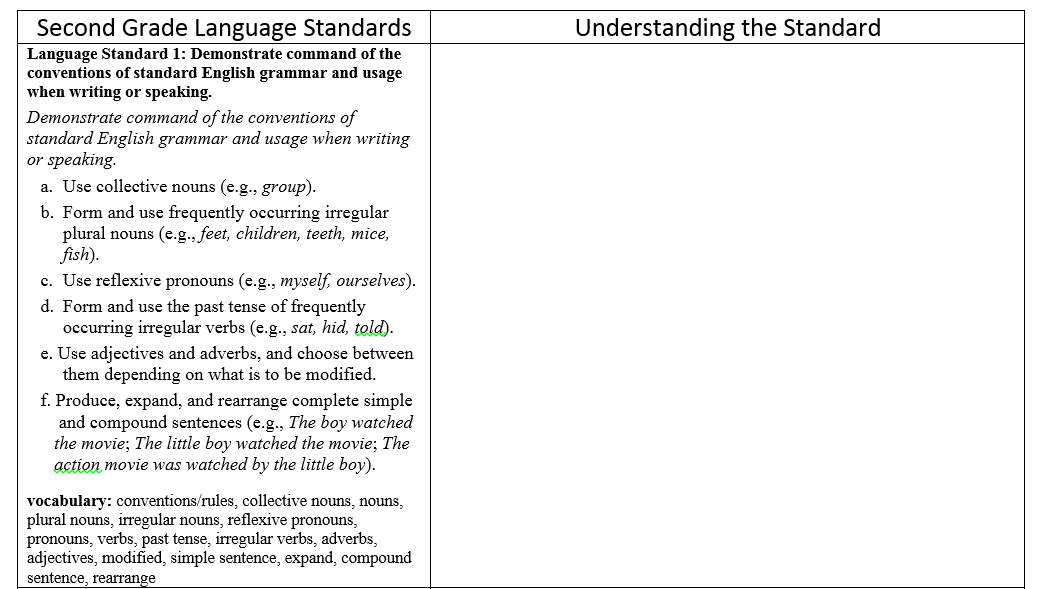
We know that students in early grades can not jump over developmental milestones in order to master the anchor standard.  Therefore teachers must build their expertise in understanding the standards by completing a Standards Trace.  Please see a piece of a resource document my colleague and I created for K-6 teachers at one school, to assist them in completing a trace.


Teachers began with Language Standard 1.  They used various resources to help build their understanding of the standard, while meeting in their grade level PLCs.  Teachers filled in the column on the right with definitions and examples to to clarify their understandings.

A few weeks later all K-6 teachers came together at a late start and completed a trace by sharing out their understandings of standard one across grade levels.  Teachers also discussed how they would determine which of the above vocabulary terms would be critical for students to know and understand.

Here are some questions teachers had while completing the trace...
  1. What is a modal auxiliary?
  2. Can we have a list of common Latin and Greek words? (6th grade)
  3. What are frequently occurring adjectives?
  4. How do you teach plural nouns? (besides just add the s…especially for ELL students
  5. Should we use common language? i.e. conjunction
  6. What does demonstrate command of in writing or speaking mean?
  7. What is the correct terminology? Linking or helping verbs?
  8. What does spell grade level words mean? Is there a list? Is it the old No Excuse words?
  9. What is proven to be best approach to teaching Greek/Latin words, can these strategies be shared across the district?
  10. Irregular verb spelled with a t? verbs whose past tense and past participle are not formed by adding-ed, -d, or –t to present tense.


I am hoping that teachers will continue to build their understanding of the language standards and what they look like across grade levels.

Friday, November 13, 2015

Conferring and Goal Setting Made Easy

Jaimie Howe contributed today's thinking.

Last month I wrote about the potential of implementing the Lucy Calkins Units of Study for Teaching Reading in the district I currently teach in. In preparation for this potential implementation and also for use during this transition time, the district purchased all teachers (classroom, SPED, ELL, and more . . .) The Reading Strategies Book by Jennifer Serravallo.  


Until I came into this district I had never even heard of Serravallo and little did I know that she has done a ton of work with Lucy and The Teacher’s College Reading and Writing Project as well as written numerous other texts that support the implementation of a Reader’s Workshop model.   


The Reading Strategies Book makes conferring, goal-setting, and strategy groups so EASY.  Serravallo says:
“For years I’ve been getting emails almost daily asking, 'Isn’t there a book of the strategies themselves?' Now there is. Strategies make the often invisible work of reading actionable and visible. In The Reading Strategies Book, I collected 300 strategies to share with readers in support of thirteen goals-everything from fluency to literary analysis. Each strategy is cross-linked to skills, genres, and Fountas and Pinnell reading levels to give you just-right teaching, just in time.”

Recently I began coaching in a fifth grade classroom, supporting the teacher with the initial work of setting up a reader’s workshop.  A big hurdle to overcome was getting the routine in place in order to make time for meaningful conferring. Once this happened and we began conferring last week, the bigger question became, “How do I know what goals to set with students?” and “How do I know if it is the right one?” This is where Serravallo’s The Reading Strategies Book comes in.  Each of the thirteen goals within the text has a chapter with a brief, but detailed explanation about who the goal would be best suited for.  With this information in hand and the thirteen goals on a list right next to us when conferring, we were able to very easily select a goal with the student based off of the student’s oral reading behaviors and our conversations. We then recorded each student’s goal on a class list and organized them based on the goal. With the ease of the way Serravallo’s book is set up, we will easily be able to select the strategies we need to teach in order to achieve the goals and will be able to get started right away. 

I highly recommend, any teacher of reading, check this book out.  

Wednesday, November 4, 2015

Embracing a Workshop Model

Jaimie Howe contributed today's post.

I am embarking on a new journey this year with a new job in a new district; a district that has been implementing the Lucy Calkins's Units of Study for Teaching Writing for about two years and is starting the process of looking at the Lucy Calkins's Units of Study for Teaching Reading. I have wondered for a few years now what it might look like for a whole district to embrace a workshop model and how that might affect student achievement over time. I believe I am about to find out.

In my opinion, implementing a workshop model district-wide will be a very challenging task. In order for it to be successful, it will require extensive professional development, coaching, collaboration, and time for reflection. For many teachers, a workshop model is a huge shift in thinking and will be/is very challenging. It will take time on the front end to really engage teachers in its framework, research, and philosophy; however,  in the long run,  if we take this time, I believe we will see a remarkable increase in the depth of student discussion, thoughtful thinking and writing, overall love of reading/writing, and ultimately, gains in student achievement.

Lucy states that her . . .

“ . . . series builds on decades of teaching and research—in literally tens of thousands of schools. In states across the country, this curriculum has already given young people extraordinary power, not only as readers, but also as thinkers. When young people are explicitly taught the skills and strategies of proficient reading and are invited to live as richly literate people do, carrying books everywhere, bringing reading into every nook and corner of their lives, the results are dramatic.”

I am excited and nervous about the possibilities of this adventure and can’t wait to continue to share our progress as we move forward.  Stay tuned . . .