Friday, April 29, 2016

Authors Writing Badly and Inviting Us to do the Same (Part 3)

Marci Glaus, English language arts consultant at the Wisconsin Department of Public Instruction, contributed this post.

In the video trailer for Wisconsin Writes, you will hear Nickolas Butler say “you can’t be a good writer unless you’re a reader.” Through the author interviews and in review of the footage, I noticed a trend developing among most of the authors who participated in the project saying the same thing. The basis for such agreement is simply the idea that we can learn how to write by reading great writing. But it is so much more than just reading.

How many times have your read something and just let the story wash over you with little thought to the structure, word choice, or what the writer was doing to help you get lost in the text? I do it all the time. I found that I really have to step into a text much more purposefully when I am reading with a writer’s craft in mind if I am going to learn anything about writing. If I want to make my own writing better, I need to understand and be able to name what other writers have done so that I can try it out for myself if I find it useful. Even then, my writing can come in fits and starts while I try to tackle what the pros have done in a way that fits with what I am trying to do. It takes practice, but it is possible. Take, for example, speaker and writer Tasha Schuh and company. She talks about trying to start her first book several times, but growing frustrated each time before figuring out how to plan and put her ideas together. She states that while she loves to read, she had to find examples of books that she could use as models for her own. They helped her get started in her writing process which ended with her first book and landed her here, in this video series, working on her second.

Linda Godfrey advises students not only to “write, write write, and write some more,” but to “read, read read, and read some more.” She says this based on her own experience as a writer who ended up writing about things she never thought she would. Through extensive reading and writing experiences, she was able to step into different genres with success. This holds true with other writers who participated in Wisconsin Writes.

Stay tuned for the end of this school year when Nickolas Butler is featured, writing in a genre very few people (including himself) would expect to find him. 

Wednesday, April 27, 2016

Authors Writing Badly and Inviting Us to do the Same (Part 2)

Marci Glaus, English language arts consultant at Wisconsin Department of Public Instruction, contributed this post.

I love perusing the “What are you Reading” Literacy Booth blog posts for several reasons, but mostly because I like to see the diverse genre and topic choices. I have made more of an effort not only to track what I am reading, but to purposefully break out of what has become my established reading norm which is usually fiction, preferably with a strong female lead. The Wisconsin Writes project was an excellent method to help me branch out. By making it a point to read something from each writer before meeting with them, I not only experienced new and different genres/topics, but found a heightened sense of appreciation for the excellent work produced in the state of Wisconsin.

The biggest reading stretch for me was Patrick Rothfuss because he writes fantasy which is a genre in which I tend not to partake. Once I did my research, I very quickly found out how big of a deal he and his beard are and I ordered his first book. I (somewhat grudgingly) started it, but 722 pages later decided that I really was a geek (in the best way possible—watch his writing process video), and declared myself a fan. When I bought his second book, I geeked out with the cashier at Barnes and Noble for as long as it takes for people waiting in line to become annoyed.

A second reading stretch for me came through the works of two Wisconsin authors who (among other things) write for the Wisconsin Historical Society Press Badger Biography Series. Both Karyn Saemann and Stuart Stotts have published in the series. At first I was leery because again, here are texts that are not catering to my established genre and character needs, but I ended up learning so much about Wisconsin’s first public school teacher, Electa Quinney, and activist Father Groppi through texts that are written for younger readers. Coming in to these books with very little background knowledge, I appreciated the writing style for the series and the assumed audience.

Beyond the texts above, I viewed the Wisconsin Writes project as a method for taking stock of how many Wisconsin authors I have actually read. I obviously loved to meet some of the writers from our state in person, but I also loved meeting them in their writing. 

Monday, April 25, 2016

Authors Writing Badly and Inviting Us to do the Same

Marci Glaus, English language arts consultant at Wisconsin Department of Public Instruction, contributed this post.

When I sat down to talk with Wisconsin author and investigator Linda Godfrey about the hardest part about writing, I felt as if I had struck gold. She delivered the biggest, most valuable nugget when she said that the best thing she can do for herself as a writer is “giving myself permission to write horrible things badly.” Here, a professional writer admits that she has to get out of her own way and just write—no matter how awful it might come out the first time. Linda is not the only professional writer to say this. Wisconsin Poet Laureate Kimberly Blaeser admits “I think it’s that need to do it perfectly instead of messily… and I still struggle with that because I want to sit down and I want to keep at it until I get it how I want it to be, and a lot of times you simply can’t do that.”

Although there were several, one of the happiest discoveries through the Wisconsin Writes project was that of writers showing how messy, recursive, and hard writing can be. They help unlock part of the mystery of writing, showing us, in the words of writer and educator Molly Magestro, “you don’t just sit down and spit something out and it’s golden.” The icing on this literary cake is that when each Wisconsin writer shows part of his/her writing process in the videos, they share an established assumption that they will go back during and after their writing process to make their writing better. Stuart Stotts agrees. He shares part of his process while editing two books that are almost done. He admits that all of his books have taken at least four or five drafts to complete, and states “I don’t know anybody who just sits down and writes and ‘here it is, my book it’s done.”

There is power in showing students that even the best writers in the room have to stop, think, try on, delete, and get over the idea that polished, good writing will just flow every time they sit down. Whether it is an author, an educator, or a peer, students learn valuable lessons each time they experience someone else’s thinking. Sharing our thinking as we write is a great strategy to explicitly teach students different parts of a writing process, whether they are working on brainstorming, putting a writing plan into action, or revising.

Seventh grade teacher and writer Pernille Ripp provides some important advice for us, and especially for students in Wisconsin: “Just get that horrible first whatever it is out of us…you can go back and change it.” She encourages us to just write, no matter what level or how awful because revision is such an important part of a writing process. 

Friday, April 22, 2016

Mindset on My Mind: Chapter 7 Disco

Barb Novak contributed this post. She is reading Mindset by Carol Dweck and sharing her thinking about every chapter. Click here to read more of Barb's posts about mindset.

Click here to read Barb's notes from Chapter 7 as a PDF.

In Chapter 7, Dweck applied mindset to parents, teachers, and coaches - people who have great power to use their words and actions to develop growth mindset in children.

Basically, everything adults say in response to children carries a message. Our adult words tell young people how to understand the world around them. Our response to success, failure, and behavior can build a growth mindset or reinforce a fixed mindset.

Our adult words and actions can also tell other adults how to understand actions. I heard Joel Westheimer say, "Teacher working conditions are student learning conditions". In chapter 7, Dweck proposed that schools must be about teacher learning if they are ever to truly be about student learning.

It's not enough to develop a growth mindset in our students. We must also develop a growth mindset about ourselves and our profession.

Wednesday, April 20, 2016

Comprehension Focus Groups: Looking at Child Labor with a Focus on Word Choice

Heather Zimmerman contributed this thinking. Click here to read more of Heather's thinking about Comprehension Focus Groups.


If you read my post about managing your learning, you might recall I decided this year I would have a stack of go-to texts.  With all my new learning, I sometimes feel I do not end up applying the learning in a consistent and strategic way.  I created a stack texts that would be my go-to for my lesson planning this year.  I have found this to be a successful way to manage my new learning.


One of my go-to texts is Chris Lehman’s book Falling in Love with Close Reading.  I read this book last summer and a co-worker friend of mine told me how wonderful this book is.  I decided I had to make sure to use this in a Comprehension Focus Group (CFG) this year.


The time came when I looked back at Lehman’s text to see if it could guide my student’s learning in a CFG for my 8th graders.  My school uses Lucy Calkins’ Units of Study for Writing and my 8th graders would soon be working on the informative unit and starting letters on an important issue.  I decided to get the ball rolling.  I found texts about child labor that centered around a book my students had picked from our classroom library that they wante to read- Iqbal by Franceso D’Adamo.  After digging back into Lehman’s books and thinking about my students’ needs, I decided word choice would be a powerful next step.  I also wanted to incorporate some open journaling on the topics they read about regarding child labor with a focus on their own word choice while they wrote.  


I was very happy with how this unit came together.  I felt this gave them resources for their literacy class if they chose to use the topic.  It also got them thinking about how word choice can show the purpose and tone, which can make an impact in their writing.  


Here is the outline to the CFG if you are interested:

Do you or your intervention teachers tie the intervention work to other classes?  What classes do you usually connect the work to?

Monday, April 18, 2016

I See You, I Hear You (Part 4): Missed Opportunities


Meghan Retallick contributed this post. Click here to read more of Meghan's thinking.

This post is part is the fourth in a series about building relationships with students:
  1. I see you, I hear you: Building Relationships with Students
  2. How do students know we see and hear them as readers and writers?
  3. Being Culturally Response = Seeing and Hearing Each Other

This morning I had an experience that took me by surprise.  One of my former students stopped in my office to visit--always something that brightens my day as I work more with teachers rather than students in this role.  This student was in my 9th grade English class for one semester two years ago, so he is currently in 11th grade.


He politely asked what my plans were for spring break (not big events--just pure relaxation!), and I returned that question.  His face became very animated as he talked about how his aunt had arranged for him and his brother to go to Ohio to visit a bunch of museums.  The one he was most excited about is the Armstrong Air and Space Museum.  This launched (ha ha…) us into a debate on the movie The Martian starring Matt Damon, and I just sat back with a smile as he expanded on what he knows and how much he loves learning about anything dealing with space.  After a 10 minute conversation, we wished each other well and parted ways.  But, I was left thinking about him the rest of the day.  I had no idea that he had that passion for learning about space.  He was a reluctant reader and writer and needed a lot of support when in my English class to stay engaged.  He had also visited me earlier this year after I observed his Environmental Science class through a coaching cycle.  When working in that class, I saw a very disengaged student and he shared that his multiple “Fs” in other courses kept him from playing hockey this season.  And yet, he will spend his entire spring break willingly and excitedly visiting museums and growing in his learning.


The overwhelming feeling I had was one of a missed opportunity.  Why didn’t I learn about his passion for space sooner?  I had never seen him as engaged and excited in conversation as he was this morning.  If I would have known this as his English teacher, maybe I could have channeled that passion into further learning.  How many other opportunities for growth had I missed with my former students because I didn’t take the time to see and hear them in casual conversation?  


I can’t change the past and obviously still created a positive relationship with this student as he still comes to visit me, but I take with me this small lesson in finding out who our students really are.  I remember that even when our minds are filled with so many other pressures and worries, taking the time to stop and listen to what drives them will drive us all to higher learning.  Creating authentic and engaging experiences that ensure student choice and can fuel their passions are always the key to creating amazing learning opportunities.  I move forward, more aware and on the look-out for these possible opportunities as well as sharing that awareness with the teachers I coach.


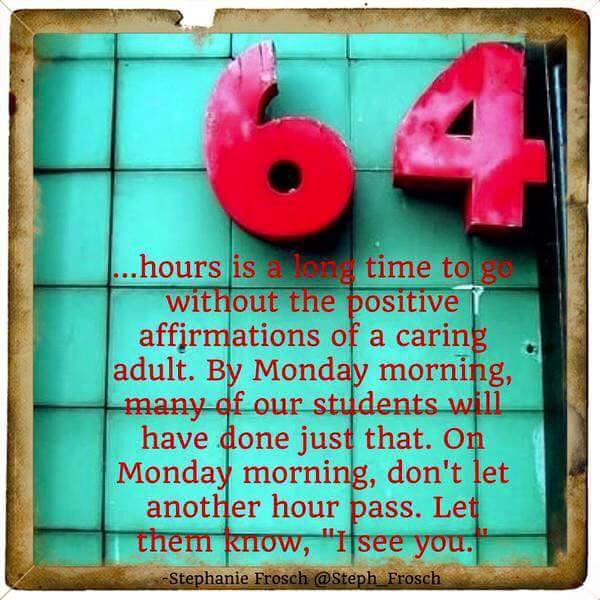
Last, but not least, since my last post in the series (see prior Parts 1-3), I saw the image below on Facebook and couldn’t help but see the connection to this series.  We never know when the opportunity will present for us to show students that we see and hear them and how much they might just really need us to do so.  It is our responsibility as educators to be vigilant about keeping our ears and eyes open, preventing missed opportunities.

12272_10154663260773677_4985141521542679907_n.jpg

Friday, April 15, 2016

What Students Need From a Secondary Reading Intervention Class...Unfortunately, It’s More Than Just Reading!

Carrie Sand contributed this post. Click here to read more of Carrie's thinking.


As a secondary interventionist in addition to my coaching role, I am always thinking about what works for struggling readers at the high school level. So...what does work? As evidenced by the lack of intervention options and resources available, no one really knows.  A post from a blog I subscribe to titled “When We Harm Rather Than Help-Some Thoughts on Reading Interventions” recently re-started my thinking on this topic.


In my experience, any intervention at the secondary level has its challenges. Assessment upon assessment has repeatedly reminded some students that they are “not proficient”, or in the “lowest percentile”, or not “college ready.” It is no wonder that as a result, many become disenfranchised with the experience of school. As a teacher working closely with high school students who struggle with reading, I’ve begun to think about the role of emotional intelligence within the secondary reading intervention classroom.


In recent years, terms like grit and perseverance have become popular in the world of education. I jumped on the bandwagon and started reading the books Mindset by Carol Dweck and Drive by Daniel Pink. Each of these books talked about totally different concepts, one about mindset, the other about motivation, but each made me think about the students sitting in my intervention classrooms. I especially thought about how the ideas I was reading about in these books were exactly the types of skills these students needed the most.


As I’ve done more exploration with emotional intelligence, I’ve come to learn that the traits often synonymous with success: conscientiousness, grit, perseverance growth mindset, are all malleable traits that respond to teaching. I wondered that if I could teach emotional intelligence within my classroom, in addition to the reading skills, what benefit would my students get?


So I tried it out throughout the first semester of this school year. I grounded my practice in the research of people like Dweck, Pink, and Angela Duckworth. As it is hard to determine exactly if teaching emotional intelligence was the cause, I will say that each of my students saw more growth than usual in standardized assessments and classroom grades. More importantly, students expressed through conferring that they often thought (in a variety of classrooms!) about certain strategies, such as positive self-talk and growth mindset approaches.


As a teacher working with high school readers who struggle, I think it is my duty to recognize the fact that students enter my classroom with more than just challenges in reading. While I know teaching emotional intelligence is not the magic answer to addressing students’ reading needs, by teaching these skills,I feel I am recognizing and responding to the needs of my student as person, not just a struggling reader.


Here are some resources that really helped shape some of my work in the classroom:


Growth Mindset Lesson Plan and Videos by Khan Academy:


Ted Talks:
The Power of Yet by Carol Dweck:


The Key to Success? Grit by Angela Duckworth