Friday, November 6, 2015

Setting a Coaching Purpose Through Coplanning

Carrie Sand contributed today's post.

Last month, I talked about the importance of establishing and articulating a common vision at the beginning of each new school  year for the role of a literacy coach. After a vision has been shared, a coach often moves into developing and implementing a menu of service options he/she will offer throughout the course of a school year. One structure that offers a range of differentiated options is the Literacy Coaching Continuum outlined in Mary Catherine Moran’s book Differentiated Literacy Coaching: Scaffolding for Student and Teacher Success.
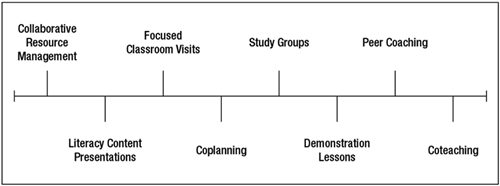
Of the options that this continuum presents, I find coplanning to be one of the more common ways I start my work with teachers and teams in the beginning of a school year or a coaching cycle. In my experience, coplanning can be a comfortable entry point for a coach’s work because it can feel less invasive, less personal, and overall less threatening than starting with conversations about instructional routines, practices, or philosophies. Also, I believe curriculum and planning are naturally on the forefront of teacher’s minds within the fall months, as many times teachers are still working on gathering their first pieces of classroom data, getting to know new grade levels, starting off in new positions, or even working with new team members. Finally, I also find coplanning to be a good place to start with those teachers who are having difficulty (or are reluctant to) articulate a purpose for the coaching cycle. Often, throughout the course of coplanning, questions, uncertainties, or frustrations will naturally arise. In this way, coaches can “tease” out a purpose for the coaching cycle through the conversations that originate during coplanning.


A coach can support teachers through coplanning in a variety of  ways, depending on the needs of their teacher or teams.. First, coplanning time might involve an examination of data; secondly, a teacher might work to align and plan a certain lesson or unit of instruction with a teacher or a team. In her book Differentiated Literacy Coaching, Mary Catherine Moran highlights the following four responsibilities for a literacy coach during coplanning. During coplanning, coaches may:
  • Coplan lessons and curriculum units with teachers based on a systematic study of teacher’s needs.
  • Work with teachers to align instruction to learning standards.
  • Set goals and plan lessons with teachers based on analysis of student assessment data.
  • Examine students’ ongoing performance data to identify needs, monitor progress, and modify instruction for struggling readers.

In my experiences, I have also used coplanning to work with teams in setting a protocol and structure for lesson plan writing, understand a new curriculum, tool, or resource, and lay out a systematic scope and sequence. As I mentioned above, these opportunities are especially useful for teams/teachers who have new members or new tools they are working to understand and implement. My recommendation is that coplanning occurs for a minimum of once a week up to five days a week, depending on needs and scheduling. I have found by setting aside a structured time for coplanning, acting as a collaborating member of a team or partnership, and following a structured protocol (for team planning or conversations) coplanning time is a very productive way for a coach to start off their school year. The coplanning process allows a coach to support teams or individual in building knowledge and a common vocabulary, it fosters a relationship of collaboration between the coach and the individual/team, and it helps set a purpose for future coaching opportunities. For these reasons, a coach can easily use the coplanning experiences to purposefully select additional tools or options from the coaching continuum to move into a new or deeper phase of coaching.

Wednesday, November 4, 2015

Embracing a Workshop Model

Jaimie Howe contributed today's post.

I am embarking on a new journey this year with a new job in a new district; a district that has been implementing the Lucy Calkins's Units of Study for Teaching Writing for about two years and is starting the process of looking at the Lucy Calkins's Units of Study for Teaching Reading. I have wondered for a few years now what it might look like for a whole district to embrace a workshop model and how that might affect student achievement over time. I believe I am about to find out.

In my opinion, implementing a workshop model district-wide will be a very challenging task. In order for it to be successful, it will require extensive professional development, coaching, collaboration, and time for reflection. For many teachers, a workshop model is a huge shift in thinking and will be/is very challenging. It will take time on the front end to really engage teachers in its framework, research, and philosophy; however,  in the long run,  if we take this time, I believe we will see a remarkable increase in the depth of student discussion, thoughtful thinking and writing, overall love of reading/writing, and ultimately, gains in student achievement.

Lucy states that her . . .

“ . . . series builds on decades of teaching and research—in literally tens of thousands of schools. In states across the country, this curriculum has already given young people extraordinary power, not only as readers, but also as thinkers. When young people are explicitly taught the skills and strategies of proficient reading and are invited to live as richly literate people do, carrying books everywhere, bringing reading into every nook and corner of their lives, the results are dramatic.”

I am excited and nervous about the possibilities of this adventure and can’t wait to continue to share our progress as we move forward.  Stay tuned . . .

Monday, November 2, 2015

What Are You Reading: November 2015

We believe it is important for educators to be readers and writers, so every month we take a day to report out on what we're reading. Join in by sharing your current reading list in the comments.

Professionally, Maggie is reading 10 Things Every Writer Needs to Know by Jeff Anderson. She says, "Don't let the title fool you; this book contains many useful tips and strategies for teachers that can be implemented immediately."

Barb just started A Man Called Ove. She says, "This book has been recommended to me by three people within the about the last month. So, I picked up a copy at a local book store on a recent vacation."

Carrie writes, "As a reader who loved both Fangirl and Eleanor and Park, a new Rainbow Rowell book is a cause for celebration! Carry On tells the story of Simon Snow, the fictional Harry Potterish character created in Fangirl. I just picked this book up and can't wait to sit down to enjoy it!!"

Andrea is reading parts of Uncommonly Good Ideas: Teaching Writing in the Common Core Era.


Barb (and her book club) are reading All American Boys. She explains, "The chapters of this book alternate perspectives of two teenage boys. One just had a violent confrontation with a police officer after being wrongfully accused of a crime. The other is trying to understand the actions of the officer, a man who he previously had tremendous respect for."

Julie says, "With a big part of our Back to Basics focus being on conferring, I am reading ONE to ONE by Lucy Calkins.  Calkins provides a predictable framework for conferring with young writers."

Andrea says, "Professionally, I am still reading Writing With Mentors, as I never got to it from the last time I posted!"

Maggie says, "I just finished Sunny Side Up, a graphic novel by Jennifer Holm and Matthew Holm. This is a very sweet and funny story that I'd recommend to any upper elementary or middle school reader."


Maggie is reading The Night She Disappeared by April Henry. She says, "This is a mystery written by the author of Girl, Stolen. I have a group of middle school girls who are flying through any titles by this author and I'm attempting to keep up with them!

Jaimie is reading Room by Emma Donoghue. She says, I googled 'books all women should read' and this one came up.  It is about a women who was kidnapped at 19 and kept enclosed in a room for 7 years.  During this time she gave birth to a child.  It is wonderfully written from her son's perspective and goes through their lives in the room and the struggles and joys they encounter after escaping.  I highly recommend it."  

Heather continues to read and love The Two Writing Teacher's blog. She explains, "Teachers share various writing tips for implementation during writer's workshop.  Their primary audience is PK-8th grade.  They provide tons of great strategies every week!"

Andrea says, "I am reading Outlander for fun.  I got hooked on the show during a free Starz weekend and then stopped watching because I wanted to savor the story."

Photo collage made with piZap.

Friday, October 30, 2015

Reading the Research: Critical Discourse Analysis of IEP Meetings

Barb Novak contributed today's post. More of her thinking about research can be found here.

I mentioned a PLC I'm part of in a previous post. We meet monthly and discuss a piece of research (selected by one of the members) at each meeting. The study I'm writing about today was discussed by my PLC.

I'm sharing it simply to give access to how I process research when I read - how I organize my thinking before, during, and after reading research. This post is not intended to be an endorsement of the research or its conclusions.

"The the Eyes of the Institution: A Critical Discourse Analysis of Decision Making in Two Special Education Meetings"
Rebecca Rogers (2002)


The article is available free for Wisconsin educators through BadgerLink.

Why This Article: 
I'm interested in discourse analysis as a research methodology and am on a work group about College and Career Readiness IEPs.

Research Questions:
How are "contradictions of social structure embedded within the special education process" (p. 214)? Basically, research has already demonstrated that children from minority groups are over represented in special education. Rogers's research is unique because it investigates how the special education process maintains and/or perpetuates social inequalities.

Methods:
This is an ethnographic study; Rogers served as a participant-observer.

Rogers studied language and literacy practices of a community (Sherman Hollows) for two years. Much of her work focused on a mother (June Treader) and daughter (Vicky Treader). Rogers data collection was extensive; data included interviews; documents and photographs; 300 hours of recorded interactions in home, community, and school; 500 hours of participant observation in home and community; and interviews with school and community members. 

Rogers participant-observation included a special education eligibility and IEP meeting (when Vicky was in sixth grade), and Vicky's subsequent annual IEP (when Vicky was in seventh grade). The article focuses on the discourse as these meetings. Although, Rogers relies heavily on her understanding of the Treader family and their community to make sense of the meetings.

Findings:
There were vast contradictions between the two special education meetings.
  • The eligibility determination meeting included a cataloged and data-based list of Vicky's deficits. One year later, the same things noted as deficits were discussed as strengths.
  • Prior to both meetings, Rogers talked with June and Vicky about their hopes for the meetings. The outcomes of both meetings (along with communication between meetings) contradicted what June and Vicky wanted prior to the meeting.
  • The eligibility meeting was highly structured and data driven. The second meeting included no formal data or evidence.
  • June and Vicky spoke much more at the second meeting than the first meeting. Yet, democratizing the meeting did not change the results. Vicky remained in special education as
Limitations:
This research is highly contextualized. Findings cannot be generalized to other settings.

Vicky transitioned to a new school (elementary school to middle school) between the meetings. How were the contradictions between the meetings related to the differences in protocol and practice between schools?

Questions:

  • Rogers references Mehan's (1996) work about disability as a cultural construct. I want to know more about this.
  • How would these meetings look the same and different for a student who identifies with other cultural groups?
  • How would the participants reflect on the experience now (almost 20 years later)?
Complete citation:
Rogers, R. (2002). Through the eyes of the institution: A critical discourse analysis of decision making in two special education meetings. Anthropology and Education Quarterly, 33(2), p. 213 - 237. Retrieved from http://www.jstor.org/stable/3196174


Wednesday, October 28, 2015

Probortunity

Sharon Seely contributed today's post.

Last year was my first year as our district’s first instructional coach. What an eye opening experience!  It was definitely a year of growth for me.
 
The year for me began at our annual District Data Dig in Mid-August. In the past I sat at a table filled with my individual building colleagues. This year was different; it was the first time I looked at the data from all of the elementary schools in our district. There were similarities and differences in and among them all. The discussions at each table representing each of the schools in our district were amazing – talking about students, needs, interventions, data results and closing the gap. One common thread that was woven throughout was, "Yes, we are doing okay, but what can we do better?"

As a first year coach, our CESA Literacy Leader recommended that I attend The Wisconsin RtI Center and PBIS Network Leadership and Coaching for RtI Implementation – Implementing a Culturally Responsive Multi-level System of Support. In October, I attended the pre-requisite two-day RtI training. This is where I learned more about the RtI pyramid, the tiers, and what the percentages really meant.

Yes, we were doing okay, but in studying the scores I realized that we didn’t have 80% of our students at or above district benchmarks.  “What?!?!” We are doing okay… meeting expectations…that’s what our school report cards said. Probortunity moment… We needed to take a closer look at our universal instruction.

So, a team from our district attended the Wisconsin RtI Center K-5 Universal Reading Instruction three day training…talk about enlightening!  Day one was overwhelming, wondering, “What are we doing right?”- so much information – lots of questions about our instructional practices, research based best practices, consistency between all of our elementary buildings, etc. Great discussions! We spent lot of time reflecting and questioning. We realized that we needed written non-negotiables and consistent teacher resources from building to building.

Day Two followed with more great discussions and Day Three was time for planning… moving forward …coming up with the beginning works for our district’s Instructional Playbook (non-negotiables), bringing this information back to our district with consideration of varied learners:
  • Listening Learners: heard the information, believed the information
  • Visual Learners: watched someone else try it, saw the results/effects
  • Kinesthetic Learners: jumped right in, learned through doing/trial and error

and having great team (grade-level, building, district) discussions to have a positive impact on everyone – teachers and students alike. 
       
So, find those probortunities, partner with a team and embrace them.

Monday, October 26, 2015

Setting Norms

Meghan Retallick contributed today's post.

keep-calm-and-follow-the-norms-3.png

Maybe I missed an important piece of information along the way, but it was seven years into my career as an educator before I attended a meeting where norms were set.  Why is this?  

Is it because, as adults, we assume that we already know the standards and expectations of working as a team?

Is it because we are teachers that constantly ask high standards of our students during collaboration, so naturally we know them in our own collaborative settings?

Is it because it is uncomfortable to suggest that our colleagues’ behaviors would take away from the effectiveness of a meeting?

I’m still not sure why my previous experiences didn’t include norms for the teams on which I was a member, but I do know now that the process of setting norms is essential for effective teamwork.  

First, for those of you that may be feeling as clueless as I was about this, Webster’s dictionary defines a norm as “a principle of right action binding upon the members of a group and serving to guide, control, or regulate proper and acceptable behavior.”  Knowing the expectations is something that all of us enjoy.  Whenever I am asked to participate on a team or group, knowing the purpose and what to expect from my fellow team members makes me a more comfortable, confident, and productive participant.

So what does this mean for teams in school settings?

I’ve recently attended two meetings: one where norms were written by the facilitator  and one where norms were set with all group members having input.

For the sake of time, I won’t go into the details about each meeting, but I’d like to help give you insight to the atmosphere of each by sharing their norms:

Meeting #1 (facilitator determined norms):  
  1. Timekeeper will notify the facilitator when it is time to move to the next agenda item.
  2. Keep conversations related to the current topic.

Meeting #2 (team determined norms):
  1. Problem Solving Conversations/Focus
  2. Active Participation
  3. Be Positive
  4. Outcome Oriented
  5. Build Trusting Relationships

Just from looking at the norms, which meeting would you rather attend?

For me, Meeting #2 is the team I can’t wait to work with again!  The process they used for determining their really impressive norms is a protocol called “Affinity Mapping” created by the National School Reform Faculty (NSRF).  The basics of the protocol are that each team member individually brainstorms ideas for norms on sticky notes.  Then the sticky notes are posted on the wall for all to look at.  In silence, team members categorize like sticky notes/ideas.  The team then determines the norms from those categories.

Find this protocol and more on the NSRF website.  (Shout out to Casey Gretzinger at CESA 9 for introducing me to this resource and the power of norms!)

And so, my great take away for the week is that the process of setting norms is just as important as the norms themselves.  Using a protocol like Affinity Mapping begins the process of building trust in the team because all members can share their thoughts in a safe way.  Purpose is set, along with guidelines and expectations for team behaviors, and ownership is built from the very first team activity.  

What are the “must haves” for effective teamwork on your norm list?