Friday, February 27, 2015

I'm a Struggling Reader

I'm in school - I'm always in school. Right now, I'm taking a course about quantitative research - specifically, advanced quantitative research. And, friends, I can't lie. It's hard. It's crushingly hard.

Every single week (multiple times each week, actually) I am reminded that I am a struggling reader. Scratch that. I'm not just a struggling reader; it's more than that. I'm a struggling learner.

The reading assignments for class go something like this:

Step 1. When I can't possibly delay the reading assignment any longer, I create the perfect conditions for reading. This usually involves a food-related incentive schedule and lots of self-talk ("If I read two pages, I can have a square of chocolate" or "I will treat myself to an afternoon at a coffee shop and a whole milk latte while I read this assignment.")

Step 2. Read two paragraphs and declare that I cannot possibly do this. Go on the internet to review the drop deadline for the course. Remember that I can't drop the course without significant consequences for my checkbook and transcript. Chastise myself for immediately wanting to give up. Remind myself that I'm not a quitter. This step is generally repeated multiple times throughout the reading process.

Step 3. Get serious about reading the assignment. I've noticed this involves a few strategies:

  • Skip many, many words, sentences, and paragraphs while looking for sentences with words (instead of numbers and other symbols) that have main ideas. Underline these even if I don't understand them.
  • Keep a list of terms and symbols that I don't understand. Sometimes I Google these right away; sometimes I just write them down. It depends on how frustrated I am.
  • Resign myself to not understanding much of the text. Be okay with that.
  • Text a friend. Sometimes to bemoan how awful the reading is - sometimes to ask a question. I've even texted pictures of the text to my own personal mathematics coach.
Step 4. Do some work after reading. This usually involves that personal mathematics coach I mentioned earlier. I see him and immediately teach him anything I managed to understand from the reading. He gives me real-life examples and clarifies.

Step 5. Reflect on what would have helped me be successful with the reading assignments. I realized that I really need:
  • Vocabulary lessons. It's all Greek. Seriously. Greek. I don't know what to call any of the symbols (I make up names for them based on what they look like). There isn't a glossary in any of the texts. And that's just the symbols. There are also lots of real words. I don't understand those either.
  • Learning targets. When text is difficult, I need some statements to tell me what I'm supposed to know, understand, and be able to do after I read. I don't just need targets for each text; I need targets for the course, too. I have no idea what the big ideas are and no clue how they fit together.
  • Discussion. Time to talk. Collaborative conversation. I don't need a protocol or a role sheet or teacher-provided text-dependent questions. I just need some time to talk to my peers, hopefully, peers that are knowledgeable about the topic.
Despite the fact that I'm a smart and capable person,  I'm a struggling learner in this environment, this context. 

This experience has reminded me that I don't struggle very often. In fact, I've realized I struggle so little that I don't even know how to do it! I haven't mastered much (or really any!) content of the course, but I've learned a lot about who I am as a reader and learner. 

And, for this reason, I encourage you to struggle. Find a really difficult concept you know nothing about it and study it - not just for a couple of sentences or a quick Google search, really study it. Notice what you do to understand. Notice what supports would have been helpful to you. Notice how you feel. Then, change something - something about yourself or something about how you work with students or adults - because of your experience.

Wednesday, February 25, 2015

Connecting School with Home Culture

Barb Novak contributed today's post. Barb is a literacy consultant at the Wisconsin Department of Public Instruction and serves as the moderator for this blog.

Confession: Even after spending 10 years working in a variety of Wisconsin public schools, I never felt my bag of tricks for engaging parents and families was quite as full as I wanted/needed it to be. This was especially true for techniques to connect with families who were dramatically different than mine.

So, I've been doing a lot of reading and thinking and talking about what it means to connect school with home culture - especially as it relates to literacy. 

If you're interested in similar ideas, I would recommend Bringing Literacy Home edited by KaiLonnie Dunsmore and Douglas Fisher. This edited volume includes sections about:

  • Supporting Families in School-Based Literacy Practices
  • Connecting School with Home Culture
  • Implications for Family Literacy Research and Scholarship


I found Geneva Gay's chapter ("Teaching Literacy in Cultural Context") particularly helpful. Gay asserts that "underachieving marginalized students of color" (p. 161) need to simultaneously develop academic knowledge and skills and cultural competencies. A teacher's journey to develop the knowledge, skills, and dispositions to teach litearcy in a cultural context is complicated and on-going. Gay suggests teachers begin by packing a "metaphorical suitcase of things that they will take on their multicultural education journeys" (p. 168). The suitcase can be packed, unpacked, and repacked as a teacher's understanding develops.

Gay suggests several key messages (p. 180 - 181):

  • Acquire cultural knowledge about your students (including "cultures, histories, and contributions of ethnic groups")
  • Use diverse "examples, materials, experiences, and perspectives"
  • "Apply academic literacies in the process of teaching and learning about cultural diversity" (p. 181)
  • Access students' "cultural literacies, or funds of knowledge" to scaffold academic, school-based literacy


Monday, February 23, 2015

Leading a Balanced Literacy Assessment System


Barb Novak contributed today's post. Barb is a literacy consultant at the Wisconsin Department of Public Instruction and serves as the moderator of this blog.

A big part of my job - a favorite part - is talking to Wisconsin's students, parents, educators, and leaders. What seems to be on everyone's mind lately? 

Assessment.

What are we assessing? How long does it take? How much money does it cost? To what extent is students' privacy protected? What assessments are required? Who analyzes the data? Does the data actually make a difference? How can I access the data? What assessments exist for special populations? Why are certain data sources valued more than others? Who makes decisions about assessments? 

Laura Adams, fellow literacy consultant, and I answer all of these questions and more in the 2014 - 15 season of Literacy Live!, a pre-recorded webinar series for Wisconsin's literacy leaders.

"Leading a Balanced Assessment System" will include about 10 sessions. Each session includes a recording (generally 25 - 30 minutes) about a specific topic related to literacy assessment. Supporting resources accompany each session. New sessions are posted about every three weeks.  The episodes can be viewed at any time. While the sessions can be viewed independently, we do suggest watching with colleagues to take advantage of opportunities for discussion and application.

Introductory episodes include:


Contact me via email (barb.novak@dpi.wi.gov) or phone (608-266-5181) with questions.


Friday, February 20, 2015

What Is Our Role?

Jaimie Howe contributed today's post.

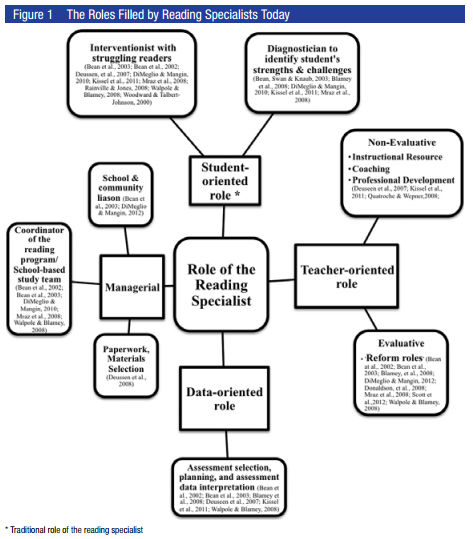
I recently read an article from The Reading Teacher titled “Leader, Teacher, Diagnostician, Colleague, and Change Agent: A Synthesis of the Research on the Role of the Reading Specialist in This Era of RtI-Based Literacy Reform,” by Emily Phillips Galloway and Nonie K. Lesaux. What a mouthful, I know. However, isn’t that truly what our jobs, as literacy coaches/reading specialists, are?  A smorgasbord of responsibilities. We have so many roles and our roles look so different across the state, within districts, and even across schools within the same district.  This article helped me to truly reflect on what my role as “Literacy Coach” entails and how it has evolved.  

In the past, I was always frustrated at the idea of our roles being so inconsistent; however, the more I reflect I understand why that is and why it may be “okay”.  Every building, every district, is at a different point in their journey.  The literacy coach needs to meet the needs of their current situation to move their building/district forward. As I've said before in my posts, we need to differentiate in all that we do, not just with our children.  It doesn't pay to move too fast, putting teachers/staff in a position they’re not ready for (frustration); however, we can’t  move too slow either. A  little push into the discomfort zone is how change happens. Think Vygotsky . . . Zone of Proximal Development.  The idea holds true in all that we do. Change does not happen overnight.  It takes time.

The charts and quotes below are from the article.  I used them to help me reflect on where my current reality is as a literacy coach in my building/district.  I looked at the first chart (Figure 1: The Roles Filled by Reading Specialists Today) and said, “Yep, I do all of these things.”  However, the most meaningful to me was looking at the second chart (TAKE ACTION!) and filling in what my role looked like for each of the 4 years I’ve been a literacy coach.  It is amazing to see how it has evolved. I’ve really done all of these jobs each year, but the percentage spent in each area has completely changed. I challenge you to take a look at your role and reflect on where you have been, where you are now, and where you want to go.

“The role of today’s reading specialist is highly influenced by school type (elementary or secondary), school performance, and the professional culture in the building.”

“Assuming the role of reading specialist in an era of school reform, requires skill
in managing uncertainty and in seeing the possibilities that exist.”

“If this review suggests anything, it is that reading specialists in an era of RtI-based reform,
remain dedicated to supporting students to become readers.”

Galloway, Emily P. & Lesaux, Nonie, K. (2014)  Leader, teacher, diagnostician, colleague, and change agent: A synthesis of the research on the role of the reading specialist in this era of RtI-based literacy reform.  The Reading Teacher, 67(8).

Wednesday, February 18, 2015

Coaching Prompts

Diane Jenquin contributed today's post.

Over the last few years I have been accumulating prompts, and questions to promote reflection that promotes inquiry and to alter the thinking and behaving  that occurs afterward. I do have to admit I do not know where some of these prompts came from, but the important idea is that they are coaching conversation starters.  I have put 2 questions from each on a bookmark to help prompt myself as a coach along with teaching and practicing with others.

My hope for you is to take what you need out of this and run with it.  Happy Coaching, Diane

Asking Open Questions:
  • What might be the best possible ways to…?
  • If you taught this lesson perfectly how would it look?
  • How do you think the lesson went? What happened that caused it to go that way?
  • When you think about what you had planned and what actually happened, what were the similarities and what were the differences?
  • As you think about the results you got, what were some of the ways you designed the lesson to cause them to happen?
  • When you reflect back on the lesson, what might you do differently?
  • What were the strengths of the lesson? What did not work?

Statement of  Ability/. Attitude:
  • I know you have been thinking a lot about this, and I am curious about ….
  • Its obvious you're committed to this.  What are some things you have been doing?
  • As you’ve been thinking about this you probably anticipated…
  • As you test your insights where do you think you start?
  • I don’t have the answer and I’m curious about your...

Paraphrasing Language:
  • Recode and repeat back to the teacher creates conditions for active listening and promotes metacognition.
  • So you're feeling…
  • In other words…
  • Hmm, you're suggesting that…
  • Let me see if I understand: You said…
  • I want to make sure I got all the points ; you said...your noticing that…

Summarize and Organize:

  • So there seems to be 2 key issues here...and…
  • On one hand there is… and on the other hand…

Monday, February 16, 2015

Comprehension Focus Groups: Using Leveled Texts


Heather Zimmerman contributed today's post. All of Heather's posts about implementing comprehension focus groups with middle school readers who are struggling can be found here.

As I have been talking with others about my experiences this year with implementing Comprehension Focus Groups at the middle school level, one question that comes up is about leveling texts.  This was one challenge that I encountered early on in the school year.  I wanted to share with you how I tackled this challenge.  On a side note, the way I approached this is not “by the books” necessarily, but it is practical and what needed to be done to make CFGs work for me.

In my CFG, I have anywhere from five to nine students.  (The way we work our intervention time is there cannot be more than 10 students in an intervention.)  At the beginning of the year I had students ranging from a level R to a level V.  I started asking myself how the CFG would run and look if I split them all by level into different CFGs.  I also wondered how my 50 minutes of time would look.  When I met with one CFG, what would the other students do that was effective?  I was told a CFG is supposed to last at a minimum 30 minutes to keep 80% fidelity, I could not meet with two group in one 50-minute period.  So would I only meet with a group two to three times a week?  What would be the most beneficial for students?  And what could I make work?  (All while keeping in mind the three phases, and wanting to keep them all meaningful.)

As I searched for texts, as many of us who search for middle and high school texts know, many of the middle school appropriate texts are not leveled.  I decided to meet my students in the middle...I chose a range of levels for the three independent texts my students would work with.  By doing this though, I make sure to scaffold for those students who needed it and challenge students who are ready to dig to a different level in a text.  

As I reflect on my work with CFGs and have a frame for a few groups, next year, I will continue to add different levels of texts to my library.  I wanted to have a range, but knew that as I started the year, I might not have all that I need in place.  But even though not all the texts are perfectly leveled, teacher expertise is just as important.  I think my students have had just as powerful experience in CFGs as I help meet their needs as individual learners looking at the same text.

Friday, February 13, 2015

What’s it like to be in a session with Diane Sweeney?


Bobbi Campbell contributed today's posts. Bobbi's recent posts focus on her learning around student centered coaching (facilitated by Diane Sweeney).

This blog entry is an example of a full-day professional development opportunity with Diane Sweeney, including coaching reflections and notes in response to the content.

https://lh5.googleusercontent.com/uhBIE42NuAVaF1msa6JVwJxBB07ZJPm_IXfR5M_XykZNJQoUYlBQ3XQZKhdSmRFQcmpIhGT4hUCDRRIBFBOxGiWOFFcjfIWMbsF1nyCsPLTANeXFBe5cVOQqGoyJ9Ej1ZAThe essential questions for the session were:
  • EQ1: How can a coach guide goal setting towards culturally and linguistically responsive instructional practices?
  • EQ2: What are some coaching skills that bring about culturally and linguistically responsive instructional practices?
  • EQ3: How might learning labs create opportunities for teacher collaboration in MMSD?
Read about the content of the session and Bobbi's notes (shared in PDF using GoogleDrive).