Wednesday, April 15, 2015

Back to Basics

Julie Schwartzbauer contributed today's post. Read Julie's previous posts to understand more about her district's Back to Basics plan.

After implementing the roll-out of our first back to basics component, building coaches returned to the coaching PLC  with the message that teachers were apprehensive when it came to opening up their classroom doors to be observed.  They felt like the coach and/or principal was there to evaluate them, not learn with them.  We wanted teachers to understand that the main objective of the Back to Basics plan was to develop a coaching model that would help teachers develop consistency in universal instruction in literacy across the school district through a workshop framework.  In order to develop consistency, we needed to see inside classrooms.  We also wanted teachers to understand that the visits were meant to be student centered.  The focus was on how the student was responding to the teaching.  

As a way to make teachers more comfortable with the visits, we decided to provide some frontloading of information surrounding the shared beliefs of the Back to Basics components.  There was a small group of coaches who stepped up to plan and share what a roll out would look like.  The building Coaches were given the flexibility to roll out the Back to Basics components in the following ways; during late start, at grade level PLCs, during lunch, and/or before or after school. The nonnegotiable was that every teacher must be part of the roll out.  

Throughout the roll out of Back to Basics it was extremely important for our coaches, principals  and teachers to understand that the work of strengthening universal instruction through Back to Basics was ongoing.  Although we were focussing on one component at a time to develop our shared beliefs within our Coaching PLC, the work that coaches do in their buildings takes place throughout the year.  

My next post will explain how we developed a survey to look at the Back to Basics data.

Monday, April 13, 2015

Comprehension Focus Groups: A theme focus - "Overcoming Obstacles"

Heather Zimmerman contributed today's post. More about Heather's work implementing comprehension focus groups in middle school can be found here.

I wanted to work in the theme “Overcoming Obstacles” for one of my Comprehension Focus Groups (CFG) at some point during the year.  Third quarter worked out to be a great time to work in this CFG.  After a CFG focusing strictly on informational texts, working in a few fiction texts was welcomed.  I also had a CFG lesson shared with me by one of my colleagues, Norah Olig.  The texts in this lesson were thanks to her!

After working with my students during the last CFG, I noticed they were still struggling with author’s structure.  I decided to incorporate in my graphic organizer two components that focused on this.  One area focused on the words the author chose and the other area focused on the title of the text.  I also went back to some of the important components we worked on from first quarter: theme, conflict, Beers and Probst’s signposts, and point of view.

I have been very pleased with my students’ progress and hard work.  We are currently in the writing phase and they are passionately writing their texts about obstacles from their own life.  They are working on word choice, adding a theme, and focusing on adding a signpost. I am proud of how much I have seen each of them grow as readers and writers so far this year.

Here is an overview of my first CFG:  

Friday, April 10, 2015

(Mathematical) Fluency

Ken Davis, mathematics consultant at Wisconsin's Department of Public Instruction, contributed today's post.

The impetus for me writing this actually didn't come from a mathematical situation, but from a reading one.  I was having a discussion with one of my children about reading.  His concern was that he was reading slowly, especially when compared to others in his class. I'm not sure what data he was pulling in order to come to this conclusion or what he was using to measure how he stacked up to his peers, but my fear was that he was equating his reading ability to how fast he could read.  

I calmed his anxiety by telling him that his dad was not a fast reader either.  In order for me to read and read well, I have to use a highlighter or pen and track as I am reading.  I move across and down the page a little slower, but I understand or comprehend everything I read and seldom do I have to reread.  I asked him, "How do you feel as you are reading? Do you understand what you are reading?" He assured me that he is understanding what he is reading, but just feels as if he is going slow.  

It's ironic that about at this same time one of the chat groups that I belong to began to discuss mathematical fluency and the fact that mathematical fluency doesn't equal speed. In fact, many in this group spoke out against the idea of using timed-tests and memorization to teach mathematics because many students equate speed with being a "good" math student.

This can be damaging for students in two ways. First, it is discouraging for the student who is unable to reach the target of 20 problems in 60 seconds or whatever the objective of the timed-test may be. Some students are just not going to be able to work at a faster speed.  I turned 50 last year, (scary thought in and of itself) and still would not consider myself a fast reader, but do I have command of the English language?  I would like to think that I do. Second, are we setting up the student later for failure when they can answer the 20 problems in 60 seconds, but have no understanding of how they got the answer? Consider this scenario. We teach a student that to multiply by ten, simply add a zero on the end of a number. We give this student a timed-test that includes multiplication by 10 and the students gets them all correct in the specified amount of time.  The student (and parent) now have the sense that the student can multiply by ten.  Now, the student encounters this problem 3.14 times 10. The answer is not 3.140, but the student has no understanding of what it means to multiply by ten because they were not taught the concept of multiplying by ten, but rather a quick method of memorizing that did not teach number sense.

In an article from 2012, Linda Gojak, then National Council for Teachers of Mathematics (NCTM) president, pointed out that in Principles and Standards for School Mathematics  it states that “Computational fluency refers to having efficient and accurate methods for computing. Students exhibit computational fluency when they demonstrate flexibility in the computational methods they choose, understand and can explain these methods, and produce accurate answers efficiently. The computational methods that a student uses should be based on mathematical ideas that the student understands well, including the structure of the base-ten number system, properties of multiplication and division, and number relationships” (p. 152).  The article doesn't mention that fluency is equivalent to speed.

In another article, Jo Boaler, Professor of Mathematics Education at Stanford states: "Mathematics facts are important but the memorization of math facts through times table repetition, practice and timed testing is unnecessary and damaging...It is useful to hold some math facts in memory. I don’t stop and think about the answer to 8 plus 4, because I know that math fact. But I learned math facts through using them in different mathematical situations, not by practicing them and being tested on them."  

For me, if we do equate fluency with speed, then how do we measure it? 20 problems in 1 minute or 45 problems in 2 minutes? How do we place time on fact fluency and say that "this" rate is proficient?  Let's begin by teaching students an understanding of mathematics; let's build their number sense.  Isn't this really what's important? Students should truly understand and appreciate the mathematics and are not just concentrate on being the fastest in the class.

Wednesday, April 8, 2015

Model, Model, Model

Lisa Weiss contributed today's post. For more information, read Lisa's other posts about her district's "laser-like focus on the intentional use of literacy in service of our contents."

Wanting to play off of the positive energy that our fall professional learning generated, I wanted the next steps of our professional development to show 6-12 teachers what modeling writing looked like in their content areas.


I invited all the stellar 6-12 Fox Valley Writing Project teachers I know to demonstrate the gradual release of responsibility when modeling writing on December 10th. My plan was to have every content teacher view a model, using the gradual release of responsibility, of writing by a Writing Project teacher who teaches that content. For example, I invited my friend David, a biology teacher, to model writing to the high school science teachers.


I plan, and God laughs. Naturally, that was not quite how things worked out. I ended up having to group some of the contents with smaller numbers of teachers together, because I could not get enough teachers to model in the elective classes. The groupings can be found at the bottom of the agenda (link) if you are interested in seeing how I grouped teachers.


Each FVWP demonstrator was partnered with an OASD facilitator, who was either a literacy coach or a principal. The agenda was set so that the OASD facilitator had the responsibility of setting the goal for the afternoon, introducing the demonstrator, leading teachers through the guide for how to prepare for a writing demonstration, and getting feedback on the session. The FVWP demonstrator was responsible for engaging the OASD teachers in writing and the gradual release.


The feedback was overwhelmingly positive. The high school science teachers really appreciated what David had shown them. One of the science teachers told me that this was the best collaboration she had ever been a part of in her 20 years in the district; another went to his principal and showed her how he was going to recreate his lesson plan for the following day, emulating what he saw David model! Impressive. Most people left the professional development session with a clear understanding of what modeling writing looked like in their contents.


Next came the tricky part--consistently building the modeling of writing into practice.

Monday, April 6, 2015

Teaching to the Test

Andrea Reichenberger contributed today's post. More of Andrea's thinking can be found here.

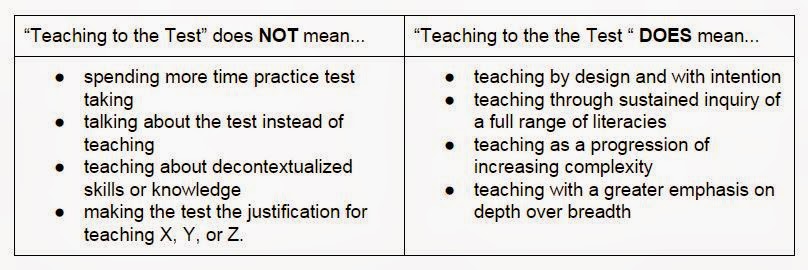
Standardized testing is a topic that weighs heavily on all of our minds as coaches, teachers, administrators, parents, and students this time of year.  Ultimately, the testing is required whether we agree with it or not, but it does trigger interesting discussions about the idea of “teaching to the test.” When I hear this phrase, I often react negatively and have to refrain from screaming, “ABSOLUTELY NOT!” But the more rational side of me forces me to ask, what does “teaching to the test”  mean, or rather, what should it mean in 2015? How can we change the narrative?  I recently “attended” Jim Burke’s online webinar sponsored by Corwin Press entitled: When Is It Best to Teach to the Test? One of the ideas I loved about this webinar (and I loved several) was Mr. Burke’s creation of a new definition for “teaching to the test.”


(Forgive me Mr. Burke, as I have stolen the important points straight from your slides.)


Burke reiterates that we need to prepare our students for assessments such as the Badger Exam, ASPIRE/ACT, AP Exams, etc without interrupting our daily instruction. We do this by focusing on the skills our students need as a result of the shifts in the standards that these assessment align to including:  close reading, using text based evidence to support their thinking, writing from sources, using academic language, increasing text complexity, focusing on the  importance of argument and a greater emphasis on nonfiction and literacy in other disciplines. Since this is the case, and since we are shifting our definition, Burke reminds us that we should ALL be collectively “teaching to the test” and therefore need to be intentional when choosing and/or creating:

  • Texts
  • Topics
  • Tasks
  • Tests
  • Technology
  • Techniques

Mr. Burke summarizes it best when he states, “Students learn best when assessment and preparations for tests are integrated into our daily instruction as a means of enriching and extending that instruction.” I agree. Thank you for changing the narrative for all of us. Spread the good word, my friends!

Please see page 4 of the link from Burke’s English Companion handouts for using Webb’s Depth of Knowledge Model. If you have an hour to spare, you can access the archived webinar here.

Friday, April 3, 2015

Preparing for the Badger: Finding the Positive

Jaimie Howe contributed today's post. More of Jaimie's thinking can be found here.

I’m sure we all see and hear about the controversy associated with state testing and specifically this year in Wisconsin with the new Badger Exam.  The controversy that accompanies this assessment and the decisions that are made regarding the Badger exam our pretty much out of our control as individual districts, schools, and educators; however, how we choose to handle, proceed, and/or deal with the fact that in the end we will all be giving the assessment in some way shape or form, is ultimately our choice.  Instead of continuing to dwell on the fact that changes seem to be made daily, technology isn’t always working, or the possibility that it may not even be around next year; consider the material that is available to us and how those materials may support our teachers and students in so many ways; more than just preparation for a test.

Back in January, I was given the charge from my principal to dig into ways in which we could prepare the students in our building for the upcoming Badger Exam.  I browsed, researched, printed, and read an abundance of materials available to us; in search of a way to build not only our students capacity, but our teacher’s capacity and knowledge in regards to the Badger Exam and ultimately, the Common Core State Standards.  As our teachers plugged away at the materials through January and February, I couldn’t help but worry that we were spending all of this time “teaching to the test,” and wondering if all of this preparation was truly worthwhile. As I continued to have conversations with the 3-5 teachers in my building about their experiences with the materials, I started to worry less.  I heard a lot of, “Wow, the content is so HARD,” but not hard in a bad way; hard in a rigorous way.  Teachers have come to me and expressed that using these materials has really opened their eyes to what really is expected of our students with these standards and the rigor involved. This is really the first look, since the implementation of Common Core, that teachers have had, that truly allows them to be able to see and understand what is expected.  I also feel that the way in which the teachers in my building chose to use the materials, has been paramount.  At first, it was frustrating because the technology wasn’t working on ipads, so the students couldn’t access the tests since we do not have a computer lab in our building.  However, not using the technology turned out to be very valuable. The teachers ended up truly using the materials to teach and not just practice. They modeled, worked as a class, worked in groups, and really dug in. I had numerous comments regarding how engaged the students were with the materials and the topics.  Teachers have also commented that the resources have helped them in their own instruction.  They have reflected on their own teaching and indicated ways in which they are going to change their instruction to better meet the demands of the Common Core.

As a result of  this, the teachers in my building seem to be less stressed than other buildings about the unknown of the upcoming Badger Exam.  They've worked around the complications, which are certainly inevitable with anything new; and have turned the complications into a positive change in their teaching.  

In current times of education, I see too often, time spent dwelling on all that is negative and we fail to realize all of the positive that is out there.  Because the teachers in my building chose to find the positive in the materials and use them to better their instruction vs. “teach to the test,” the controversy regarding the Badger Exam has affected them very little. They don’t feel they've wasted instructional time; rather, they’re thankful for the opportunity that they had to use the materials to improve their instruction.

If you haven’t had the opportunity to see some of the Badger Exam materials that are out there, check out some of the links below.

Online practice tests:
Print Resources:
Additional Activities:


Wednesday, April 1, 2015

What Are You Reading: April 2015


One. Barb recently finished listening to I'll Give You the Sun by Jandy Nelson. Amidst plenty of YA-style drama, Nelson uses some amazingly beautiful language to describe the relationship between twins, Noah and Jude. I'll Give You the Sun would appeal to high school students, especially those struggling with sibling relationships and sexuality. The book is set in contemporary California, and both main characters are artists.

Two. Lisa, Andrea, and Barb recently read Professional Capital: Transforming Teaching in Every School by Andy Hargeaves and Michael Fullan. The authors describe their work as being "about a collective transformation of public education achieved by all teachers and leaders in every school." Hargreaves and Fullan believe in the power of educator expertise to transform learning for every student, writing, ". . . transforming our public school system isn't magic: It comes from supporting all educators to 'teach like a pro.'"

Three. Barb also read Everything I Never Told You by Celeste Ng. Barb explains, "My favorite kind of fiction is a book with many perspectives about the same situation that all come together in the end. This quick novel did just that. Set in the 1970s, Everything I Never Told You, explains the events leading up to the death of a Chinese-American teenager. It delves into the secrets of families, feminism, and pressures faced by immigrants."

Four. At the recommendation of Donalyn Miller, Heather just started The One and Only Ivan by Katherine Applegate. Heather says, "The story is about a gorilla who lives in a cage at a mall.  I just started the book, so I do not more much more than that yet."

Five. Heather is also reading Better Learning Through Structured Teaching, 2nd Ed. by Doug Fisher and Nancy Frey. Heather writes, "Fisher and Frey discuss the framework for the gradual release of responsibility.  Our district is focusing on GRR this year and I especially wanted to see what they they said about collaborative learning and homework."

Six. Jaimie is reading Linda Dorn and Carla Soffos's Teaching for Deep Comprehension.
Jaimie says, "I just started reading Linda Dorn’s,  Teaching for Deep Comprehension.  I picked up this book after attending the Waukesha School District presentation at WSRA on how they are using Linda Dorn’s Comprehensive Literacy Model.  I am most interested in the use of 'Thoughtful Logs.'"

Seven. Carrie is reading a blog! She says, "Recently, I've been reading a blog resource focusing on close reading by author Christopher Lehman (Falling in Love with Close Reading). The blog is a compilation of close reading resources. This discovery is thanks to a WSRA tweet!!"

Eight. Julie is reading In Defense of the Read-Aloud by Steven Layne. Julie writes, "This book reinforces readers’ confidence to continue the practice of reading aloud and presents research to defend the practice in grades K-12."

What are you reading? Use the comments to join the conversation.