Friday, December 6, 2013

1 Cup Coaching + 1 Cup Leadership = Amazing Mentors

Today's post is brought to you by Heather Zimmerman.

1 Cup Coaching + 1 Cup Leadership = Amazing Mentors

There has been two pivotal people that played a role in shaping me into who I am as an educator the past six years.  Julie Mosher has been my assistant principal and my principal.  She has shaped my perspective on how to be a leader. Jenny Thompson, my peer coach, has helped me grow as a literacy teacher and literacy coach.  Their guidance has been the key to helping me grow into the educator I am now.

Here are qualities I admire in these two ladies, and I know others do too.

Qualities in Jenny’s Coaching
  • Coaching knowledge:  Jenny always knew when I needed advice, resources, or someone to listen.  She has a good read on people, which makes efficient use of coaching time.
  • Valuable resources:  She gives practical tools and advice that can be used right away in the classroom or in my literacy coach role.  I think it is so important for coaches to give a manageable amount of tools or advice that can easily be used.  Overwhelming someone with resources or knowledge is never helpful.
  • Do I Really Have to Teach Reading  By: Cris Tovani - A resource Jenny recommended when I entered the world of literacy coaches.  It was a great reminder of a wonderful resource that really looks at solid tier 1 instruction.  
  • Reading beliefs:  Jenny is a strong believer of reaching all children in the classroom.  She finds it critical that all content-areas embrace literacy.  One of many things she finds importance in is that teachers work with readers to set a purpose and show students multiple ways to hold their thinking while they read.  Then teachers should determine what students will do with the knowledge they gathered while reading, whether that is something with writing or discussion.    

Qualities in Julie’s Leadership
  • Wealth of knowledge:  Julie loves data and her knowledge from sifting through data shows.  She also is up-to-date on research and shares what she reads.  Before she makes a decision you can see the wheels turning and she can always back up her decisions with well developed thoughts and/or research.  
  • Transforming Classroom Grading By: Robert Marzano- A resource Julie recommended me and my co-teacher to look at when we were wondering how we benchmark grade some of students with learning disabilities who received substantial assistance.
  • Involvement:  Not only staff, but students and parents noticed Julie’s presence in the school when she was principal.  She was in the hallways, available to listen to staff, and attended many after-school events.  People knew the school and staff mattered to her. 
  • Attitude:  She not only has a positive attitude, but staff appreciate her calm manner she has when dealing with situations.  She is also always fair and open-minded to all student and staff ideas.

Both of these ladies shaped me into the educator I am today.  I am so grateful for their guidance and support.  And I know their mentoring will continue to be a recipe for success as I continue down my career path.

Wednesday, December 4, 2013

December: Gratitude

All the turkey has been eaten. The last crumbs of pie have been licked from the plates (if your house is anything like mine). The fall leaves, scarecrows, and pumpkins have been replaced by pine trees, snowflakes, egg nog, and twinkly lights.

A midst the bustle of a different holiday season, we are taking some stolen moments protecting time around here to express gratitude - gratitude for the people who have influenced our professional lives.

-------------------------------------------------------------

I would like to thank (and apologize to) Chilton High School's class of 2008. I was their eighth grade ELA teacher. It was my first year of teaching.

I made a lot of mistakes. Let me just say that again. I made a lot of mistakes. I am confident there are kids that I failed (both literally and figuratively). For that, I apologize.

I was learning about classroom management. I was learning about assessment. I was learning to allocate time. I was learning how to do all the other "stuff" that is part of teaching - the stuff that didn't actually involve student learning.

I was doing the best I could, though. I built relationships with kids. I encouraged choice in reading and writing. I built a classroom library. I asked kids to write every day. I read and studied to become better at my job. Plus, my bulletin boards were top notch, and I had a new seating chart at least every quarter.

There was someone by my side through all of that. Pat Sowls, the district reading specialist, helped me learn to reflect on what caused my mistakes. She celebrated my successes and knew just the right times and ways to push me further. She introduced me to the Wisconsin State Reading Association.

My first years of teaching (and the learning of the students I knew in those years) would have been a very different place without Pat.

Monday, December 2, 2013

What Are You Reading? (December Edition)

A narrative (about an imagined experience) by one of my most favorite first graders. (I'm the one with the red hair and the big hips on the left.) One of the first things I see every day when I get to work - a reminder of why I do the work I do (especially on days when that work is really hard).

From our professional piles:

Content-Area Conversations by Douglas Fisher, Nancy Frey, and Carol Rothenberg
(Andrea) I am trying to educate myself more on how ELL students learn English as I work closely with our ELL/Bilingual Coordinator.  What I am discovering is that these practices, especially when it comes to language, are best for ALL of our students.  

Reading in the Wild by Donalyn Miller
(Andrea and Barb) New book from THE Book Whisperer.

They Say I Say by Gerald Graff and Cathy Birkenstein
(Carrie) They Say I Say is a resource recommended to me by a colleague who excels in promoting high level, academic writing and discussions within her sophomore English classroom. This compact  book provides a set of resources meant to promote argumentative rhetoric within the classroom. Most helpful includes a set of templates focusing on sentence starters, transitional phrases, avoiding logical fallacies, and incorporating persuasive techniques in student writing. A great resource for unpacking the argumentative writing standards.

Motion Leadership in Action: The Skinny on Becoming Change Savvy
Motion Leadership in Action: More Skinny on Becoming Change Savvy
(Jaimie) Michael Fullan is a “guru” in educational leadership.  These two books are so “skinny,” (hence the title), that you just have to read them.  They’re fast, easy, and packed full of insight.  

Student-Centered Coaching at the Secondary Level by Diane Sweeney
(Heather) Our district is having a group of educators in different coaching positions participate in a book group.

Self-Paced Phonics: A Text for Educators by Roger S. Dow and G. Thomas Baer
(Heather) Yes, I am reviewing for the reading test so I can get my masters.

Falling in Love with Close Reading by Christopher Lehman and Kate Roberts
Close Reading of Informational Texts by Sunday Cummins
(Barb) Both of these present close reading as something that "real" readers do. Both advocate for an authentic purpose for close reading and annotation and interrogation of a text that results in text-dependent thinking (without text dependent questions).

From our children's and young adult piles:

Daughter of Smoke and Bone by Laina Taylor
(Andrea) Actually this isn’t entirely true. It isn’t in my pile. I am listening to the audio version when I go for walks.

Planet Middle School by Nikki Grimes
(Barb) Novel in verse about a self-described middle school "tom boy" who is struggling to understand what it means to like boys, want to wear make-up, and be a basketball star. Recommended for grades 6 - 8, especially for struggling readers.

Etched in Clay by Andrea Cheng
(Barb) Historical fiction novel in verse about Dave, a slave who made pottery in North Carolina shortly before the Civil War. Poems are written from multiple viewpoints including Dave, his owners, his owners' wives, and Dave's family. Highly complex but would make a cool mentor text for writing narratives or for use in a history class.

Friday, November 29, 2013

The CCSS: Making Sense of Argumentation!

Today's post is brought to you by Bobbi Campbell.

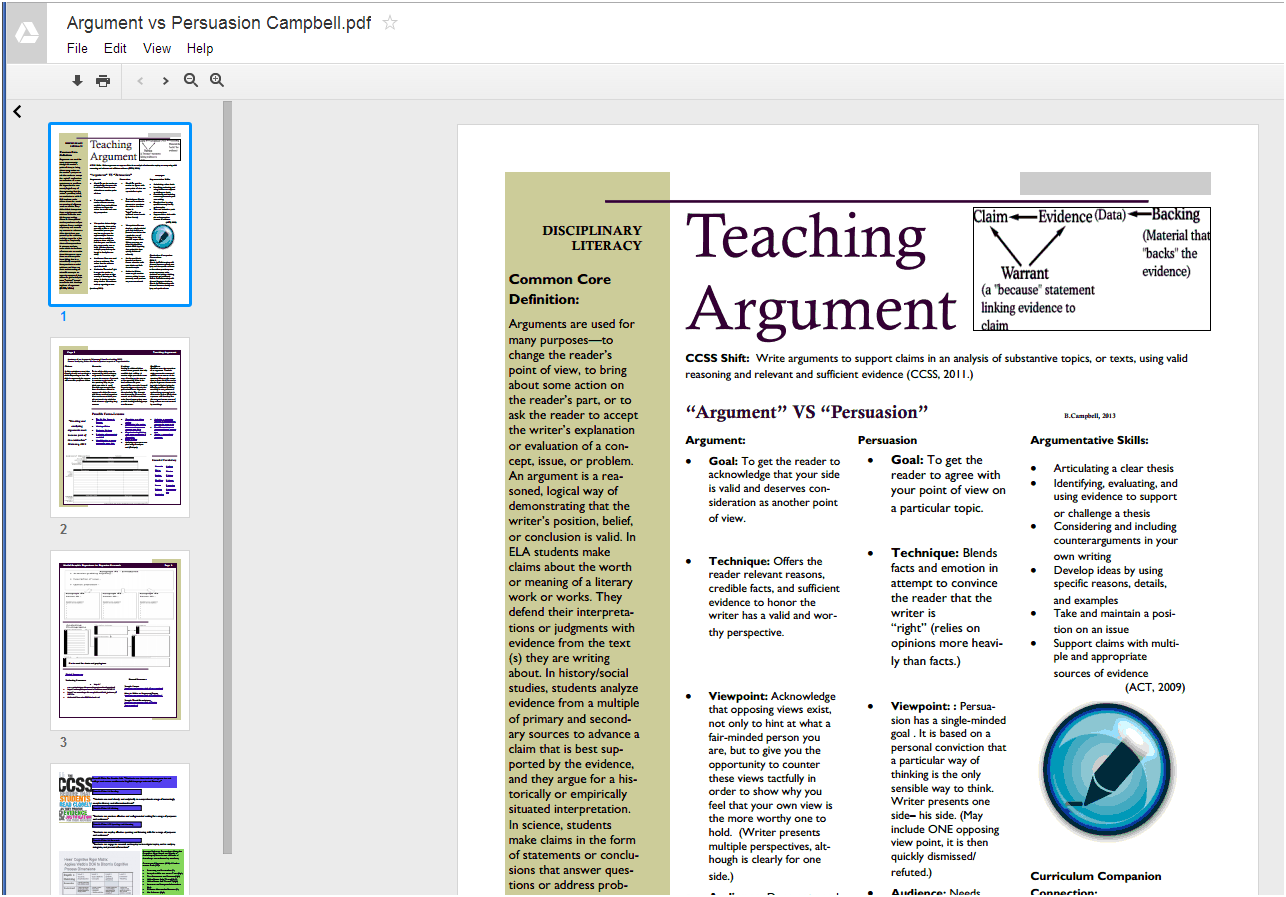
Planning for instruction takes time, so I wanted to develop a tool that would support coaches and teachers in planning for instruction – specifically, planning for a shift in teaching and learning from persuasion to argumentation.  

Before I could jump into resources regarding this shift, I wanted to provide the research supporting this shift; hence, the reason for the development of this handy dandy resource in the form of a newsletter/hot-linked document.  This document’s purpose is to provide the research supporting the shift from persuasion to argumentation, as well as to light a fire under students’ butts to get them excited about digging into text, while tracing arguments, analyzing the rhetoric and style of some authors, and eventually towards writing their own fantastic and dynamic arguments.  

Who knows, we may create a mutation of argumentationators (disclaimer:  argumentationators is not really a word, silly.) There are links to possible focus lessons, vocabulary, and graphic organizers.  Knock yourself out and choose the resources that best match your style, kids, and/or teachers. 

(Note: Image below is a screenshot. Click on hyperlinked text above to view the PDF in GoogleDrive.)

My only request is if you use this resource, please post comments and feedback  so I can revise.

Wednesday, November 27, 2013

No Argument Here

Today's post is brought to you by Andrea Reichenberger.

There is a lot of sensation surrounding the Common Core State Standards, and it isn't just in our state. While on Facebook, I noticed that The New Republic posted an article written by a University of Iowa English professor entitled "Federal Bureaucrats Declare 'Hunger Games' More Complex Than 'The Grapes of Wrath.'" Its argument is based on the Lexile measure used for text complexity. However, if one reads the CCSS document carefully, it is clearly stated that text complexity is based on three important components - the Lexile being only one of them. I was even more disappointed when I noticed that NCTE (National Council of Teachers of English) posted the same article. The standards aren't perfect, but many of the arguments against them are misleading and continue to perpetuate untruths.

What people need to understand is that the CCSS provide a clear list of skills that our students need in order to be successful in school and outside of school—and I say this in regard to the literacy standards as I am more familiar with them.
Why would we argue against our students being able to read at grade level?
Why would we argue against students using evidence from a text to defend their thinking?
Why would we argue against teaching our students critical thinking skills that allow them to analyze, synthesize, and write effective arguments?
Why would we argue against students participating in collaborative discussions and building on the ideas of others in those discussions in a respective manner?
Since the implementation of the Common Core, our instruction has dramatically improved and has become more focused.  The standards are designed with common language and skills at the appropriate grade levels.  In my district, this is imperative as it is a very transient one, so when our students are bounced from one neighboring district to another (which is often the case), they allow for consistency and the opportunity to build upon the skills and help to avoid providing disjointed instruction for those students.
Several well-known action researchers from across the country have used the Common Core to guide their instruction and have evidence to show that their students have made huge gains.  As a coach, I have the pleasure of visiting several classrooms and the opportunity to witness the powerful learning that is a result of these standards.  The learning is exciting and is based on best practices.  Unless you are an expert and well-informed in the area of education, and have a deep understanding of instruction, the standards, and what is best for student learning—there should be no argument against them.

Tuesday, November 26, 2013

The Spotlight Still Shines on the CCSS

Today's post is brought to you by Heather Zimmerman.

The Common Core State Standards are a hot topic.  They were when they were introduced.  Then resources starting flooding the market with ideas and lessons tied to the CCSS.  Now they are are in the  spotlight because of the debate if these standards should be used.

In my district, teachers have spent a lot of time diving into the standards.  I have been apart of teams with the literacy teachers in my district, and we have spent quite a bit of time unpacking the standards to explore and understand them.  These learning goals have a focus in all areas of literacy that encourage teachers to plan for different aspects than just the reading and writing component. 

The standards are a bar to reach for, and teachers should not only reach for the bar, but continue to raise that bar.  

Here are some resources teachers have shared with me that they turn to:
  • Checklist for standards-  Teachers shared they enjoyed this site as they started to use the Common Core State Standards.  Then they could check off the standards as they use them throughout the year to ensure they were giving enough time to each standard. http://www.englishteachersfriend.com/common-core.html


The discussions that happen with the learning process in understanding the Common Core State standards highlights different interesting topics.  I just had a conversation with a few coaches and a teacher analyzing RI.7 and the progression sixth to eighth grade.  There was a debate at the seventh grade level if the text had to the be exact same as the medium portrayal.  This discussions about analyzing different mediums and how that can be done was intriguing.  

I also recently was reading a section in Notice and Note by Kyleene Beers and Robert E. Probst.  I really enjoyed the discussion about text-based questions.  Beers and Probst point out that the standards are focused on this form of question.  They shared a bit of history regarding this area in education and highlighted the importance of focusing not only on the text, but the reader too.  

The spotlight will continue to shine on these standards for awhile.  I think it is is important to keep in my mind these standards are goals.  With all goals, the process can be messy sometimes.  But learning is always messy.  You keep the goal in mind though and always aim for the bar.  And once you hit the bar, you can raise the bar.

Friday, November 15, 2013

What's Hot with the Common Core?

Since the CCSS have come into the picture, I have seen more “intentional” teaching than ever before.  Teachers know what they are teaching and why they are teaching it. They have an understanding of the vertical alignment as well.  There is more of a push to reach the standards because they know what is expected of their students next.  

To be honest, I was a classroom teacher three years ago, before the CCSS were adopted by so many states. I didn’t even know the standards for my grade level (first grade).  All I knew were the assessments I had to give for report cards.  The curriculum was what we taught - not the standards.

The CCSS now brings a level playing field for students and teachers.  We teach the standards now and the curriculum is our resource. Teachers are understanding the "why” more than ever and not so focused on the “what.”  Expectations and rigor have risen and the most remarkable thing  . . . students are rising to the challenge.  I have observed some of the most incredible lessons in the last year.  The Common Core not only has the students more engaged in their learning but the teachers more engaged in their teaching.
It’s a remarkable thing to witness and be a part of.

We have been working so hard in my district becoming familiar with the Common Core State Standards and implementing them with success over the last three years.  I am listing below the three“hottest” topics in regard to CCSS in my district and resources that we use to tackle them.  

Unpacking the standards and SMART Goals

“I Can” Statements and Learning Progressions

“Close” Reading